Showing posts with label faces of easter. Show all posts

09 May 2013

presenting the Ascension

If only I were doing Godly Play this year, it would be time for my favorite lesson from Young Children and Worship. I hope you'll bear with me if I repeat some of what I've written on this topic before:


The relationship between Young Children and Worship and Godly Play is somewhat murky, especially to outsiders. But it would seem that the Ascension lesson was written by Sonja M. Stewart after visiting and working with Jerome W. Berryman (and after reading Sofia Cavalletti). 

It's one of my favorite lessons. It is simple, while being both biblical and liturgical. It brings together the story of the Ascension with Berryman's "changing of the light", while also introducing (or reinforcing) the response we often give during the Eucharistic prayer to sum up the Mystery of Faith:

Christ has died, Christ is risen, Christ will come again.

(photo by stf, cropped by me)
In presenting this, I adapted Stewart's lesson in small ways. I didn't use a satin underlay, but a small linen table cloth. I showed the Crucifixion/Resurrection card from the Faces of Easter lesson to emphasize the connection with (and continuation of) the Easter story. I deliberately used the word Eastertide as well as "season of Easter". And I followed Berryman's choice of phrasing, the tomb could not hold him, rather than Stewart's God made him alive again. 

31 March 2013

Easter Wondering


I'm "preaching" at both of my English churches this morning. What I have planned is not really a sermon but more of a discussion-starter. With the help of Vanderbilt's Art in the Christian Tradition database and Wikimedia Commons I created a slide-show to go with our Gospel reading. I have an illustration for each sentence - much like a children's picture book.

I will introduce this by talking very briefly about celebrations, that an important part of most celebratory gatherings is the talking. We reminisce about the old days; we share our feelings. And so I want us to celebrate Easter together by listening to one of the stories of Easter and then sharing our responses to it. I'll read the Gospel, showing the slides, and then I'll ask Jerome W. Berryman's Wondering Questions for Sacred Stories.

We'll see how it goes. One service is an all-age service in a large church. I've already drafted one teenager to be a microphone runner for the back of the church, carrying the mike to anyone who raises their hand. I will do the same at the front. The other church is smaller but the congregation is deaf-er, so microphones will be important there too.

I intend the pictures to slow down the reading so that we notice some details afresh, but also to prepare us for hearing different perspectives on the story, and moreover to jog memories as I ask the Wondering questions. During our discussion I'll be showing summary slides of the pictures we've seen.

Like this:


As Berryman's Faces of Easter script tells us, you can't see the resurrection without knowing that the crucifixion is behind it. So rather than starting where the lectionary says to start, I'll include seven verses from the paragraphs preceding it. Like that snippet on television shows: Previously in "The Gospel"... These are my illustrations for those verses.

05 April 2012

mixed feelings


Bishop Sebouh Chouldjian washing feet (photo by Psalm Tours, used by permission)

Last year, I found it very moving to interact with a child at our Maundy Thursday service. Thinking about that this year, it struck me that foot-washing is one of the few sacramental-like rites at church that children might participate in. (Most children in our congregation do not take communion yet, and were baptized long before their earliest memories.)

So I really wanted to provide a way for children to participate in our Maundy Thursday service this year. I made arrangements with the priest well ahead of time, and agreed that I'd lead children's activities outside the chapel until the footwashing, and again from the footwashing until communion. The idea I was most pleased with was that it would be the children (and me) who would strip the altar afterwards.

photo source
Since we wouldn't be in our regular setting, I'd decided to bring only the Faces of Easter and focal shelf materials, which we'd then clear during the evening in a practice for clearing the altar, leaving only the Christ Candle. I'd also decided that since we couldn't Wonder by bringing something to the story plaque of the Last Supper, instead *I* would lay out a few things to help me tell a slightly extended version - a bowl of water and a small towel, a slice of bread and a small bottle of wine (with a little glass to pour a bit out into).

Unfortunately, with all the stress and over-time at work, I had neglected to publicize my plan to offer Junior Church for this service. It was only today that I texted the parents of the children who are our regulars to invite them. Most texted back that they'd already made other plans or couldn't come for another reason. By that point I'd already begun to realize how exhausted I was, and that I was on the verge of a fever / sore throat / cold.

So it was with great of relief and disappointment, in pretty much equal parts, that I sent a followup text to say I wouldn't do it after all unless any parent had already told their children about it. And curled up in a fleece jacket on the couch with a hot tea and the television remote control.

18 March 2012

4th Sunday in Lent

This is the first time I've been in Junior Church since Lent began. I told five plaques' worth of the Faces of Easter and we created a wonderful assemblage to help tell more of the story.


The items brought to the circle were: the baptismal doll (because it's a baby and Jesus was a baby), the church clock, the desert bag, the Holy Family figures of the Christ Child, the Mother Mary and the Father Joseph, the Risen Christ cross, two parable boxes, flowers (like Easter lilies), the ark (not representing the ark, but either the boats that the disciples left when they followed Jesus or maybe the boat that Jesus taught from), and the Advent materials.

This really encouraged children to use story materials during our Response time. They got out the Baptism materials, the World Communion materials, the Great Flood materials, and the Great Family materials. 

On a more disappointing note, I should not have tried to show off to the visiting priest. I assured him that "we" knew several things about Lent. I know, it's not the done thing in Godly Play to encourage the children to perform like trained monkeys, and I got what I deserved, I suppose. They looked very blank, and I encouraged, What color does the church use during Lent?

One child answered reasonably confidently, Brown!


17 March 2012

wondering with materials

It's an exciting feature of the Faces of Easter lessons that instead of opening up a time of verbal wondering or discussion at the close of each story, the storyteller says, I wonder what there is in this room that can help us tell more of the story. Look around and see if you can bring something to show more about this part of the story.

That's all. There are no more rules than that.

Some in the circle may be thrown by this and have no idea how to respond. As Berryman says, that is okay. Many children learn by watching as well as by doing.  Since most of us will present portions of this lesson at least twice during Lent, participants will have another chance on another occasion... and after all, this is an opportunity but it is never a requirement. If you don't feel like getting something, that's okay. Just enjoy what we make together.[All the Berryman quotes in this post are from The Complete Guide to Godly Play, volume 4.]

The first person I ever called upon took the instructions very literally, and brought our Bible to the circle. Which was an excellent response. Berryman had predicted what my next child did: Sometimes children get up, wander for a moment and bring something at random, without knowing why. That's okay. [Notice how often he says, that's okay. That's one of the things I love about Godly Play!] Be amazed and wonder why with them, together coming up with something relevant. Everything in the room is connected in some way.

Last year, though, I chose not to wonder explicitly about connections. I just accepted anything that was brought to the circle with silent wonder and appreciation. And perhaps a nod or a smile. My children were young, and not always very articulate. And ever since my training I've liked this special kind of Wondering for its freedom from words and freedom from over-thinking things.

And this is why I love writing this blog and reading your comments, and reading the posts that others write, especially those submitted to our Lenten link-up. It's so helpful to hear about how others put this into practice, what they like best, what they think is most important, and what they think can be left out.

photo from the So Many Joys blog
Amanda wrote a post at So Many Joys pointing out that sometimes we may need to set limits about how much it is practical to bring to the circle. Berryman suggests that a child might bring the desert box, but many desert boxes are so heavy and unwieldy that this may be too disruptive. Amanda writes about a bit of chaos that grew from large item connections to the first Face of Easter -- the entire Books of the Bible lesson, the desert, the World Communion lesson -- all big and very interesting stories to explore all out at once when we were still in our circle. I actually think that is when my headache started. Perhaps next week, I'll just have them bring one small item from the story rather than an entire story. 

Berryman proposes some Wondering Questions for use when these stories are told outside the Godly Play classroom. But it may also be entirely appropriate to ask people to think creatively and look around whatever room you find yourselves in for objects which would help to tell the story, or even to share aloud what object they would bring if it were available.

photo from Featherglen, cropped by me
When Featherglen did this, family members brought various objects, some overtly religious and others not. She writes, My beloved rummaged for a while in his overstuffed desk and brought out a beautiful big dried bean. He is gardener and this was one that came from last summer's crop. He placed it by the picture with baby Jesus. We all wondered a while about the significance of the bean, its colour (you can't see so well but it is actually a rich purple colour), baby shape and, of course all the elements of growth. 
photo from Explore and Express, cropped by me

As Sheila's experience shows, you may get unusual connections and contributions even within a Godly Play setting. Can you see what has been placed next to the plaque depicting Jesus resisting temptation?

She writes, One child laid a package of cookies and a stop sign made of sticks beside the picture of Jesus in the wilderness.  He then explained that this represented Jesus’ long fast and how hungry he must have been.  

I hope this post encourages you to try this kind of wondering if you have not done it before! Feel free to set boundaries that work for you - whether or not to ask for explanations about the objects brought, whether to limit the size of object brought, whether to restrict the objects to Godly Play materials, whether all objects should relate to one plaque or to any of those laid down...

The rewards, for you and all the circle, can be rich. As Amanda's So Many Joys post continued, I still loved seeing their connections to the Mother Mary and the Father Joseph and the Word born flesh as a wordless child. They are profound, the kids! 

02 May 2011

resurrection

This week I presented the Faces of Easter VII lesson for a second time, giving the children a chance to bring materials to the story, which we were unable to do on Easter Day.

Story materials brought to the circle: Trinity symbol and Baptism materials, the Presentation in the Temple, Christ candle, Advent materials

Vandriver said to me this morning, I wonder if there's any part of this story that we could leave out, and still have all the story we need? Well, Father Berryman seems to think we can leave out the Resurrection. 

He was partly joking, but it was also a comment on my frustration with this lesson. And it was a reminder that I have lots more I want to write about the tensions in wanting to honor Berryman's model, scripts, ethos, etc. while also needing to be true to my own understandings and beliefs. This post will likely only scratch the surface a bit more, but here it is.

The lesson asserts, Jesus had died on the cross, but somehow he was still with them, as he is with us, especially in the bread and the wine. But never does it say, He is risen. Left out of the story are the angels, Mary's encounter with Jesus in the garden, indeed any resurrection appearances at all. (Berryman has now finally released new lessons which may incorporate some of these post-resurrection appearances, "Knowing Jesus in a New Way", but for the time being, apart from part 1, the only way to get these texts is to buy a $200 package from the United States.)

My frustration was compounded by the fact that the picture on the final plaque in the German series I have been testing out, by Juliana Heidenreich, does not show Jesus at all. Instead there is a shaft of light, and a community of Christians sharing bread and wine. But I was not about to present a lesson which included no representation of the risen Christ in word or image, especially not on Easter Sunday!

What I ended up doing visually was faithful to my understanding of Berryman and still something I was comfortable with myself. I used the image of an icon of the Eucharist which includes representations of Jesus, grain and grapes, bread and wine, and a Gospel book or Bible.


I felt that this worked as a representation of the Risen Christ today, who, as we know from the Holy Family story, is no longer bound by space and time. It visually conveys Berryman's emphasis that Christ is present to us today in the bread and wine of Holy Communion. And it is so different from all the other plaques that it emphasizes the line about the fact that the Mystery of Easter changes everything.

As for the words of the story, I added one line of my own to the story of the women finding the empty tomb: Angels explained that Jesus had risen. I added the line Berryman uses in "Knowing Jesus" part 1: The tomb could not hold him, and then my own partial summary of ideas from the "Knowing Jesus" series: Over the next hours, and days, and weeks, Jesus' friends had to learn new ways to recognize Jesus - in the sound of his voice, in the breaking of bread, and in the memory of that empty tomb (which at first had seemed so sad). And these are still ways that we know Jesus today.


01 May 2011

Wondering about the Faces of Easter

Images by St. Michael's Workshop (UK)

Storyteller: I wonder which part of this story you think is the most important.

4.5-year-old: This (pointing to the Resurrection plaque).

13-year-old: I think the first one [the birth of Jesus].

3-year-old (jubilantly): I like ALL OF THEM!

4.5-year-old (quietly): Even the upside-down one? 

Storyteller turns over the Resurrection plaque to reveal the Crucifixion plaque.

13-year-old: That's important because Jesus died for our sins.

Storyteller: But that's not what 4-year-old asked. 4-year-old asked if we like that part. Isn't it interesting that there might be a part that we think is very important and yet we don't like it.


25 April 2011

Faces of Easter (Easter Day)

For our congregation, the last Sunday of the month is "family service" - a communion service abridged for children, with a sermon aimed especially at them (or sometimes a craft in place of a sermon). The goal is that the whole congregation (not just young families) should attend. This year, Easter fell on the last Sunday of the month, and the pastor asked if I'd like to present the sermon to keep continuity with what we'd been doing in Junior Church. Another congregant then suggested I should organize the whole service as a Godly Play session. And that's what I did.

ready to begin (with the Lenten purple under the Holy Family)

I was really grateful to our pastor for being so flexible about this. Not least for carrying on with aplomb when one child finally decided he was ready to examine the Holy Family figures... in the middle of the Eucharistic Prayer! Given that I'd placed all our focal shelf materials on the altar, you can see how some priests might have found this unnerving.

at the end of the service (Easter white)

For Finnish Lutherans, just as important as the liturgical color is the number of candles to be placed on the altar. Easter is a six-candle festival, so I needed to negotiate with the vaktmästare [caretaker] to make sure that those candles looked clearly different from the Christ Candle. I think the result was clear: six candles for Easter plus the Christ Candle for Godly Play.

thank you, Pastor, for this photo

Some things didn't work so well. Seethroughfaith warned me near the beginning that I needed to speak up, but as soon as I began to tell the story I forgot. (After all, my focus was on the materials, not on my audience!) Some of the time I was "competing" with a baby who was at that squeal-y stage of exploring its voice, as well as two tots who just could not stay still and quiet. Perhaps I should have asked if I could have a lapel microphone.

And I regret not cutting the summary of the earlier plaques right down to First we heard about how Jesus was born, and a story from when he was a boy, and then about when he was baptized... Since there were a number of children there completely new to this lesson, I gave slightly longer summaries, and walked around the circle showing everyone the plaques (mine are only 4x6 inches / 10x15 cm). But with Vandriver interpreting into Finnish for me, this meant that this already rather long story became twice as long. Too long.

Yet even those whose focus had been lost were startled back to attention when I suddenly cried out that the story shouldn't stay in a line and re-arranged it, and there was good response at the wondering. Then I handed out Easter cards, blank on the inside, and asked everyone to decide what it was important for them to do - draw a picture inside, write a poem, make it a card for someone else or a card for themselves... And folks of all ages really seemed to enjoy that.


thanks, seethroughfaith, for the Response Time photos

11 April 2011

missing child

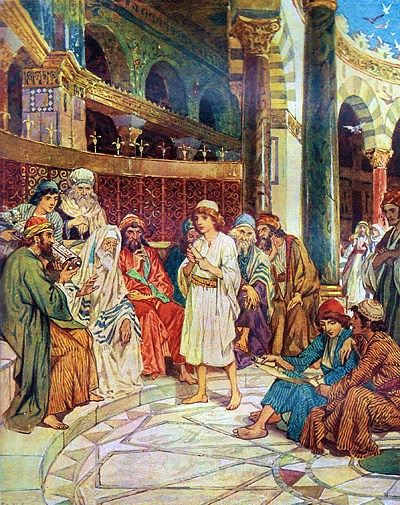
This is a story passed on to me by one of our mothers. The story which has made a real impact on her child was the story of the boy Jesus in the Temple (Faces of Easter II):


Mummy! Mummy! When Jesus was a boy, he went missing! 


William Brassey Hole (public domain image)

I want to be careful not to present this just as cuteness. It strikes me that the child is recognizing the humanity of Jesus - realizing that he really did share in the kinds of experiences that we are familiar with, even as children.

10 April 2011

Faces of Easter (Lent 5)

Today we had the plaque about Jesus' work as a teacher and friend/healer, and the plaque about the Last Supper. I did what I had proposed after last time, and invited members of the circle to bring things twice, once after each story. We are supposed to say that you don't have to bring anything, and I do. But the honest truth is that while I mean it when I say that that's ok, I'm even more pleased when they do bring something. I love the participation of it, and the unexpectedness of seeing what they will choose.

Today for the first time, everyone brought something! Some people declined in one round or the other, but in the end everyone had brought up at least one thing to help to tell more of this story. Here is what we made together:


Clockwise from top right, we have the image of the Risen Christ, our holding (prayer) cross, the Advent materials, the Palm Sunday materials ("Jesus the King"), the control card for the story of the Presentation in the Temple (Candlemas), and a parable box. (In the very top right of the picture is the control card for putting away the Faces of Easter materials.)

Telling these two stories together made it easy to change where one ended and the next began. The first of today's stories, by the script, is very short, and the second is very long. Instead of sticking to that, I extended the first plaque's story right up through Jesus teaching in the temple on Monday, Tuesday, and Wednesday of Holy Week (on the grounds that it tied in thematically with his work as a teller of parables). And then the second plaque was devoted to the events of Maundy Thursday. I left out altogether the tale of the widow's mite, since I needed to keep things a bit shorter for my young audience (something which Berryman himself recommends).

This hints at a very long post which I keep intending to write about how true to the text Godly Play stories are supposed to be. Already in my head it's growing into a whole series of posts. I'm daunted both by how much I want to say, and how adamant some people seem to get about it. I guess we can consider this a preface, or maybe a taster.

09 April 2011

glue and baptism

(that's Joseph's head next to his left foot)

This weekend I got out the glue and repaired Joseph's head, and the donkey's as well (turns out the piece that I had assumed had come from the manger was actually the donkey's right ear).


(no dividing strips)
While I was at it, I finally glued dividing strips onto the underlay for the Faces of Easter, and glued the white section onto the end of it. I was down to the wire getting it ready for the first Sunday we used it, and realized that those were among the lowest priorities - what I needed for that first week was just a purple underlay and for the plaques to be ready.

In fact, even then, the plaques had had coats of decoupage but no sealer yet (so they were a little "tacky"), and the final plaque needed re-doing. Now I think all those materials are done.

This afternoon, Vandriver and I attended a baptism service, and some of the children from Junior Church were there as well. I asked the priest to try to make sure that all the children could see, which he did by making sure that the family and godparents were not between the congregation and the font. It was our congregation's first baptism since the baptism lesson I presented in February. I was so excited! And yes, it was very like what I'd presented to the children (which I'd tried to adapt, as recommended in the script, to our typical practice). Afterwards I confirmed with one of the children - Did you see the priest make the sign of the cross over the baby? Did you see the water go on his head? Did you see the baptism candle? I hope I didn't over-do it, but I really was excited. (I'm glad to report that the answer was yes.) I probably spent as much time furtively glancing at the children present in the congregation as I did watching the baptismal candidate and his family!

You may be wondering what the differences are between a Lutheran baptism in Finland and the one described in the Berryman lesson. Well, our Lutheran priests make the sign of the cross over the candidate's forehead and chest before the baptism rather than after, and no oil is used at all.

"E--, remember the day of your baptism"
(my doll)
.

05 April 2011

more faces of Faces of Easter

I've just read a really nice post by Sheila, over at her Explore and Express blog, about presenting the Faces of Easter material to an after-school club in Germany with a dozen children from grades 1-3. There are loads of pictures, and a lovely description of some of the things her children chose to bring to help to tell more of the story. It was especially nice to read the reasons that some children gave for the items they had brought.

Explore and Express: Easter Club Week 3/Oster AG Woche 3: This week the children heard a Godly Play story called “The Faces of Easter” that recounts important events in the life of Jesus ...

As I've posted in a comment there, I'm comfortable about not asking my children to explain what they've done. I think some of them are so young that it could be difficult to articulate their associations and feelings, and so I'm happy to keep things on an unspoken level right now. But perhaps during the feast I will more explicitly begin to offer space for sharing work or words if anyone wants to.

[You might also be interested in posts about my own use of the Faces of Easter.]

04 April 2011

Faces of Easter (Lent 4)

Lots of folks visiting the blog lately have come via Google searches for "Faces of Easter". So I thought I'd write a longer post about our use of these materials this week. We had the next two stories from the Faces of Easter material yesterday - Jesus' baptism and the Temptation in the wilderness. It's a bit of a pity that our schedule has worked out so that we have two stories each week. It's been a lot for our youngest children (ages 3-5) to take in.

In the book, Berryman says that these lessons were designed for older children, but that they have been used with children as young as two years old (vol. 4, p. 53). Still, I think the fact that they were written for older children really shows. There is little action, apart from showing the picture to everyone. In the baptism story there is a small gesture to show Jesus going down into the water and coming up again, and I was supposed to draw an outline of a dove with my finger (but I was really unsure how to do so, especially in a way that would really make it clear to my listeners what I was doing). * Update: I've now realized that there is a dove in some versions of that picture.

(American materials for these lessons)
There is not a single gesture in the temptation story script... but I added one. Each time Jesus says, No, I held up my hand in a "stop" gesture (mirroring what is already on the picture). The comment in the book is that the very different kind of "wondering" done with these stories - inviting children to make connections by bringing other materials to set beside the Faces of Easter - is especially important because it provides movement and action to these stories.

Berryman does say that for very young children, the stories might be shortened (and that summaries of earlier stories should definitely be kept short). (On the other hand he also acknowledges that sometimes, as with our situation, it may be necessary to tell two or even three stories on a single Sunday.) Some are easier to abridge than others. I had left a few phrases and sentences out of the story of the boy Jesus in the temple last time, but I didn't really feel there was anything I could leave out of this week's temptation story. In discussing it with Vandriver, I've decided that next week I might try inviting the children to bring items to the circle twice, once after each story. It'll give them a chance to stretch and move in between the two narratives. And next time's stories are less connected to one another than the pairs we've had so far.

This week three children chose not to bring anything to the circle. One was a new visitor and had no idea what materials were available in the room. One wanted to bring something, but couldn't decide what - I think in part she was disoriented by the fact that we were in an unfamiliar room (and that our "shelves" were tables a bit too high for her height). But our visiting adult, also completely new to Godly Play, made a lovely connection with our baptism materials. Then I asked the children if it would be okay if I brought something (Yes!)... and I opened up the parable box and brought out one of the dangerous places from Psalm 23 to put beside the temptation picture.


To see the picture of what we created for the first two stories in this lesson, jump to this post. 
To read a little more about my materials, read this.

27 March 2011

Faces of Easter control card

We have no Godly Play this week, because on the last Sunday of each month we have an all-ages worship service. But thanks to stf, here's a photo from last week:


In the foreground you can see the control card I made for the Faces of Easter (Lenten) materials. This lesson takes us through various important episodes in Jesus' earthly life, from birth to resurrection. [I'm trying out the plaque designs by Juliana Heidenreich. For now, I have used the free sample cards - the German GP copyright notice is printed right on each picture. In the longer run, once I know which pictures I like best, I want to pay for them properly (or ... commission my own drawings?!?).]

Something that had really struck me back in Advent was how easy the Advent plaques were to arrange. If you get them mixed up, it's easy to put them in order again, because the first one shows only one candle, the second two candles, and so forth. The hardest part is remembering to put them back in the basket "backwards" (the first goes in last, so that it is on top for the next time).

But with the Faces of Easter, a person cannot put them in order without remembering which story each picture relates to, and knowing the order in which these episodes happened in Jesus' life. So I made a control card, which I hope will work a little like a puzzle. You can see at least a portion of each card, and should therefore be able to figure out which plaque needs to be on top of which.

I wonder how it works with store-bought Faces of Easter cards. Is it easy to put them back in order?

20 March 2011

Faces of Easter (Lent 2)

Today's lesson was about two episodes in the life of Jesus. After I'd showed pictures of them and talked about them, each member of the circle had the opportunity to choose anything in the room that would help us tell more about these parts of the story. It was also okay not to choose anything.

This is what we created together:


I say we, although I was one of the ones who chose not to add anything... except a song. While the materials were still out like this, I invited the circle to sing, Amen, Amen, Amen, Amen, Amen, and once they'd got the hang of the chorus I sang the first two verses, which are about exactly the scenes we were looking at: