Showing posts with label baptism. Show all posts

10 April 2015

today

I am feeling a little sorry for myself today. Lovely pictures of this weekend's Godly Play® UK annual conference keep appearing in my Facebook feed, and I am not there. I would so much have loved to put myself forward as a potential Godly Play Advocate (for which they were doing training today)!

But for various reasons, all related to being a curate (a trainee minister), I was unable to attend.

However, I did have a nice Godly Play® encounter today and I am trying to tell myself I should focus on that (rather than dwelling on feeling sorry for myself missing the conference and Advocate training).

Today, for the first time, I made a "baptism visit". That is to say, I met with a young family who will have their 8-month-old baptised in our church. They have an older child, a girl who is in "Reception" (similar to American Kindergarden), who has already been baptised. However, as is the case with many families seeking baptism in the Church of England, they do not regularly attend our church. I decided that what I would do at this meeting was to present the Godly Play baptism lesson.

I explained to the mother (the father was at work) that this was aimed at the older daughter, but that it was also for her (the mother) and that at the end of it I would ask her about whether there was a particular hymn she'd like at the baptism. And we sat down on the living room floor.

I didn't feel there was really time to settle down, but trusted that the lesson itself would gradually settle us. It did, although it took a while. The mother interrupted near the beginning to ask, "Is this how the baptism itself is going to be?" and I explained that no, this was just to lay the groundwork for them. With the baby crawling about, I didn't leave all the symbols on all the circles, but put them down one at a time, and then once I'd used each one I removed it to the coffee table.

it never looked like this today

But by the time I got the doll out, we were still and focussed. Mum had corralled the baby into her lap when I lit the Christ candle, and the older sister had settled into the mode of watching a presentation or hearing a story.

I asked what we should name the baby and looked at them, and the girl suggested, "Rosie". She looked ever so pleased when I said (straight from the script), "Rosie. That's a good name." And I showed how I would baptise the baby, and lit tea lights for each of us, and then we changed the light and spent a long time watching the smoke (the invisible light of Christ!) rising into the air.

What have I taken away from this? And what have they? In addition to the little lesson or reminder about our Trinitarian God, I believe I gave the sister a framework from which to follow the baby's baptism service, and I think the gentle demonstration prepared both Mum and sister to expect something reverent. And it's made me realise how much I want to try to carve out the time at the font (the baptism and then an anointing with oil) as a reverent time within any baptism service. I don't feel that's something I've done as well (or as consciously) as I'd like at baptisms I've done previously.

09 February 2014

an update, at long last

Thank you, Nicky, for your kind comment asking after me. I'm sorry to have neglected the blog. It's not for lack of photos!

The boy who used to attend our sessions sometimes as a sort of gentle giant (a good-natured 13-year-old among 4-year-olds because our congregation had nothing to offer teens) is now a young man of 16, and agreed to photograph my lesson about the Magi (complete with burning frankincense and myrrh). He took about 100 photos, or more! So I was a bit overwhelmed with trying to choose a mere three or so to put on the blog.

And when I forgot my i-pad at Candlemas, a mother snapped some photos with her camera phone and sent them to me afterwards:


Meanwhile, I have accepted a post as curate (assistant minister, on-the-job training) for next year. It will mean moving to England, which Vandriver and I are very excited about but also a bit overwhelmed by how much there is to do between now and then. 

But today I am about to drive to Helsinki, because tomorrow and Tuesday there is a Godly Play symposium in Finland in the town of Järvenpää, with special guest Carolyn Pritchard. Sounds like I could well be inspired to write another couple of blog posts this week already, eh?

22 July 2013

the water and oil of baptism

Although Little Sister initially ignored the Baptism materials in favor of the Holy Family and World Communion, she eventually went back to the attic and turned her attention to the Baptism doll. I accompanied her to a sink/basin where she was able to fill our little jug with water. She carried that through to where the materials were, and poured some out into the bowl. She then picked up the doll by its feet and prepared to dip it head-first into the bowl of water!

Never interfere?? All my training fell by the wayside. I gasped in horror and insisted, "No no no! We take water in our hand and put it on the baby's head that way."


Little Sister was much intrigued by the bottle of oil and asked what it was for. I used a little to make the sign of the cross on her forehead, and she did the same for me. But what is this [the bottle of oil] for? It struck me that I make little use of it in the lesson, since our Finnish Lutheran priests don't use any oil in a baptism. I said that we use it in the lesson to help us think about the Holy Spirit, and wound up presenting a portion of the Baptism lesson to her, the part that introduces the Trinity (The Holy Spirit ... is invisible, like the scent of this oil. It is invisible, but still there), and she went completely silent and gave it her full attention. 


We didn't have the Christ candle out, but I just indicated
what I would have done if we'd had one, and that seemed fine.

Afterwards she continued to wonder about the oil, and as we talked I realized and told her that her baptism had been a little different from her brother's in that she had been anointed with oil and he had not. Neither of her parents had been anointed at baptism; nor had I. Later at supper I recalled (and said) that Vandriver had, like her, been baptised by an Anglican priest. Both she and Vandriver had been anointed with oil at their baptisms.

Too late, it now occurs to me that I could have given her the words of a Finnish priest, Mika K T Pajunen, who said to us in a sermon, We are confirmed into a specific denomination, but we are baptized into the Christian Church. Whether our baptism includes anointing with oil, full immersion, the use of a scallop shell or not, we belong to the one body of Christ.

22 July 2012

another baptism doll

I've written here about finding and purchasing my baptism doll, and her/his christening gown. (The doll is anatomically correct, but he/she wears bloomers so that children can decide for themselves what the doll is.) While at the same flea (super-)market last week, I bought another one for our Play and Pray area at church.

This doll came wearing a badly stained dress but since I wanted to get a christening gown, that didn't worry me at all. The doll was also wearing a pair of white and pink shorts, which will be kept for now as an undergarment. This doll is a bit different than my first one - slightly smaller, mouth pursed for a bottle, one tuft of hair on the forehead, and a little more ambiguous anatomically. I didn't take time to hunt right through the market for the "best" doll (it's an ongoing struggle for me to curb my perfectionist and "maximizer" tendencies), but chose this from among three dolls at the same stall. This one was simply the one most like the one I had already, that the children were used to.

Now that I think about it, there would be advantages to a considerably smaller doll. A smaller doll would be easier to store, and more manageable for small children to work with. Here are two (poor-quality) snapshots of children working with my original doll. They cannot lay the doll in the crook of their arm as I do when I demonstrate what it would be like to baptize a baby.

girl holds doll under left arm, grasping water jug with right handGirl struggles to keep hold of doll while opening oil jar.


On the other hand, it would have been harder to get a christening gown for a smaller doll. I was pleased to see that the doll clothes stall where I'd found the gowns the last time was still in business. There was a smaller selection this time, with only two gowns for sale, both with pink ribbons. So before I take this to church I'd like to replace the ribbon with one in a more neutral color - maybe green? 

baby doll, wearing long white gown with long pink ribbon decoration

Even on this doll (only slightly smaller than my other one) the gown is a little too big. [They're marketed as fitting a "Baby Born" doll.] The sleeves have to be pushed back up over the fingers to the wrists, and the neckline is large. But if I get a rush of energy and determination I could unpick the back placket and re-sew it (by hand - I don't have a machine) to give a better fit. Or I might just leave it - it's not impossible as it is. I gave the doll a wash before clothing it in this new dress and the tuft of hair went all funny... but I managed to curl it around a beeswax taper (!) which held it until it had dried into a cute curl.

Close-up of baby doll, with curl on its forehead. Its sleeves come down to its knuckles.


15 June 2012

more on Play and Pray

As promised, somewhat belatedly, here's more on the launch of our Play and Pray area. This post will tell you what the set-up was like, including some initial reflections on what worked and what didn't.

We chose our space to gave a good vantage point for any child who wanted to see what was going on. The space felt enormous as we were moving twelve chairs to make room for it, but didn't feel so large once three children were inside it. As soon as one lay stomach-down to do some drawing I began to be thankful that more children hadn't come!

The floor was lined with a thin comforter / padded blanket. Each corner was covered with a mat (and sometimes a strategically-positioned chair leg) to help keep it in place. Spare mats were available by the "entrance", but they weren't really made use of this week.

I realized that my idea of putting all the materials around the edges was perhaps ill-conceived when I watched the smallest child labor to get past the other two to reach the colored pencils. (I praised him for carefully avoiding stepping on any artwork in doing so.) I then moved the pencils, explaining in hushed tones that it would be better to put them where everybody could reach them.

materials
  • For an embarrassingly long time, I've had the materials for the Godly Play Jonah story on loan from a neighboring parish (fortunately, they had two sets). But I never put it into our classroom because I have trouble with that story. (Why? That's for another post!) But I brought it out for the Play and Pray area, along with an odd assortment of tiny stuffed animals in a basket - I couldn't find an ark at the flea market!


  • Our book basket included a storybook about Jonah and the Whale in English and a book in Finnish with a huge fold-out poster of  (a cartoon painting of) Noah's ark. When a child first bored of drawing, I silently drew his attention to the correspondences between the illustrations and our 3D materials.
  • Two very different sheep, both  found at the flea market for super-cheap (the cheap sheep?), stood alongside the book basket.


  • The pastor was very leery of bringing clay / plasticine / play-dough to the service, feeling that then children would need to wash their hands before coming to the altar and that would just be impracticable. Similarly, I wasn't convinced we'd be able to clean glitter glue off the blanket we were using. But we did have paper and card in various sizes, colored pencils, two kinds of crayons, and some stickers left over from Easter egg decorating.


  • On the chair closest to the altar I laid a green cloth (flea market place-mat), the Christ candle, and a basket of half-assembled cardboard Nativity pieces. As it turned out, nobody took any notice of this activity this week.


  • Also available but not used were the flip-book guides to the liturgy (I might place at least one of these into the book basket next time).
  • Because we were having baptisms that first week (a whole family was baptized), I had also brought along my own Godly Play baptism materials. But at the start of the service they were accidentally covered up. Just as the youngest's patience and attention was wearing thin and I was getting ready to bring them out... I recognized the strains of Jesus, Lamb of God and announced that it was time for communion. So we did fine without them.


When the time came for the baptisms themselves, I stood up and walked right up to the front of our space, encouraging the children to do the same. It was rather a long process, as each adult knelt to be baptized and was then robed in an alb by their godparent before the next baptism. As you can see, by the time the family father was being robed, only one child was really still interested. But when the baby was finally baptized and began to cry that got everyone's attention again.


thoughts for the future: One member of the church has already told me she owns a Noah's ark puzzle that she'd like to donate to us. Hooray!

It feels paradoxical to think that two or three children at a table will take less space than the same children coloring on the floor, but if we can figure out how to store them I'd like to consider getting a child-sized table and chairs. (Last year we tried having the children kneel in front of the pew-chairs and use them as desks, but this was disastrous because these wooden seats make extremely loud percussion instruments. A mere dab of a glue stick  reverberates around the chapel like a gun-shot.)

02 May 2012

Eastertide guest post: "Baptism"

photo by Markus
This week's guest post is in German! Fortunately, Sheila has translated it into English for us. The writer is Markus, of the Gott im Spiel - Godly Play blog. Having him as a guest blogger reminds us that there are men out there, as well as women, leading Godly Play (David Pritchard is another male writer blogging about Godly Play), and also that Godly Play crosses denominational lines (as I have said here). Markus works in the Roman Catholic church. His blog includes simply beautiful photographs, but Google's machine-translations of his posts are often tantalizingly bizarre:

  • When fathoming it was a boy, the Holy Family so on and found this: Mary and Joseph standing with his back to the crib. (from the post "Jesus in der Pubertät")
  • At the end of a picture ensteht with a steel end "sun" from the twelve brauenn felt strips (previously the house in Jerusalem was praying in the imaginary), at the ends and around which the shields and symbols of male and female disciples are. ("Das Geheimnis von Pfingsten")

What a relief to be able to read him in a proper translation for once! Thank you both, Markus & Sheila.

Die Vorbereitung meiner sechs Jungs (9 Jahre alt), die sich auf ihre erste heilige Kommunion vorbereiten, endete nun. Die letzte Stunde sollte sich mit der Taufe beschäftigen und so die Überleitung für ihr Fest, das sie jetzt in der Osterzeit feiern, sein. I have been preparing six 9-year-old boys for Holy Communion, and our time together has slowly come to an end. In our last class, we covered baptism and with it the transition that they will be celebrating during Eastertide. 

To read the rest, see Markus's baptism materials, and learn what "Holy Star Wars cards" are, click here

29 April 2012

Who's left holding the baby?

It was about a year ago that Sheila commented to say she enjoyed hearing about local church customs which "outsiders" might not know about or even necessarily notice - like the significance in Finland of the number of candles on the altar.

Today, seeing Emily's beautiful photograph of her son being baptized in the Cathedral of St. Andrew, reminded me of another Finnish practice. Here it is not the priest, nor a parent, but one of the godparents who holds the baby.


Anglican and Lutheran priests alike accept this practice here. I've mentioned some features which distinguish our Lutheran priests' baptismal practices from the Anglican ones in another post.

The photograph below was taken the first time any of the children chose to work with our baptism materials, only a few weeks ago. An older girl chose to work with them alone first, but she finished before our Response Time was over and so this other girl was also able to use them. I didn't intend the photo to be quite so blurry, but it does a good job of obscuring her face!


07 January 2012

How can we Remember?

Our pastor contacted me early this week to say that on Sunday, when she comes as usual to administer communion and blessings, she would also like to do with the children what she will have done with the adults during the service - that is, to offer everyone the chance to dip their fingers into blessed water and bring it to their foreheads as a memorial of their baptism.

And so, although I had initially been planning to do the Epiphany lesson this week, I've changed my plans and will be doing the Baptism lesson. And there's one reason in particular that I'm glad about that.


Last year, one mother reported back to me that her child had come home somewhat concerned about being unable to remember the child's own baptism. The baptism lesson tells us to Remember the day of your baptism! This child was apparently distressed not to be able to do that in a literal sense.

Tomorrow, our pastor will tell the children that this touching of blessed water to their foreheads is one way to Remember your baptism.


You might also like to revisit these past blog entries, which mention:

06 June 2011

Core vs Enrichment - which are the foundational lessons?


I don't yet own Volumes 6 or 7 of the Godly Play scripts, containing Enrichment Lessons "for older children". (Most of Volume 8 hasn't even been published yet.) The materials for these enrichment lessons should sit underneath the Core Lessons in the classroom, and should be presented once children have really absorbed the Core Lessons. Since my circle is mostly children aged five and under, and since I'd never been introduced to the Enrichment Lessons by a GP trainer, I started off with the assumption that I would just ignore those for now.

But as Watkins and I discussed in the comments to her post about the Godly Play story of Joseph, an exclusive focus on the Core Lessons in Godly Play means accepting Berryman's determination of which are the foundational stories. If we're under the authority of a Sunday School committee or superintendent, it might be important to accept that determination, but for those who are using Godly Play in the home as Watkins is, or solely responsible for the Sunday School curriculum as I currently am, we carry a responsibility to decide for ourselves what stories our own children need to hear, and when.

Some of you probably feel like jumping in here to remind me that Berryman has been doing this for almost forty years. He has studied pedagogy and theology, and tested his ideas on generations of children. He's a priest, he has a doctorate, and he studied with Sofia Cavalletti. So I would agree that an important part of our decision-making process is to draw upon his knowledge and insights. But we also "follow the child". And we tell the stories of our faith and our own congregations from our own hearts. 

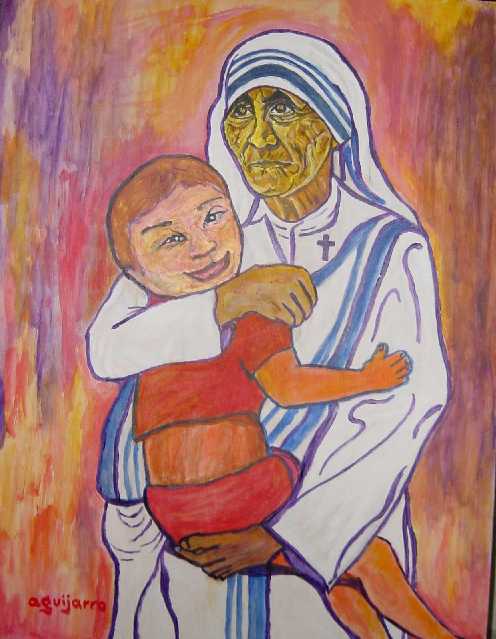
Most stories of individuals are Enrichment Lessons rather than Core Lessons: Abraham, Moses, Ruth, Daniel, Jonah (yes - it's in Volume 2 but it's an enrichment lesson), and also the saints, from St. Patrick to Mother Teresa. The idea is that the curriculum is a spiral. Berryman sometimes calls the enrichment lessons "Extension Lessons" (Teaching Godly Play page 126). The stories of individuals follow on from and extend the Core Presentations. The Enrichment Lessons are therefore fitted into the larger context of "The Story of the People of God". The stories in Volume 7 show how the Holy Spirit continues to inspire and lead us as the People of God, the Communion of Saints, post-Pentecost.


"Teresa of Calcutta carrying Pepo, a friendly child with Down's Syndrome" by Aguijarro  (by permission)

But Berryman also emphasizes that Godly Play is not a complete children's program (this is repeated in the introduction to every volume of The Complete Guide to Godly Play). Ideally children are also participating in Vacation Bible School, listening to children's sermons at church, reading Children's Bibles at home, and talking to their parents and godparents. So of course stories of individuals in the Bible will have come up in those contexts.

Moreover, Berryman emphasizes how important it is to adapt [at least some of] his materials to our own circumstances. Here's a quote from the lesson on Holy Baptism: Adapt the materials according to the usage of your church. For example, if your church uses a shell for baptism, you can place one on the tray with the other materials. If your tradition baptizes by total immersion, you will need to work out a way to show that, perhaps by using a larger bowl or basin...

And that makes me think that for some of us it is surely appropriate to follow our own intuitions and present the Enrichment Lessons when we feel it is right for our children. But the lessons in Volume 6 haven't been written for young children. As Watkins wrote, they don't interact with the materials playfully. Then again, as I've mentioned already, not all the Enrichment Lessons are in Volumes 6-7. Did you know that even "The Holy Family" is labelled as an Enrichment Lesson? (I confess that I'm not sure why, unless it's because it's often presented not as the main lesson of the day, but as part of the getting ready when we enter a new liturgical season.)

As you might have guessed - I presented an Enrichment Lesson in our classroom yesterday. In my next post I plan to tell you which one that was, and how it went.

09 April 2011

glue and baptism

(that's Joseph's head next to his left foot)

This weekend I got out the glue and repaired Joseph's head, and the donkey's as well (turns out the piece that I had assumed had come from the manger was actually the donkey's right ear).


(no dividing strips)
While I was at it, I finally glued dividing strips onto the underlay for the Faces of Easter, and glued the white section onto the end of it. I was down to the wire getting it ready for the first Sunday we used it, and realized that those were among the lowest priorities - what I needed for that first week was just a purple underlay and for the plaques to be ready.

In fact, even then, the plaques had had coats of decoupage but no sealer yet (so they were a little "tacky"), and the final plaque needed re-doing. Now I think all those materials are done.

This afternoon, Vandriver and I attended a baptism service, and some of the children from Junior Church were there as well. I asked the priest to try to make sure that all the children could see, which he did by making sure that the family and godparents were not between the congregation and the font. It was our congregation's first baptism since the baptism lesson I presented in February. I was so excited! And yes, it was very like what I'd presented to the children (which I'd tried to adapt, as recommended in the script, to our typical practice). Afterwards I confirmed with one of the children - Did you see the priest make the sign of the cross over the baby? Did you see the water go on his head? Did you see the baptism candle? I hope I didn't over-do it, but I really was excited. (I'm glad to report that the answer was yes.) I probably spent as much time furtively glancing at the children present in the congregation as I did watching the baptismal candidate and his family!

You may be wondering what the differences are between a Lutheran baptism in Finland and the one described in the Berryman lesson. Well, our Lutheran priests make the sign of the cross over the candidate's forehead and chest before the baptism rather than after, and no oil is used at all.

"E--, remember the day of your baptism"
(my doll)
.

04 April 2011

Faces of Easter (Lent 4)

Lots of folks visiting the blog lately have come via Google searches for "Faces of Easter". So I thought I'd write a longer post about our use of these materials this week. We had the next two stories from the Faces of Easter material yesterday - Jesus' baptism and the Temptation in the wilderness. It's a bit of a pity that our schedule has worked out so that we have two stories each week. It's been a lot for our youngest children (ages 3-5) to take in.

In the book, Berryman says that these lessons were designed for older children, but that they have been used with children as young as two years old (vol. 4, p. 53). Still, I think the fact that they were written for older children really shows. There is little action, apart from showing the picture to everyone. In the baptism story there is a small gesture to show Jesus going down into the water and coming up again, and I was supposed to draw an outline of a dove with my finger (but I was really unsure how to do so, especially in a way that would really make it clear to my listeners what I was doing). * Update: I've now realized that there is a dove in some versions of that picture.

(American materials for these lessons)
There is not a single gesture in the temptation story script... but I added one. Each time Jesus says, No, I held up my hand in a "stop" gesture (mirroring what is already on the picture). The comment in the book is that the very different kind of "wondering" done with these stories - inviting children to make connections by bringing other materials to set beside the Faces of Easter - is especially important because it provides movement and action to these stories.

Berryman does say that for very young children, the stories might be shortened (and that summaries of earlier stories should definitely be kept short). (On the other hand he also acknowledges that sometimes, as with our situation, it may be necessary to tell two or even three stories on a single Sunday.) Some are easier to abridge than others. I had left a few phrases and sentences out of the story of the boy Jesus in the temple last time, but I didn't really feel there was anything I could leave out of this week's temptation story. In discussing it with Vandriver, I've decided that next week I might try inviting the children to bring items to the circle twice, once after each story. It'll give them a chance to stretch and move in between the two narratives. And next time's stories are less connected to one another than the pairs we've had so far.

This week three children chose not to bring anything to the circle. One was a new visitor and had no idea what materials were available in the room. One wanted to bring something, but couldn't decide what - I think in part she was disoriented by the fact that we were in an unfamiliar room (and that our "shelves" were tables a bit too high for her height). But our visiting adult, also completely new to Godly Play, made a lovely connection with our baptism materials. Then I asked the children if it would be okay if I brought something (Yes!)... and I opened up the parable box and brought out one of the dangerous places from Psalm 23 to put beside the temptation picture.


To see the picture of what we created for the first two stories in this lesson, jump to this post
To read a little more about my materials, read this.

12 February 2011

Trinity

The most dramatic thing that happens in the Baptism lesson is the pouring of water onto a baby doll's head, to show what happens externally when a person is baptized. Probably the most emotional thing that happens is that each person in the circle is recognized and named, and a candle is lit for them.

But also very important is that the lesson begins with a symbol of the Trinity - three overlapping white circles - and "images of action" are placed on each one. Water for the God the Creator, the light of the Redeemer Son, and the dove and scented oil to represent the Sustaining Holy Spirit.


My white circles are a very soft white, maybe even cream. They aren't felt, but fleece, cut from a flea market blanket. My dove was bought new - a Christmas ornament from the Finnish design shop, Pentik. The oil is sandalwood massage oil, not ideal except that it's a very strong scent (the existence of the scent is emphasized in the lesson) and that the lid seals tightly. It's a plastic bottle, so won't get broken, but I'd like to replace it with a pretty glass bottle if I can find an inexpensive one. The ones at the flea markets all tend to be missing their tops!

I am most pleased with my pitcher and glass bowl. The bowl is really too small for the purpose, but it's so pretty, and goes so well with the little jug. I got them from two separate stalls at a flea market several months ago. I think they look great together, and the jug seems to fit perfectly into the base of the bowl. Even though some of the water dribbled onto the floor and one of the white circles during the baptism demonstration, it was easily wiped up with the white cloth I had used to dry off the doll's head.

So those are currently my baptism materials!

08 February 2011

My baptism doll

The Baptism lesson was the lesson I presented during my Godly Play training course. It’s also the lesson that seems easiest to furnish from a flea market or charity shop! So one of the first items I bought for Godly Play was a baby doll.

Finnish flea markets are like big supermarkets. The sellers are not present: all the stuff for sale is just labeled with a price and a stall number. The customer pays for their goods at a cash register by the exit, and the market itself keeps track of what was bought from whose stall. The disadvantage, I suppose, is that you cannot haggle – the price on the tag is the price you have to pay. But a big advantage to my mind is the lack of hassle! You can pick up an item and carry it around with you until you find a better one (or a cheaper one) in somebody else’s stall. And then you can put the first one back.

I started browsing for dolls. Funnily enough, it hadn’t occurred to me how many dolls have hair. I wanted a smooth head that would be easy to dry off. Soon, though, I found a nice bald doll wearing a little track suit. Then I started hunting through the stalls of baby clothes, trying to find a white dress or shirt that might work as a christening gown. Nothing seemed right – they were all too big for the doll, not fancy enough, and otherwise unsuitable. Imagine my delight then when I came across a stall selling doll clothes (brand new – this seemed to be a stall rented out by a seamstress)… including a range of christening gowns!


I stripped off the track suit to make sure the gown would fit and – Oh. It’s an anatomically correct doll. Ok, I’ll take one pair of bloomers as well, thank you!

(It’s not just a matter of propriety. It’s that I would like the children to be able to imagine the doll as whatever they want it to be, boy or girl. At least until the first time a child takes its bloomers off.)

Ah, Finland. A land where so many babies are baptized that there’s a good market for dolls’ christening gowns, and where the dolls are likely to have, um, all their parts. :)


To read about my other Baptism materials, click here. In July 2012 I bought another doll for our church to use, and mused on a couple of downsides to this doll. You can read that here

07 February 2011

Candlemas

Yesterday was our first official Godly Play Junior Church, in new premises (although not the room we will usually use, as that had already been booked by someone else), and with a new extra-long time slot (parents drop off their children before the adult church service starts, and we do not join them again until their coffee time afterwards). Also new: the celebrant joins us as soon as the adult service is over, to administer communion or blessings to everyone at junior church. Wonderful!

Our congregation is served by both Anglican and Lutheran clergy, following the Porvoo Agreement. The Anglicans celebrated Candlemas the Sunday before, but the Lutherans have it on the Sunday after, and both last week and this week the adults were following the Lutheran lectionary. So yesterday I began by putting all of our candles (including a brand new Christ candle) in the middle of our circle and praying for God's blessing on them and on us as we use them. Our lesson was the Baptism lesson. During the feast, I also told a short story of Christ's presentation in the Temple.

I made a control card, with the reference to the story in Luke on the back, and a series of small photographs on the front:

the Christ Child (who was not baptized as a baby...)
his mother Mary, who stayed at home with the baby Jesus for 40 days after he was born
his father Joseph, who, with Mary, took him to the Temple, to dedicate him to the Lord

the prophet Anna, who recognized Jesus as the child who would change everything
Simeon... who prayed a poem which we still sing at Evensong today 
Simeon's poem said that Jesus would be a light, not just for those who knew they were the People of God, but for everyone. And that's why we bless candles on Candlemas.