Showing posts with label bible. Show all posts

23 April 2014

two children and Our Story

I'm a little nervous about sharing this first story. I don't want to shame anyone, but perhaps to criticize the way Facebook chooses what stories to prioritize for us...

      *     *     *     *     *

licensed photo by williac
On Sunday one of my Facebook friends posted a montage of four photographs with an Easter greeting written across the whole. Two pictures were family groupings, one showed their Easter eggs, and one showed the oldest son reading. Alas, what Facebook showed his grandmother was his mother's teasing comments about the boy's father "boozing" it up, beside a photograph of the Bloody Mary the man had ordered with his Easter brunch.

But, I said, did you see the photograph of N? 

--I saw the picture of him posing with his uncle and the Easter Bunny after brunch ...

No. The picture of him reading, in his father's Easter montage. The reflective finish on the top edges of the pages, the black leather binding, the two-column layout, and the glimpse of a marker ribbon all signal - this is a Bible. Even just a second glance reveals that he is reading the end of a book within this Bible. The resolution of the picture won't permit me to see which the following book's title is, but I can see that he's about three-quarters of the way through the Bible. As if I hadn't already surmised that he was reading the Resurrection narrative from one of the Gospels!

It's a story important to his father, important to his grandmother, important to the holiday. And the boy read it out to his family before brunch.

     *     *     *     *     *

Our godson's little sister knows that I am pleased to see children enjoying spiritual things, so when we dropped by their house on Easter Day to deliver an Easter basket (really a small gift bag) to her big brother, she ran and met me at the door with the Jesus Storybook Bible.

She opened it to show me the page with Jesus carrying the cross.

from The Jesus Storybook Bible by Sally Lloyd-Jones & Jago

I said, That looks like a Good Friday picture! What's today? And she excitedly flipped forward a few pages until she found the first page of the Resurrection story, with a picture of three women carrying jars and cloths towards tomb, which we see in the distance with the stone already rolled away. 

I don't really know whether she showed me these pictures because they are important to her, or because she knows they are important to me. In one sense it doesn't matter, because I think for her what "church" is - is interaction with the family of God. In showing me the book she was maintaining our relationship as much as she was affirming our shared faith. Maybe for her the two are inseparable: the relationships within the body of Christ and the relationship of all those parts with the head. 

04 April 2014

slow progress on the Bible cards

I ran into a snag with the Bible cards - I was unable to figure out what the print settings had been the first time and so I seemed unable to print out the same size again. Today, though, our godson came for a visit and asked whether I had "the rest" of the cards ready yet. Not by a long shot! But that did prompt a long printing session, at the end of which, by trial and error, we managed to print out cards which were only about 5% bigger than the originals. 


So that's Hebrews and Jeremiah added. I chose those books because the Church of England lectionary has us working through Hebrews at the moment in Morning Prayer, and Jeremiah at Evening Prayer. And I'm pleased to say that doing this little project has helped me with that! 

16 March 2014

Bible cards

A project I have underway is the creation of a set of cards for the books of the Bible. I am making this for one of our godsons, since he is at an age where he is very interested in collecting cards with bits of information on them - cards for the Magic game, for example (or baseball cards, to use an example I find easier to relate to!). 

I plan to use a second set as part of the materials for the Godly Play enrichment lesson about the Books of the Bible. I used the Keynote software (similar to Powerpoint) to design them, then printed and laminated them. The face of each card shows two pictures representing stories from the book (using the wonderful resource of Bible illustrations from Sweet Publishing), and the Gospels also show the symbols associated with each evangelist (with Luke's symbol repeated on the Acts card). Each card also has a quote from the book, a single phrase which sums up something distinctive or important about the contents.


Today I delivered the first batch - just six: four Gospel cards, one for the book of Acts, and one Old Testament book. All six are green, for narrative history. I tried to make the Gospel cards a different shade of green but that didn't show up as well as I'd hoped.

We looked together at the tables of contents of two complete Bibles (of very different sizes and layouts), and one which contained only the New Testament and Psalms. One Bible listed the books twice, once by the order in which they appear in the Bible and once in alphabetical order. My godson then went off by himself. He laid the cards out and organised them by their numbers (the order of the books of the Bible). Then he attempted to re-order them into alphabetical order. Later, using information on the backs of the cards, he might try ordering them by date of [estimated] composition, or the relative chronology of the events they describe (his parents will probably have to explain BC dating again!). 
What I also wanted to do, though, was to tie these cards firmly to the Bible and its contents. So I showed him that in his Jesus Storybook Bible there is a note at the beginning of each story saying which book (and chapter(s)) the story is taken from. And then, without him looking, I slid the cards into a Bible so that each card marked the place its book began. When he searched for them it reinforced the fact that the Gospels are found all together, three quarters of the way through the volume, while the Old Testament histories are much further toward the front. 

I'm providing several extra bits of information on the backs (which is why I've only finished six so far). But the description of the Godly Play cards by Jerome W. Berryman (in vol 2 of The Complete Guide to Godly Play) is that there's relatively little information on each card - just "one or two sentences about the content of each book", and a color-coding to show which genre the book belongs to. So if you set out to make your own, they needn't be as elaborate or time-consuming as mine. 

02 November 2013

geography

Both Godly Play and Catechesis of the Good Shepherd take geography seriously.

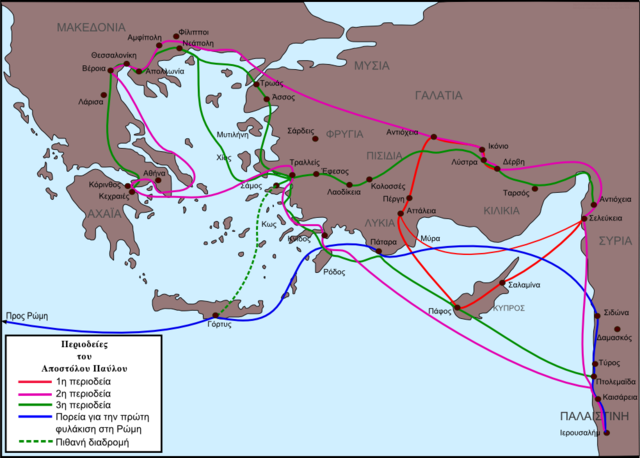
a map of the Northwest Mediterranean, showing St. Paul's missionary journeys as complicated lines, labelled in Greek
map by Geraki

I don't remember any Biblical geography in my childhood, except maps at the back of Bibles. The ones in my Bible weren't in Greek, like the one pictured above, but they might as well have been. I looked at them sometimes if I got bored during church. I guess I thought that one day I would "learn" them, whatever that might mean. Maybe really mature Christians memorize the routes of Paul's missionary journeys?

Godly Play teaches storytellers to tell the story of Abraham's journey from Ur to the oaks of Mamre with relative geographical accuracy, and the same for the story of the Babylonian captivity. It's not made into a big deal. Children aren't asked to "learn" it; they're simply shown. The storyteller lays blue ribbons onto the sand - Here is the Tigris river, here is the Euphrates. The message is, This is what I need to get ready in order to tell this story.
a small and simple map showing the Tigris and Euphrates rivers and some unlabelled national boundaries
public domain map by Kostisl
(The storyteller does this all "upside-down" so that North is at the top for children sitting opposite.) The rivers serve as points of orientation, I suppose, and when the child later sees a map like this they can think, Oh yes, I'm familiar with that place. 

In Catechesis of the Good Shepherd, the materials for 3-year-olds include a small globe. It is simple, showing only land and water. Ideally, the land is slightly textured, encouraging the child to run their fingers across it. The only marking is a small dot, showing where the land of Israel is. The catechist explains that when Jesus was born, he came to a very tiny place. That idea is left to grow in the child's mind, the beginning of a recurring theme of paradox -

Humility / Immensity (All things were made by him).

Later, perhaps some weeks or months later, the child is introduced to a topographical map of that land of Israel.

a map of Israel, showing water in blue, low-lying land in green, mountains in brown, and land in between in yellow.
licensed map image
The map is 3D. Most of the land is built up higher than the sea but the shores of the Dead Sea are below sea level. The child is encouraged to spend time feeling the mountains and valleys, the river and the sea. This is the land where Jesus was born, and where he grew up, where he died and then came to life again. Later still, the child will be shown where the cities of Bethlehem, Nazareth, and Jerusalem are. It's all a very hands-on experience, putting across the message that Jesus came into human history in a concrete place.


30 August 2013

"Heaven and earth will pass away, but my words will not pass away" (Mark 13:31)

Today I want to share with you a poem by the poet José María Rodríguez Olaizola, SJ. I came across it because it was used in one of the daily prayer podcasts by Rezandovoy, a sister initiative to Pray as You GoAs I listened to it today, I thought of the way the Godly Play scripts draw from the eternal word of God, that well which will never run dry. 

You can read the original here. This is my translation into English:

Your word will not pass away

The days and the years go by.
History unfolds and is filled
with names, with faces, with little gestures.
Joys and sorrows come and go.
Faces and hands become wrinkled,
and hair turns to snow.
Some wounds finally heal.
Words are spoken and forgotten.
Songs die. Poems fall silent.
Life goes by. One life.

But your word endures.
There remains love's powerful force.
There remains every caress
which makes the world humane,
every act of forgiveness,
and every feast from which no one is excluded.
There remains blessedness as a way of life.
And one's neighbour.
And the embracing of the prodigal son.
Your word will not pass away. Ever.


21 May 2013

Easter followup (part 1)

Featherglen asked how my Easter presentation had gone. (Thanks, FG, for the query!)

As I explained earlier, I made a slide show to illustrate the Easter story, line by line. I used the day's lectionary reading, Luke 24:1-12, but also included some background from the previous chapter to set the scene. The pictures below illustrate these lines:
  • Darkness came over the whole land until three in the afternoon.
  • Then Jesus cried out in a loud voice, saying, “Father, into your hands I commit my spirit.”
  • With these words, he breathed his last.
  • All his friends stood at a distance; so also did the women who had accompanied him from Galilee and saw all this happen.
  • The women took note of the tomb and how his body had been laid. 
  • Then they returned, and prepared spices and ointments.
  • On the Sabbath day they rested, as the Law required.


In the telling, each slide contained just a single picture, but during the Wondering I showed a "review" slide to help jog people's memories. I started the Wondering with a slide showing all the images from the Resurrection part of the story (the lectionary reading), but I also prepared this review slide of the Crucifixion part of the story, and switched to this when anybody mentioned this part of the story.

And how did it go? Well there were a few minor mishaps. At the second church, even though we had tested all the equipment in advance, the projector and laptop refused to talk to one another when we started setting up for the service. Fortunately, the problem resolved itself after about ten minutes of sweating ... and rebooting things over and over again. 

Other than little snags like that it went well! I did learn something useful about the Wondering... and I'll make that a separate post.


24 March 2012

off-topic and likely preaching to the converted

photo source
This is somewhat off-topic, and I'm late in responding to a news story from late Jan / early Feb, but I just feel that I have to type this out! Skip over this rant if you've heard it all before and just find it too depressing or infuriating.

I recently read this in a comment on an American blog: I once heard a woman being interviewed on TV. She had been a teacher in the public schools, but as a second career had become a financial advisor. When the host asked about her career change, she said, “they’ll pay you to take care of their money, but they won’t pay you to take care of their children.”

And then today I came across this from an Alabama state senator: "It's a Biblical principle. If you double a teacher's pay scale, you'll attract people who aren't called to teach. To go in and raise someone's child for eight hours a day, or many people's children for eight hours a day, requires a calling. It better be a calling in your life. I know I wouldn't want to do it, OK?  And these teachers that are called to teach, regardless of the pay scale, they would teach. It's just in them to do. It's the ability that God give 'em. And there are also some teachers, it wouldn't matter how much you would pay them, they would still perform to the same capacity. If you don't keep that in balance, you're going to attract people who are not called, who don't need to be teaching our children."

The same man defended a 62% pay raise for legislators, because of the risk of bribery and corruption. He needs to make enough that he can say no, in regards to temptation. I read about his arguments in a blog post about the use of the word BiblicalNotice the damage done to the sacredness of the word “Biblical” to toss it around like that. I myself might have wanted to point out the Biblical stance against those who serve their own interest... and oppress their workers (Isaiah 58:3). 

Guido Reni (1575-1642) Education of the Virgin (source)
No, it's not Biblical to underpay teachers and nor is it Biblical to pay legislators more than teachers. According to Luke, Jesus said, The laborer deserves to be paid (10:7). Most of the other references I came up with in a quick search were somewhat specific to the spiritual realm, but did emphasize that teaching is to be highly valued and rewarded: Let the elders who rule well be considered worth of double compensation [according to the footnote], especially those who labor in preaching and teaching. (1 Tim 5:17). Those who receive instruction in the word should share all good things with their instructor (Gal 6:6). If we have sown spiritual good among you, is it too much if we reap your material benefits? (1 Cor 9:11)

05 March 2012

the power and authority of Scriptural story

[The authority of scripture was] exercised by priest and people praying the words of scripture in psalm and canticle, and reading, hearing and pondering the whole sweep of the Bible’s story year by year ... so that they might learn the way of repentance, conversion of life, and holiness. The key thought of “the authority of scripture” was the power the story had to inform prayer and shape imagination, to provide exemplar and encouragement, and to help put their lives’ journey into the context of the journey of God’s people from creation to final fulfilment by way of the cross. 
The authority of a story (and most of scripture is story) is often subtle, frequently a long-term project, and nurtured by repetition and slow digestion. It is about the reshaping of how we see ourselves and our lives by forming our mental world, and populating it with the images, examples and friends who open new possibilities to us, as well as warning us away from bad ideas and foolish practices (of which there are more than a few in the Bible). 

[The context for this quote is a blog post arguing about different understandings of the authority of Scripture. But what leapt out at me was the emphasis on the slow digestion of Biblical story/stories and the way this phrasing might encourage other Godly Play folk.]

[The photo is my own - showing materials for the story of Abraham, Sarah, and the Great Family.]

18 February 2012

enter the story and hear the song


The God of Israel and the claim that God makes [upon Jews and Christians alike] can be known only by taking seriously the full reality of the imaginative language through which that God is presented in the biblical text. Narrative and poetry are the central forms of this testimony about God. Even the nonstory elements of the Old Testament characteristically assume the framework and knowledge of Israel's story about encounter and relationship with God. We are invited, indeed required, to enter the story and to hear the song and to respond according to the shape of the story. In that encounter with Israel's imaginative language we find perspectives on the claims and witnesses of our own experiences as persons and communities. 


Birch, Brueggemann, Fretheim & Petersen
A Theological Introduction to the Old Testament
2nd ed. 2005, Abingdon Press (Nashville)
condensed by Storyteller from page 8

09 October 2011

children and chat

Today was a tough day at Junior Church in many ways. I'm always hoping for this kind of atmosphere (which, as this photo shows, we do occasionally have):

photo by stf, faces obscured in accordance with parents' wishes
But today the children's desire seemed to be for something like this:

photo by Eden Keller from Mechanicsburg (used by permission)
Because I'm in ministry training now, I've had to ask other adults week by week to take turns leading. We have agreed to try to keep the rough format the same and to set up the focal shelf each week, but that the lessons in their weeks would be told or read from Bible storybooks (we use the Me Too! Bible stories and the Jesus Storybook Bible (which I learned about from Sheila at Explore and Express)). That (and the fact that we don't use the door person system - again due to lack of training and needing to keep the threshold very low for volunteers) has made it harder for our new children to learn what *I* expect of them, particularly during the lessons.  

I had decided to do the Circle of the Holy Eucharist lesson with them this week, despite not feeling that they were really ready for it yet, because next week we will all be in the big church for Father R's last service with us. It was a mistake. The lesson (or my telling of my version of it) was too long, not engaging enough, too factual, not numinous enough. By the time I was ready to come home I really felt like a failure. 

But on the other hand, as I sat at supper and talked through with Vandriver some of what had gone on today, I realized that the children raised a lot of interesting points and topics today. And thinking over some of my experiences with them over the past several months, it occurs to me that the time we spend chatting is clearly very important to (at least most of) them. 

We always chat for a bit at the beginning of Junior Church, especially if we're waiting for others to arrive. Today we didn't have to wait for anyone, but it felt as though they'd have liked just to carry on talking forever. My trainers told us, Sometimes all you do for the whole session is form the circle. Perhaps I should not have been so fixated on my plan to do the Eucharist lesson. Perhaps what they needed was just to chat!

Afterwards, during the feast, the children's talk included:
  • God writes people's names either in The Book of Life or The Book of Death.
  • One time on The Simpsons Homer had a dream about God.
  • Can we please start eating now? 
    • (We always wait to begin eating until everyone is ready. But today the talk ran away before we'd even had time to thank God for our food!)
  • Why don't we have Junior Church every day?
  • image by Stannered
  • Another time on The Simpsons God's hand came down right next to Homer!
  • No, that was Ned Flanders.
  • We have to have adults here because children can't be left on their own.
  • My mother says I can travel by airplane all by myself when I'm eight.
  • Why aren't you (Storyteller) here every Sunday anymore?
  • You're going to Priest-Classes? We should go with you. 
  • Fr. R is moving house!
  • (a lot of guesses as to where Fr R might be moving to - Borgå, Sweden, Japan, Africa...)
  • + a couple of answers to my leading question of why it is that we [supposedly?] talk more quietly than usual in Junior Church. 
Maybe one conclusion from today's session is that I need to be more clear and firm about the behavior I want to see in Junior Church. But maybe another is that I should bear in mind the Montessori principle of following the child, and carve out more space for chatting? Maybe we need a children's fellowship group! Certainly I can be thankful for that the children find Junior Church a safe environment in which to talk about things religious, and that they appreciate the attention I pay to them. 

14 September 2011

What do you mean, "*in* the story"?

In the Wondering Time after Sacred Stories, storytellers are urged to introduce four things to ponder. These are always the same. The first is I wonder which part of this story you liked the best. Just about everyone seems to like that. It gets the members of the circle thinking back over the story, and with that question most will feel comfortable sharing something out loud (... although nobody is ever made to feel that they must speak out loud.)

The third topic is I wonder where you are in this story. It can also be asked in a different way: I wonder which part of this story is about you. But this third topic is a tricky one. Adults may over-think it. Children may be baffled by it. Yet sometimes members of the circle share very deep and personal things about themselves at this point:

I am under the flood-waters.

I am the donkey, getting tired of carrying people.

I have come back from the desert to the river where there is refreshing water.

(my own materials)
It's also interesting when this question is taken literally. Last Sunday I told the story of the Great Flood. When I asked, I wonder where you are in this story, a child answered, I'm not there! I can't remember the exact words that followed, but the child gestured and observed that there were no figures of children in the story - just two adults and a bunch of animals. It's an interesting point. We think of this as a good story for children, and yet there are no children featured in the story.

[After a pause, I did point out that the Bible story says that after the ark landed, Noah's sons, who were grown up, and their wives, had babies to help "fill the world with life again".]

Frances, at "On the Chancel Steps", explored this idea of being in the story in her children's sermon for September 11th this year:
I wonder where you are in this story: I love stories! I love to read myself into the world of Winnie-the-Pooh, or mysteries, or kings and queens, or the Bible. But not all stories are in books. Each of us has a story.
Her closing prayer begins, Dear Lord, Thank You for stories. I might pray this prayer myself the next time I feast with our children!

13 March 2011

help, encouragement, and support

[written on 8 March; scheduled for automatic posting on 13 March]

Today, Lord willing, my usual helper, see-through faith, will have taken over as leader. Last week stf was away, and a kind school teacher joined the circle to be the second responsible adult in the room. This week a gentle and godly mother will be the second responsible adult. 

This seems like a good time to thank all these people, as well as Vandriver, our pastor, and the parents of our children, for all their support. 


I especially want to thank stf, who is a never-ending source of encouragement. We debrief together every week, talking through what went well and what didn't, never in a harsh way but just seeking to acknowledge where there is room for improvement. She models appropriate behavior and creative choices during the response time - daring to work with story materials when most of the children choose art work. I notice the children glancing over from time to time, interested to see what stf is up to. 

This week stf plans to tell a brief version of the story of the Holy Family and to change the cloth on the focal shelf from green to purple. Then she will read a Bible storybook to the children, implicitly reminding them of the basket of storybooks in our classroom, available to anyone during Response Time, and introducing them to the Gospel story of the miraculous catch of fish (Luke 5:1-11).

01 March 2011

Advent - the fifth candle

[I've travelled back in time, to tell about our first Godly Play sessions, last December, in my own house.]

During free time at the end of our third session (the fourth week of Advent), the second child started off  sitting on the couch with me, listening to Bible storybooks read aloud as we had done the previous week, but then chose to work with our Lent materials ("Jesus the King" from YCW). Since it had been months since we'd used them, I sat with the child to reiterate the basic plot - placing cloaks and leaves on the road to make it ready for Jesus going to Jerusalem. Hosanna. Blessed is he who comes in the name of the Lord.


There's a nice parallel between the Advent materials and Lent materials, in that both include an underlay which has to be rolled up when the story is put away. This child is the youngest of the three, and kept scrunching the material with tight fists - it was hard work for me to let the child do it!

Much later, I remembered that in my own training the teacher had looked mischievously at us while flicking the roll of underlay with a single finger. Aha! She was being playful, but I suspect also demonstrating that rolling and unrolling could be done with a delicate touch.

Meanwhile, the first child unrolled the Advent underlay, and placed all the plaques on it (including the fifth, white, Christmas plaque, which I had not introduced yet). This week, the child also got all the candles out, and carefully examined each candle to make sure that they were put out in the correct order. Then, just as Berryman predicts, The children will probably discover quickly that the white card needs a candle, too. The child called over to me that we needed another candle. I said, Hmmm. I wonder where in this room we could find a white candle? The child walked over to the Christ candle and, eyebrows raised, checked with me whether this could be the right answer. That's right. The Christ candle! and the child carried it across to place it on the Christmas space. 

27 February 2011

Advent - the focal shelf

[I've travelled back in time, to tell about our first Godly Play sessions, last December, in my own house.]

On the second Sunday in December, the third Sunday of Advent, the two children returned. It was a little difficult to get them settled down before the story, but as soon as it began, it captured their attention beautifully. I had asked them to bring their own nativity set, since mine has no sheep or shepherds. (Theirs had none either, but I knew it had an angel, which commemorates the same event.)

So the first thing we did was to carefully move my nativity set to its stable on another table, and set theirs up on the focal shelf. This time, when I said that Junior Church was over and they could play freely, I was fully prepared to bring out toy trains or legos... but the first child asked very tentatively to play with the Advent materials. Of course! I replied, thrilled.

Then the other child wanted to do the same. Well, you'll have to ask N. If N wants to work alone then you'll have to do something else. The reply from the first child was so quiet we could hardly hear it, Want to work alone. With no fuss, the second child and I curled up on the couch together to read Bible storybooks instead. Out of the corner of my eye while reading the books aloud, I could see the first child carefully unroll the underlay, and place all the plaques in the right places.


That's the end of that week's story, but for the Godly Play die-hards, I thought I'd add a picture of our focal shelf. Everything on it, apart from the Christ candle, had been used before in Junior Church. (Well, the Advent materials and Holy Family had been new the previous week.) On the floor are table cloths for the other seasons. On the bottom shelf: a few storybooks (which we had read in previous months), materials for the story of the flood, and the gold box containing the parable of the Good Shepherd. The top left shelf held the Advent materials, and the top right the Lent or Palm Sunday story from Young Children and Worship, "Jesus the King". [It only occurred to me in January that it would have made better sense to place the Holy Family in the center, as they are on most focal shelves, and put the risen Christ cross above the Lent materials.]

18 February 2011

Our new room, part 2

One feature of Godly Play (in an ideal set-up) is that the participants are surrounded by the stories and language of the church. All materials have a place, so that children can find them easily and so that they know how to put them away. The placement also signals some of the relationships between stories - all parables are stored together, for example.

We have four low benches at our disposal in the room we use. All four are dragged into a large square, to define our circle space. One I have designated as the "getting ready" bench, in the absence of an official door person. If children need a space in which to take extra time to get ready, there it will be. (So far, it hasn't been tested. We haven't needed it or even talked about it.)

The other three benches are used as shelving for lesson materials.


The focal shelf: Although really a circle has no sides, there is still a sense that this is the front of the circle. Here we have the holy family and the risen Christ (you can see a close-up on the "About Godly Play" tab), center stage. To the left is the Christ candle, and underneath it are the materials for the baptism lesson. There is a glaring empty space on the right, which will be filled soon.


On one side of the circle is the parable shelf: So far we have only one parable box, but I have most of the materials almost ready for another one, which will come eventually. At the end closest to the front are the Palm Sunday materials, which we worked with a lot during Lent last year. (This is the "Jesus the King" story, from Young Children and Worship.)


And on the other side of the circle is the sacred story shelf: Here again, there's only one story so far ("The Great Flood", with an ark and two baskets of figures). And mirroring the Lenten materials on the other side of the room, the Advent materials are at the end of the bench closest to the focal shelf.

Then there is a Bible stand (with a basket of Bible storybooks below it), our art materials, cleanup supplies, and a 'prayer and peace' basket.


Frälsarkransen (Lutheran prayer bracelet), a holding cross, and a peace flower
I think that last basket is the only thing in the room that none of the children have been introduced to. It is just there waiting until it is needed, or wanted, or until somebody "discovers" it and asks about it.