13 April 2011

model behavior

such discipline could never be obtained by commands, by sermonizings... Discipline is reached always by indirect means.
(Maria Montessori)

I am trying to remember some Montessori principles: to model the behavior I would like to see our children using, to notice and comment on good behavior, and to correct not by focusing on the bad behavior but by reminding children what I do expect. I have a long way to go!

I often forget and say, Don't run! rather than Remember - in this classroom we walk more slowly than usual. I frequently stand up from a sitting position while holding the basket of materials in one hand. I am still struggling very much with the goal of noticing rather than praising (aka: descriptive praise).
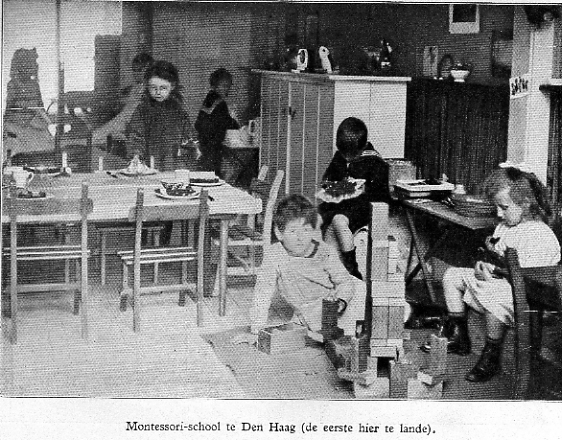

(public domain image)

Last Sunday, though, I remembered at least two or three times to stand up empty-handed, reach down and take hold of the materials with two hands, and then carefully carry them across to their place. I didn't talk about what I was doing, but just did it.


I have for two weeks now carefully (slightly exaggeratedly, but without many words) used the Faces of Easter control card when putting away the materials after the lesson. I've noticed that the children do really watch when I do this. Last Sunday one child said aloud, as I stacked the next-to-last plaque, That last one goes on the top


Two children helped me place mats in our circle before class and (without my saying anything- hooray!) rolled up the mats to carry them. I said, Oh I'm glad to see that you've rolled up the mat, and continued as they fetched the others, saying things like, It's much easier to carry that way. I see that you've rolled that up very neatly. 


Where I and the children are both falling down a bit is at the end of class, when we're all a bit tired, and we should be waiting respectfully to receive communion or blessings. The young children tend to get silly, and I let myself get irritated. But last week Vandriver came to our class. (Our pastor was ill, and so Vandriver led Anglican Evensong instead of the adult's usual Communion service. He then came to our class to say the blessing, just as normally the pastor comes with communion.) Afterwards, when I fretted privately about the silliness, he reminded me that this was not really bad behavior. They stayed in their places, they weren't loud, etc. So it's good to be reminded to keep things in proportion. And to focus on the progress that I'm making, which I think has led to good progress for the children.


Lumijoki chalice photographed by Estormiz (public domain image)
some related links and sources:

12 April 2011

simplicity and relationship

Maybe children don’t need the bells and whistles to make a connection to God’s truths. They need simplicity and relationship.
by Emily A. Mullens

Advent in Lent

This week a child chose to work with story materials during our response time. This is a rare event, and one that makes me inordinately pleased.

I managed to keep out of the way, except for trying to help two other children ask if they could watch and/or join in, and suggesting that it would be best to lift out (with two hands) the top basket of candles and set them aside, for easier access to the plaques stored underneath.

(Misleading photo - the Christ candle is not kept with the Advent materials)

The two gawkers were unwilling to ask for permission to watch, so I shooed them back to the art materials they had originally chosen to work with. Which also helped to get me out of there. I felt it was extra-important for me to stay out of the way since (with seethroughfaith still traveling) the second adult in the classroom was someone who does not know these materials and was curious about them. She started asking questions and I was very proud of what I overheard: 


The child managed to answer the questions, sometimes with correct answers, sometimes with I forget or I don't know. A few questions which didn't get answered at first, What's that black squiggle on the second plaque? What does the pink candle represent? did get answered eventually, perhaps as working with the materials triggered memories. But frankly, I was almost as proud of the I don't knows and I forgets. Those can be hard things to say. And it can be hard to work with materials when someone is watching every move you make, so I was pleased that he carried on. I was glad to hear that many of the adult's questions were "True Questions" (ones she didn't already know the answer to). This meant that the child was the expert, and hopefully had a sense of enjoyment in demonstrating the materials to the newcomer.

If I'd stayed nearby, I would have been tempted to remind him that the Advent materials are presented from left to right, not vertically as the Lent materials are. But in fact, I made the same "mistake" myself the first time I ever saw the Advent materials, which was (just like for him) immediately after seeing a presentation of the Faces of Easter. I laid out those Advent cards to have a record of what they looked like - and the result was the photo on the right.

11 April 2011

missing child

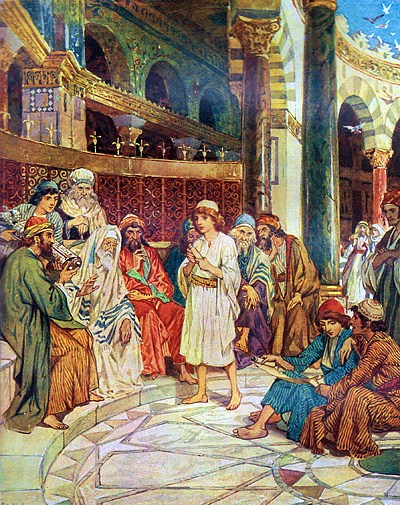
This is a story passed on to me by one of our mothers. The story which has made a real impact on her child was the story of the boy Jesus in the Temple (Faces of Easter II):


Mummy! Mummy! When Jesus was a boy, he went missing! 


William Brassey Hole (public domain image)

I want to be careful not to present this just as cuteness. It strikes me that the child is recognizing the humanity of Jesus - realizing that he really did share in the kinds of experiences that we are familiar with, even as children.

10 April 2011

Faces of Easter (Lent 5)

Today we had the plaque about Jesus' work as a teacher and friend/healer, and the plaque about the Last Supper. I did what I had proposed after last time, and invited members of the circle to bring things twice, once after each story. We are supposed to say that you don't have to bring anything, and I do. But the honest truth is that while I mean it when I say that that's ok, I'm even more pleased when they do bring something. I love the participation of it, and the unexpectedness of seeing what they will choose.

Today for the first time, everyone brought something! Some people declined in one round or the other, but in the end everyone had brought up at least one thing to help to tell more of this story. Here is what we made together:


Clockwise from top right, we have the image of the Risen Christ, our holding (prayer) cross, the Advent materials, the Palm Sunday materials ("Jesus the King"), the control card for the story of the Presentation in the Temple (Candlemas), and a parable box. (In the very top right of the picture is the control card for putting away the Faces of Easter materials.)

Telling these two stories together made it easy to change where one ended and the next began. The first of today's stories, by the script, is very short, and the second is very long. Instead of sticking to that, I extended the first plaque's story right up through Jesus teaching in the temple on Monday, Tuesday, and Wednesday of Holy Week (on the grounds that it tied in thematically with his work as a teller of parables). And then the second plaque was devoted to the events of Maundy Thursday. I left out altogether the tale of the widow's mite, since I needed to keep things a bit shorter for my young audience (something which Berryman himself recommends).

This hints at a very long post which I keep intending to write about how true to the text Godly Play stories are supposed to be. Already in my head it's growing into a whole series of posts. I'm daunted both by how much I want to say, and how adamant some people seem to get about it. I guess we can consider this a preface, or maybe a taster.

09 April 2011

glue and baptism

(that's Joseph's head next to his left foot)

This weekend I got out the glue and repaired Joseph's head, and the donkey's as well (turns out the piece that I had assumed had come from the manger was actually the donkey's right ear).


(no dividing strips)
While I was at it, I finally glued dividing strips onto the underlay for the Faces of Easter, and glued the white section onto the end of it. I was down to the wire getting it ready for the first Sunday we used it, and realized that those were among the lowest priorities - what I needed for that first week was just a purple underlay and for the plaques to be ready.

In fact, even then, the plaques had had coats of decoupage but no sealer yet (so they were a little "tacky"), and the final plaque needed re-doing. Now I think all those materials are done.

This afternoon, Vandriver and I attended a baptism service, and some of the children from Junior Church were there as well. I asked the priest to try to make sure that all the children could see, which he did by making sure that the family and godparents were not between the congregation and the font. It was our congregation's first baptism since the baptism lesson I presented in February. I was so excited! And yes, it was very like what I'd presented to the children (which I'd tried to adapt, as recommended in the script, to our typical practice). Afterwards I confirmed with one of the children - Did you see the priest make the sign of the cross over the baby? Did you see the water go on his head? Did you see the baptism candle? I hope I didn't over-do it, but I really was excited. (I'm glad to report that the answer was yes.) I probably spent as much time furtively glancing at the children present in the congregation as I did watching the baptismal candidate and his family!

You may be wondering what the differences are between a Lutheran baptism in Finland and the one described in the Berryman lesson. Well, our Lutheran priests make the sign of the cross over the candidate's forehead and chest before the baptism rather than after, and no oil is used at all.

"E--, remember the day of your baptism"
(my doll)
.