The video shows two Orthodox Christian children repeating what they have seen at church: crossing themselves, anointing each other, carrying a Gospel book, swinging a thurible (incense), chanting Alleluia, and kissing the hands of the priest. Their mother, while filming, sings.
Showing posts with label children. Show all posts
Showing posts with label children. Show all posts
24 February 2015
recreating ("playing") church at home
I'm grateful to Carolyn Pritchard for sharing this video on Facebook, and wanted to share it with my blog readers, too. It has already been blogged about at Pastoral Meanderings, who calls it a testament to what children see, hear, and learn, and Ex occidente ad orientem, who gives "Kudos" to their mother who probably took them to the vigils and the Divine Liturgy.
The video shows two Orthodox Christian children repeating what they have seen at church: crossing themselves, anointing each other, carrying a Gospel book, swinging a thurible (incense), chanting Alleluia, and kissing the hands of the priest. Their mother, while filming, sings.
The video shows two Orthodox Christian children repeating what they have seen at church: crossing themselves, anointing each other, carrying a Gospel book, swinging a thurible (incense), chanting Alleluia, and kissing the hands of the priest. Their mother, while filming, sings.

21 February 2015
not just cute, but members of the church
Within the service was a "Rededication of the Ministry of the People of God". The archdeacon (leading the service, representing the bishop) invited representative members of the congregation to come forward and, one by one, offer their new priest an object symbolizing one aspect of ministry and ask him to take that on.
For example, the organist presented the priest with a hymnal and said, Be among us as a priest using the power of music to deepen our understanding of God's Word. And then the whole congregation affirmed, Together, by God's grace, we will worship the Lird in the beauty of Holiness.
I was pleased to see that one symbol was to be of "ministry with young people", and that the congregation was to affirm, Together, by God's grace, we will value the vision of our young people and nurture the faith of our children. I was also pleased that the person presenting this symbol and speaking the invitation to the new priest was indeed a child. And I almost jumped with glee when I saw that the "symbol" chosen was a Godly Play object!

[The symbolic objects: water (representing baptism), oil (for healing), a Bible, a scroll containing the text of the Porvoo Agreement (an ecumenical agreement between, amongst others, the Church of Denmark and the Church of England), a stole, the City of Bethlehem (Godly Play / children's work), a hymnal, a chalice and paten (for Holy Communion), and a booklet about this church in its local context.]
I later reflected on the fact that the child was treated no differently than the organist or any other of the congregational representatives. He was not treated as cute or amusing, not merely tolerated or indulged, but he was acknowledged as someone of equal worth and accorded the same respect and responsibility (a responsibility within his range of competence) as others.
Again, though, this was not highlighted in any way. She was treated (and acted) just like servers I've known in other churches, servers aged 28 or 55 or 74. I thought of 1 Timothy 4:12- Don’t let anyone look down on you because you are young, but set an example for the believers.
I spoke with her briefly after the service (which is how I learned her age). She said she'd been doing this for some years already. It certainly had been clear during the service that she was very used to these tasks, acting with a quiet confidence, unobtrusively anticipating where she needed to be and when. She then said to me, I'm not just the server; I'm the assistant sacristan (!).

And yes, as we spoke she was gathering the chalices and ciborium and other "silverware" into a basket to carry back from the chancel to the sacristy for cleaning and putting away. I showed her this photo and asked if I could post it on the internet. Of course! she said, and explained, I do this for God.
What a joy to see her serving in this way, with her gifts recognised and put to use, affirming her worth within the Church.
12 February 2015
decorating the paschal candle by hand
Last year, I heard one priest from the Diocese in Europe comment that his church budget would not stretch to a paschal candle with the year on it, and that even the purchase of the paschal candle he did have was something he'd had to defend.
Just a few days later, I came across a lovely blog post, also from the Diocese in Europe, and I thought, Here is a possible solution to those financial concerns. Bishop David Hamid wrote that in St Margaret's Anglican Episcopal Church in Budapest, they have a tradition of buying a large, plain candle and having the children decorate it.
Eurobishop: Children of St Margaret's Budapest prepare the paschal candle: Krisztus feltámadt! ... These photos show them hard at work in Sunday School on Palm Sunday and presenting the finished product to the congregation.
Decorating actual candles, or doing paper-crafts of gluing bits of paper to reflect the way a paschal candle is decorated - this kind of work is often found in a Catechesis of the Good Shepherd atrium. Leslie Swaim-Fox is one of a number of bloggers who have posted about this:
Thoughts from the Sheepfold: The Paschal Candle: The paschal candle is a symbol of the Risen Christ which speaks very powerfully to children. ... I love the words that we say with the children while they press the wax pieces onto the candle.
 Leslie explains in the comments to another post that she uses thin sheets of colored wax, cutting out the shapes they will need with a craft knife. Jessica, at the Shower of Roses blog, made a more elaborate candle by using not only colored wax but also acrylic gems and gold metallic cord. Jessica has also listed several other ways of decorating a plain candle here (scroll down to "Easter Paschal Candle"). If you're not up to doing this craft but would like a paschal candle for the home, you can simply print out a design and wrap it around a candle (Jennifer at Family in Feast and Feria offers a free printable every year).
Depending on the age of the children who do this, your candle may not be as "perfect" as a store-bought one, but you will have saved money AND involved the children in a useful and meaningful way in the liturgical life of your church.
 |
| store display of paschal candles (licensed photo by Gagorski, cropped by Storyteller) |
Just a few days later, I came across a lovely blog post, also from the Diocese in Europe, and I thought, Here is a possible solution to those financial concerns. Bishop David Hamid wrote that in St Margaret's Anglican Episcopal Church in Budapest, they have a tradition of buying a large, plain candle and having the children decorate it.
Eurobishop: Children of St Margaret's Budapest prepare the paschal candle: Krisztus feltámadt! ... These photos show them hard at work in Sunday School on Palm Sunday and presenting the finished product to the congregation.
Decorating actual candles, or doing paper-crafts of gluing bits of paper to reflect the way a paschal candle is decorated - this kind of work is often found in a Catechesis of the Good Shepherd atrium. Leslie Swaim-Fox is one of a number of bloggers who have posted about this:
Thoughts from the Sheepfold: The Paschal Candle: The paschal candle is a symbol of the Risen Christ which speaks very powerfully to children. ... I love the words that we say with the children while they press the wax pieces onto the candle.
Depending on the age of the children who do this, your candle may not be as "perfect" as a store-bought one, but you will have saved money AND involved the children in a useful and meaningful way in the liturgical life of your church.
(public domain photo by Rabanus Flavus, cropped by Storyteller)
23 April 2014
two children and Our Story
I'm a little nervous about sharing this first story. I don't want to shame anyone, but perhaps to criticize the way Facebook chooses what stories to prioritize for us...
* * * * *
On Sunday one of my Facebook friends posted a montage of four photographs with an Easter greeting written across the whole. Two pictures were family groupings, one showed their Easter eggs, and one showed the oldest son reading. Alas, what Facebook showed his grandmother was his mother's teasing comments about the boy's father "boozing" it up, beside a photograph of the Bloody Mary the man had ordered with his Easter brunch.
But, I said, did you see the photograph of N?
--I saw the picture of him posing with his uncle and the Easter Bunny after brunch ...
No. The picture of him reading, in his father's Easter montage. The reflective finish on the top edges of the pages, the black leather binding, the two-column layout, and the glimpse of a marker ribbon all signal - this is a Bible. Even just a second glance reveals that he is reading the end of a book within this Bible. The resolution of the picture won't permit me to see which the following book's title is, but I can see that he's about three-quarters of the way through the Bible. As if I hadn't already surmised that he was reading the Resurrection narrative from one of the Gospels!
It's a story important to his father, important to his grandmother, important to the holiday. And the boy read it out to his family before brunch.
* * * * *
Our godson's little sister knows that I am pleased to see children enjoying spiritual things, so when we dropped by their house on Easter Day to deliver an Easter basket (really a small gift bag) to her big brother, she ran and met me at the door with the Jesus Storybook Bible.
She opened it to show me the page with Jesus carrying the cross.
* * * * *
 |
| licensed photo by williac |
But, I said, did you see the photograph of N?
--I saw the picture of him posing with his uncle and the Easter Bunny after brunch ...
No. The picture of him reading, in his father's Easter montage. The reflective finish on the top edges of the pages, the black leather binding, the two-column layout, and the glimpse of a marker ribbon all signal - this is a Bible. Even just a second glance reveals that he is reading the end of a book within this Bible. The resolution of the picture won't permit me to see which the following book's title is, but I can see that he's about three-quarters of the way through the Bible. As if I hadn't already surmised that he was reading the Resurrection narrative from one of the Gospels!
It's a story important to his father, important to his grandmother, important to the holiday. And the boy read it out to his family before brunch.
* * * * *
Our godson's little sister knows that I am pleased to see children enjoying spiritual things, so when we dropped by their house on Easter Day to deliver an Easter basket (really a small gift bag) to her big brother, she ran and met me at the door with the Jesus Storybook Bible.
She opened it to show me the page with Jesus carrying the cross.
 |
| from The Jesus Storybook Bible by Sally Lloyd-Jones & Jago |
I said, That looks like a Good Friday picture! What's today? And she excitedly flipped forward a few pages until she found the first page of the Resurrection story, with a picture of three women carrying jars and cloths towards tomb, which we see in the distance with the stone already rolled away.
I don't really know whether she showed me these pictures because they are important to her, or because she knows they are important to me. In one sense it doesn't matter, because I think for her what "church" is - is interaction with the family of God. In showing me the book she was maintaining our relationship as much as she was affirming our shared faith. Maybe for her the two are inseparable: the relationships within the body of Christ and the relationship of all those parts with the head.
25 March 2014
Happy Annunciation Day
As I mentioned in my last blog post, today is Annunciation Day - when we remember the Angel Gabriel's visit to Mary and Mary's acceptance of God's call on her.
Yesterday I made a brief visit to an after-school centre run for first- and second-graders so they won't be at home alone while their parents are at work. I noticed that they seemed to have a little worship area!

It looked similar to a prayer table in a Catechesis of the Good Shepherd atrium. I was also interested because in my Church of England theological studies we just recently been learning about the requirements for "collective worship" in English schools. I asked a few questions of the child I was visiting, but in my excitement I asked too many yes/no questions and too few open-ended questions. *sigh* Still, what I've understood is that they have a little worship time almost every day. It includes a Bible story and a prayer (at least).
The current theme clearly was the Annunciation.


Yesterday I made a brief visit to an after-school centre run for first- and second-graders so they won't be at home alone while their parents are at work. I noticed that they seemed to have a little worship area!
It looked similar to a prayer table in a Catechesis of the Good Shepherd atrium. I was also interested because in my Church of England theological studies we just recently been learning about the requirements for "collective worship" in English schools. I asked a few questions of the child I was visiting, but in my excitement I asked too many yes/no questions and too few open-ended questions. *sigh* Still, what I've understood is that they have a little worship time almost every day. It includes a Bible story and a prayer (at least).
The current theme clearly was the Annunciation.
The whole wall above this table was covered with angels. This one was made by the boy I was visiting:
15 December 2013
Third Advent
(I'm posting this from Stockholm Arlanda airport, and having a little trouble with editing. One photo is missing and the font keeps changing. I probably won't manage to fix those things before Tuesday!)
Today I was in Madrid, on my way back from a conference in Andalucia to Finland. Vandriver found me a hotel right around the corner from St George's Anglican Church. Although I had not found time to let anyone know I'd be coming, I recognized a fellow ordinand and he asked on my behalf if I could sit in and observe the Godly Play circle. While he was off asking, I watched a liitle boy supervise the priest's preparations for the service.


Today I was in Madrid, on my way back from a conference in Andalucia to Finland. Vandriver found me a hotel right around the corner from St George's Anglican Church. Although I had not found time to let anyone know I'd be coming, I recognized a fellow ordinand and he asked on my behalf if I could sit in and observe the Godly Play circle. While he was off asking, I watched a liitle boy supervise the priest's preparations for the service.

The GP team graciously allowed me to join them, even though it was an awkward Sunday. Understandably but disappointingly, their usual Godly Play room had been taken over with preparations for the Christmas Bazaar. Fortunately, they have a second, much smaller room, which they tend to use for older children. It contains a second Holy Family, and materials for enrichment lessons. So we crowded into there. We were at least 15, three adults and a dozen children. [Godly Play strongly advise against having more than two adults in the room, so I tried to minimize the adult-ness of my presence by sitting on the floor (even though I was offered a low chair), and keeping quiet.]
Their Storyteller presented the Holy Family, and then the children worked on a couple of crafts. It was simply too difficult to manage a feast, but they closed by singing and signing "Go now in peace".


Imagine a photo of a crowded room here.
(I admit I did stand up for that second picture, but by then everyone was absorbed in their work.)
There were some potentially frustrating moments. (We all have those!) The story got interrupted several times, and it was hard to maintain an atmosphere of listening with wonder. When Storyteller invited all the children to help put the figures back where they belonged, even though she did this in an orderly fashion, working around the circle, one by one, these figures got knocked over when three boys at once tried to help put Mary away.

There were also some sweet moments. When the Storyteller introduced Mary, the mother, one child clapped quietly.
There's a line in the script about many nativity sets being too fragile for children to be allowed to play with, but reassuring children that this one is for their use. The Storyteller said that line towards the end of her telling, shortly before the Wondering. Almost right away, a child asked to hold the Risen Christ figure.


Thank you very much, St George's!

24 September 2013
drawing the year
In my last post, I showed some seasonal drawings I'd done with a five-year-old friend.

I wonder if anyone noticed the little circles in the upper left of each picture. Remember my presenting the lesson about the liturgical year this summer? Well, my friend certainly did! As soon as I began to explain that I wanted to make pictures for the seasons of the year, she made the association. She pulled out a red tube of glitter glue and explained that it would ideal for that one red square that is HOT.
Even after I explained that I wanted the four seasons of Spring, Summer, Winter, and Fall (rather than the liturgical seasons like Pentecost), she could not shake the memories of the Godly Play lesson. You can talk about how time is in a line and also in a circle, she offered. [This is how the Church Year lesson begins.]
Our solution was to draw the Circle of the Church Year in the corner of each seasonal picture. I suspect that this association may be why she decided to put even our large seasonal symbols in circles.
She also carefully drew churches inside the "church clocks":
She explained to me as she drew, this is the door and this is the window, but I didn't pick up on what she was doing fast enough. So the next church was extra-elaborate:
See that passage between the two doors? That's where the WCs are!
22 July 2013
the water and oil of baptism
Although Little Sister initially ignored the Baptism materials in favor of the Holy Family and World Communion, she eventually went back to the attic and turned her attention to the Baptism doll. I accompanied her to a sink/basin where she was able to fill our little jug with water. She carried that through to where the materials were, and poured some out into the bowl. She then picked up the doll by its feet and prepared to dip it head-first into the bowl of water!
Never interfere?? All my training fell by the wayside. I gasped in horror and insisted, "No no no! We take water in our hand and put it on the baby's head that way."

Afterwards she continued to wonder about the oil, and as we talked I realized and told her that her baptism had been a little different from her brother's in that she had been anointed with oil and he had not. Neither of her parents had been anointed at baptism; nor had I. Later at supper I recalled (and said) that Vandriver had, like her, been baptised by an Anglican priest. Both she and Vandriver had been anointed with oil at their baptisms.
Never interfere?? All my training fell by the wayside. I gasped in horror and insisted, "No no no! We take water in our hand and put it on the baby's head that way."

Little Sister was much intrigued by the bottle of oil and asked what it was for. I used a little to make the sign of the cross on her forehead, and she did the same for me. But what is this [the bottle of oil] for? It struck me that I make little use of it in the lesson, since our Finnish Lutheran priests don't use any oil in a baptism. I said that we use it in the lesson to help us think about the Holy Spirit, and wound up presenting a portion of the Baptism lesson to her, the part that introduces the Trinity (The Holy Spirit ... is invisible, like the scent of this oil. It is invisible, but still there), and she went completely silent and gave it her full attention.
 |
| We didn't have the Christ candle out, but I just indicated what I would have done if we'd had one, and that seemed fine. |
Too late, it now occurs to me that I could have given her the words of a Finnish priest, Mika K T Pajunen, who said to us in a sermon, We are confirmed into a specific denomination, but we are baptized into the Christian Church. Whether our baptism includes anointing with oil, full immersion, the use of a scallop shell or not, we belong to the one body of Christ.
13 July 2013
order - everything in its place
Remember Little Sister, who hunted through my attic for "Jesus things"? It wasn't enough for her to work with them in the attic; she wanted to carry them down to the living room as well.
And when I look at the photographs I took, one thing that strikes me is order.
Godly Play is informed greatly by the educational methods of Maria Montessori. Montessori found that children are attracted to orderliness from a very early age, less than a year old in fact. She argued that children are sensitive to order (sensitivity is a technical term here, meaning able and eager to learn) during these early years, perhaps especially in their third year (age 2)). This does not mean that after their third birthday they stop finding order attractive, but rather that already by then they should have learned how to put things away, what belongs where, and how to recognize things that are out of order.
 |
| clockwise from left: Noah's ark, the Bethlehem stable, the Table of the Good Shepherd (laid with a paten, a cruet, and bread), an Anglican rosary, and the Holy Family. |
I am struck in this photograph by the way that Little Sister has made a differentiation (which is not emphasized in the Godly Play lessons) between the Christ Child's earthly family and the other characters in the Holy Family set - the shepherd, the magi, and the animals. (LS didn't have to decide where to place the "Risen Christ" figure since mine was in England at the time!) Also striking was the way she added several objects to the Godly Play materials. The terra cotta stable was unearthed while hunting through the attic, and is an obvious addition to a nativity scene.

More surprising additions might be the Anglican rosary (which she came across in our living room), and the Chinese triptych. The latter is a souvenir of the Five Oxen, a Tang dynasty Chinese painting. I don't know why she carefully placed it behind her work. Although the triptych is a common form in Christian art, I doubt that LS knows that yet. Perhaps it's because the ox (or cow) is one of the figures in the Holy Family. Or maybe it's just that this, like Godly Play materials, is a beautiful object of a size suitable for children.
 |
| adding a pair of elephants to the Holy Family |
The last addition is not clear in any of my photographs, but is a set of two wooden elephants. Elephants are not mentioned in any Biblical accounts of the Christmas story... but then again neither is the donkey or the ox! (Indeed, I have seen one or two nativity sets suggesting one of the magi might just as well have ridden an elephant as a camel.)
In the Godly Play classroom, children are encouraged to bring together materials from more than one lesson, making theological connections between stories and seeing how one might illuminate another. But afterwards, the child is always expected to put things back where we always keep them, to maintain the order which is one of the comfortable and reassuring things about our room.
10 July 2013
art on Lindisfarne
Sheila's recent post about Saint Columba and the Book of Kells prompted me to put together a post about my visit with Vandriver to Holy Island (or Lindisfarne) this summer. Like Mont Saint-Michel, Lindisfarne is a tidal island (meaning that you can walk or drive to it, but only at low tide). In 635 AD a monastery was founded there by Aiden, a monk from Iona.
Among the ruins of the Benedictine abbey (built around 1150 AD), I found several modern "tiles" on display designed by children from the island village. It seemed especially fitting that the first one I came across was by a child named Aiden!
Can you spot two tiles in the picture below?
Here are two more tiles, close-up:
While on Lindisfarne I also did some shopping. One purchase was a book which went straight into my store of art materials for the Godly Play room: The Freehand Celtic Knot Manual, written by Mary Fleeson of the Lindisfarne Scriptorium. The book gives instructions for drawing six different types of knots and plaits. Fleeson writes, Ideally you should enjoy what you are doing, exercise your imagination and draw nearer to God through the experience.

 |
| Aiden's tile - front |
 |
| Aiden's tile - back |
Can you spot two tiles in the picture below?
 |
| (hint: the tiles are white) |
Here are two more tiles, close-up:
 |
| art by Rowan |
 |
| art by Caitlin |
I was intrigued by this project to engage local children with historic monuments (which then also reminded tourists that this island is some people's home).
While on Lindisfarne I also did some shopping. One purchase was a book which went straight into my store of art materials for the Godly Play room: The Freehand Celtic Knot Manual, written by Mary Fleeson of the Lindisfarne Scriptorium. The book gives instructions for drawing six different types of knots and plaits. Fleeson writes, Ideally you should enjoy what you are doing, exercise your imagination and draw nearer to God through the experience.
05 July 2013
the Jesus t'ings

He saw the dust lying thick on everything, saw the cheerless, deserted look of the long-neglected house, and its narrow, meagre dimensions, its worn and shabby contents— and collapsed again on a hall-chair, his nose to his paws. 'O Ratty!' he cried dismally, 'why ever did I do it? Why did I bring you to this poor, cold little place, on a night like this?'
--Kenneth Grahame
Like the Mole in The Wind and the Willows, who remembers his home as being ready to step right back into, Little Sister seemed disappointed not to find our living room set up for Godly Play. With my permission (and my company) she set off for the attic, and began rummaging. Mother asked her several times what she was looking for, but she found it hard to articulate an answer. Finally, with perhaps a little frustration she cried, The Jesus tings!
It was not hard to find at least some of them, however, and she soon set about working with what we had found.

* in addition to the Holy Family, Little Sister
is working with some World Communion
materials, Noah's ark, and the terra cotta
stable which came with the figures we
originally used for our Holy Family (before
acquiring the Finnish Godly Play set).
14 May 2013
What do you like best about the Pentecost story?
The first time I prepared the Pentecost story was early in my introduction of Godly Play to the very young children in our church. Vandriver and I were not at all sure about knocking down a set of blocks as the opening to the story - the children were still learning our new, reflective storytime mood and we worried that knocking down a tower was going to send the wrong message!
Instead, I prepared a story based heavily on the Young Children and Worship version.
But I came down with the norovirus that year, and didn't do Pentecost at all.
The next year, I found myself with the materials ready for the Young Children and Worship story but discovered that after months of telling Godly Play stories I was no longer really satisfied with the YCW script. It felt like the worst of lectionary readings can feel - less like a pericope (a self-contained unit) and more like a random chunk of text. It seemed to me to lack the shape of a story.
What I did like, though, was ending with Peter's words from Acts 2:39, "This promise is for you and your children," as I drew a little flame on the forehead of each figure, tall and small.
I did the best I could, but I felt quite dissatisfied with the telling. My wondering questions were genuine, as I asked what we might have added or left out from the story (I seem to recall that one child thought my table, representing the table from the upper room, was unnecessary).
Months later, the grandmother of one of our children came to visit and I encouraged the child to show her around the room after our session. I began slowly putting things away while they explored. At one point I overheard the child say, These are the Pentecost materials, (I was pleased since I'd only used the word about 2-3 times all year) and then - joy - the young voice continued, and these are the children.
So many Bible stories don't actually feature children in them. But the Pentecost promise is explicitly for children as well.

Instead, I prepared a story based heavily on the Young Children and Worship version.
But I came down with the norovirus that year, and didn't do Pentecost at all.
 |
| our Pentecost materials |
What I did like, though, was ending with Peter's words from Acts 2:39, "This promise is for you and your children," as I drew a little flame on the forehead of each figure, tall and small.
I did the best I could, but I felt quite dissatisfied with the telling. My wondering questions were genuine, as I asked what we might have added or left out from the story (I seem to recall that one child thought my table, representing the table from the upper room, was unnecessary).
Months later, the grandmother of one of our children came to visit and I encouraged the child to show her around the room after our session. I began slowly putting things away while they explored. At one point I overheard the child say, These are the Pentecost materials, (I was pleased since I'd only used the word about 2-3 times all year) and then - joy - the young voice continued, and these are the children.
So many Bible stories don't actually feature children in them. But the Pentecost promise is explicitly for children as well.

20 March 2013
church in England
Dear five-year-old,
Several weeks ago you asked your parent to ask me, "What is church in England like?" I have been thinking a lot about your question. I go to two churches here. My supervisor (for me to learn about being a priest) is the priest of both of them.
The first thing to say is that The Holy Eucharist is the same in England and Finland. We start with the Liturgy of the Word - there are hymns, prayers, readings from the Bible, and a sermon - and then we have the Liturgy of the Sacrament - the priest tells us the story of Jesus' supper with his friends and his words, "This is my body" and "This is my blood". Your parent would know many of our hymns; some you might even recognize from our church.
Something different is they only have that communion service every other week; in between they have Morning Prayer. That's kind of like the Evensong services we used to have in the big church, or kind of like the Liturgy of the Word but without any communion afterwards. I don't mind not having communion every week, but I really miss The Peace, which isn't part of Morning Prayer.

One of my churches here has a pretty small building, which is sort of modern and boring. There are not a lot of people - usually around twenty I guess, if you count the priest and organist and people like that. Most of them are old. They almost all have grey or white hair. One lady is 100 years old! All of them except me are English. They would like to have younger people come to church and I think if they did come they might stay because these people are so friendly and nice.
My other church meets in a big, old building (not as big as the big church). You can tell it used to be beautiful but now it looks kind of worn out and it's really cold inside. They are worried about how much money it takes to keep it safe (like to fix the roof), let alone for new paint or better heaters. Right next door there is a big house (which is also really cold) and that is where the priest lives. This congregation is bigger than the other one but because the building is so big, it always feels pretty empty.
There are children at this church - one or two babies, several small boys and girls, and three or four teenage girls. At the other church everyone is "white", but at this church there are white people and black people. There's even a young family from Korea. It's hard to get to know the people who aren't white because they never stay to church coffee. I tried to invite one woman one time but she said she has to go to work after church.
They have Junior Church (but not Godly Play). I stay in grownup church and sometimes I help lead it, or even preach. At the end of church the children tell us what they learned about, and one reads a prayer they wrote. The priest always wants the grownups to tell them something about our service, but most of the grownups are too embarrassed. Last week I did it!
I like church here, but I miss Godly Play and I really miss you and your family!
love, Storyteller
p.s. I should have said that there ARE churches in England who use Godly Play! In fact, I learned how to do Godly Play here in England. But the churches I go to don't happen to use it.
Several weeks ago you asked your parent to ask me, "What is church in England like?" I have been thinking a lot about your question. I go to two churches here. My supervisor (for me to learn about being a priest) is the priest of both of them.
The first thing to say is that The Holy Eucharist is the same in England and Finland. We start with the Liturgy of the Word - there are hymns, prayers, readings from the Bible, and a sermon - and then we have the Liturgy of the Sacrament - the priest tells us the story of Jesus' supper with his friends and his words, "This is my body" and "This is my blood". Your parent would know many of our hymns; some you might even recognize from our church.
Something different is they only have that communion service every other week; in between they have Morning Prayer. That's kind of like the Evensong services we used to have in the big church, or kind of like the Liturgy of the Word but without any communion afterwards. I don't mind not having communion every week, but I really miss The Peace, which isn't part of Morning Prayer.

One of my churches here has a pretty small building, which is sort of modern and boring. There are not a lot of people - usually around twenty I guess, if you count the priest and organist and people like that. Most of them are old. They almost all have grey or white hair. One lady is 100 years old! All of them except me are English. They would like to have younger people come to church and I think if they did come they might stay because these people are so friendly and nice.
My other church meets in a big, old building (not as big as the big church). You can tell it used to be beautiful but now it looks kind of worn out and it's really cold inside. They are worried about how much money it takes to keep it safe (like to fix the roof), let alone for new paint or better heaters. Right next door there is a big house (which is also really cold) and that is where the priest lives. This congregation is bigger than the other one but because the building is so big, it always feels pretty empty.
There are children at this church - one or two babies, several small boys and girls, and three or four teenage girls. At the other church everyone is "white", but at this church there are white people and black people. There's even a young family from Korea. It's hard to get to know the people who aren't white because they never stay to church coffee. I tried to invite one woman one time but she said she has to go to work after church.
They have Junior Church (but not Godly Play). I stay in grownup church and sometimes I help lead it, or even preach. At the end of church the children tell us what they learned about, and one reads a prayer they wrote. The priest always wants the grownups to tell them something about our service, but most of the grownups are too embarrassed. Last week I did it!
 |
| GP materials from St. Michael's Workshop |
I like church here, but I miss Godly Play and I really miss you and your family!
love, Storyteller
p.s. I should have said that there ARE churches in England who use Godly Play! In fact, I learned how to do Godly Play here in England. But the churches I go to don't happen to use it.
13 February 2013
ashes to ashes
 |
Trinity Communications, over at CatholicCulture.org, say:
On Ash Wednesday small children are thrilled to receive ashes. We can tell them simply that ashes are placed on our foreheads to remind us that someday we will die and go home to heaven.It's a post worth reading in full.
Similarly, Carolyn, at Worshiping with Children, writes, The imposition of ashes is amazing to children, but she also notes that:
In the Church of England, as priests mark you with ashes, they say, Remember that you are dust, and to dust you shall return. In Finland, (Lutheran) priests tend to say something like, Receive the cross, a sign of repentance. If you feel that your child will not cope well with a heavy emphasis on mortality and death at this time, repentance is an alternative theme to emphasise. (This is something also said by both blogs that I linked to above.) Carolyn also mentions the theme of belonging. Many Roman Catholics assume that ashes mark someone off as Catholic; they certainly mark us off on Ash Wednesday as a certain kind of practicing Christian.
All this to say, I hope you'll feel able to take your children to church today. Or, if in the United States, even to seek out Ashes to Go.
For me and for my church this year, we've already had a stark reminder of our mortality: one of our church wardens was found dead yesterday morning. It would seem that she died in her sleep. She had attended a council meeting less than 24 hours before her death and seemed as fit as ever. I believe she was 72 years old.
To my mind Madeline was one of the friendliest and most welcoming people at that church. She could be very frank, yet also came across as accepting. She seemed to be someone you could rely on entirely - an excellent church warden in that regard!
The church organist announced loudly to a small group of us that Madeline had planned her funeral some years earlier, right down to a set of hymns that he claimed had been chosen expressly to annoy him: hymns she knew he didn't like playing. I hope he is able to chuckle about it rather than find that hurtful. If so, I will chuckle along as well!
UPDATE: I checked, and our priest says that the organist "liked the idea of the hymns and will remember Madeline with fondness as he plays." That's exactly as I had hoped it would be.
Other than Good Friday, Ash Wednesday is probably the day on which children are least expected or planned for in the sanctuary.And she has excellent suggestions for how to change that.
In the Church of England, as priests mark you with ashes, they say, Remember that you are dust, and to dust you shall return. In Finland, (Lutheran) priests tend to say something like, Receive the cross, a sign of repentance. If you feel that your child will not cope well with a heavy emphasis on mortality and death at this time, repentance is an alternative theme to emphasise. (This is something also said by both blogs that I linked to above.) Carolyn also mentions the theme of belonging. Many Roman Catholics assume that ashes mark someone off as Catholic; they certainly mark us off on Ash Wednesday as a certain kind of practicing Christian.
All this to say, I hope you'll feel able to take your children to church today. Or, if in the United States, even to seek out Ashes to Go.
 |
| licensed photo, used with permission © Mazur/catholicchurch.org.uk |
* * * * *
To my mind Madeline was one of the friendliest and most welcoming people at that church. She could be very frank, yet also came across as accepting. She seemed to be someone you could rely on entirely - an excellent church warden in that regard!
The church organist announced loudly to a small group of us that Madeline had planned her funeral some years earlier, right down to a set of hymns that he claimed had been chosen expressly to annoy him: hymns she knew he didn't like playing. I hope he is able to chuckle about it rather than find that hurtful. If so, I will chuckle along as well!
UPDATE: I checked, and our priest says that the organist "liked the idea of the hymns and will remember Madeline with fondness as he plays." That's exactly as I had hoped it would be.
02 December 2012
gifts for godchildren
I'm so pleased with some gifts that I delivered last weekend that I'm very tempted to write a self-congratulatory post. I'm going to try to turn it into an informative post for others, though. My apologies if I fail and just sound prideful.
We have two godsons. One is a young adult; the other is six years old. We're far away from them this year, but were visiting last weekend, and so I wanted to give them gifts - partly just to show our love but partly to foster their spiritual growth. So I went shopping for Advent gifts.
We have two godsons. One is a young adult; the other is six years old. We're far away from them this year, but were visiting last weekend, and so I wanted to give them gifts - partly just to show our love but partly to foster their spiritual growth. So I went shopping for Advent gifts.

For our young adult godson, we bought a collection of Advent reflections, one for each day of the season (plus Christmas Day and Boxing Day): Inside the Christmas Story, by Bash & Bash. It's written by a priest who once served the parish of a relative of ours, with his wife, which gave it a little extra personal connection.
Sheila, at Explore and Express, has written a post about children's spiritual styles, and I agree that it's important not to assume that the same things will touch the same children. It's almost trite, isn't it, to comment on how different siblings can be. Our young godson and his younger sister are a case in point. He is deliberate, even cautious. He likes to know things, and to get things right. His sister is impulsive; she has no patience for long explanations. She's very extroverted - friendly and open.
For our six-year-old godson, I bought the Advent magnets shown above. The big magnets on the top half of the sheet separate out into six - the wreath and candles, plus five separate flame magnets. Each "flame" can be placed over a candle on each Sunday of Advent (and Christmas Day). Below this are five "cards", with a suggested short Bible reading and prayer to go with the lighting of each candle. Besides encouraging his word-based expression of faith it also helps him practice his new reading skills, with the themes for each candle written in such large letters.
We don't usually buy presents for this boy's little sister, but in the shop I spotted a holding cross (similar to the one pictured here) which was especially proportioned for a young child's hand. Do you remember the Lego stick that we pretended was a prayer cross? That was made by this little girl! So I thought of her as soon as I saw this cross, and really wanted to get it for her. Her first words upon opening it were, I remember we used to have a cross like this in Junior Church.
I knew you would remember! I replied, and that's why I wanted to get this for you. Her second comment had to do with how small it was. I explained that it was designed for a child's hand but she corrected me: This was designed for a BABY's hand! Still, she was pleased with it. Being an extrovert, she thanked me for it (or told me how much she liked it) about four different times. Finally she said, When we have Junior Church again, I'm going to bring this, and we can pass it around the circle at prayer time.
I'm not sure our godson explicitly thanked us for his gift, except when prompted by his mother. But he immediately opened up the package and found a place to display the magnets, and later carefully asked me to help him read all the different themes. I took the opportunity for a quick chat with him about the fact that these themes don't match up exactly with the Godly Play themes for the Sundays, and encouraged him to ponder ways in which they do match up and ways in which they don't. We both laughed at the suggestion that Mary and Joseph's entry into Bethlehem might have been peaceful - probably not! Towards the end of our visit he caught my eye and slyly demonstrated how a flame would look atop a candle. As soon as we'd both seen it he snatched it away again, as if to stress how well he understood that it was not yet time to light that candle! So even though he didn't gush over the present the way his sister did, I know he appreciated it and will use it in his observance of Advent.
 |
| image source |
For our six-year-old godson, I bought the Advent magnets shown above. The big magnets on the top half of the sheet separate out into six - the wreath and candles, plus five separate flame magnets. Each "flame" can be placed over a candle on each Sunday of Advent (and Christmas Day). Below this are five "cards", with a suggested short Bible reading and prayer to go with the lighting of each candle. Besides encouraging his word-based expression of faith it also helps him practice his new reading skills, with the themes for each candle written in such large letters.
 |
| image source |
I knew you would remember! I replied, and that's why I wanted to get this for you. Her second comment had to do with how small it was. I explained that it was designed for a child's hand but she corrected me: This was designed for a BABY's hand! Still, she was pleased with it. Being an extrovert, she thanked me for it (or told me how much she liked it) about four different times. Finally she said, When we have Junior Church again, I'm going to bring this, and we can pass it around the circle at prayer time.
I'm not sure our godson explicitly thanked us for his gift, except when prompted by his mother. But he immediately opened up the package and found a place to display the magnets, and later carefully asked me to help him read all the different themes. I took the opportunity for a quick chat with him about the fact that these themes don't match up exactly with the Godly Play themes for the Sundays, and encouraged him to ponder ways in which they do match up and ways in which they don't. We both laughed at the suggestion that Mary and Joseph's entry into Bethlehem might have been peaceful - probably not! Towards the end of our visit he caught my eye and slyly demonstrated how a flame would look atop a candle. As soon as we'd both seen it he snatched it away again, as if to stress how well he understood that it was not yet time to light that candle! So even though he didn't gush over the present the way his sister did, I know he appreciated it and will use it in his observance of Advent.
What about your own observances of Advent? What are you doing? And if you have children, what are you doing with them? I love the Busted Halo's suggestion that our preparations for Advent can be like preparing for a special guest. It's not that everything has to be perfect or that we need to pretend to be somebody we're not. If you're an extrovert - go ahead and gush! If you're a word-based spiritual type, do a special Bible study for the season. It's not too late to start.
14 November 2012
an overdue hello
Our little congregation in Finland isn't doing Godly Play this year, because I'm too busy with my theological studies and even more because I'm not even there right now. My husband and I are spending a year in England. Although I told myself this might mean I could write up a bunch of half-baked ideas which had never matured into proper posts, so far I haven't posted anything on this blog since summer school! Not having the input and prompting of weekly (or near weekly) sessions has meant it was easy to ignore the blog.
But Sheila's recent post on her children's first visit to a Godly Play classroom provoked me to dust off my Blogger password and add an appreciative comment. And so I thought I ought to post here as well and explain why posts here have dried up. As I have said, I do hope to carry on... but it's unlikely to be at all frequent for a while yet.
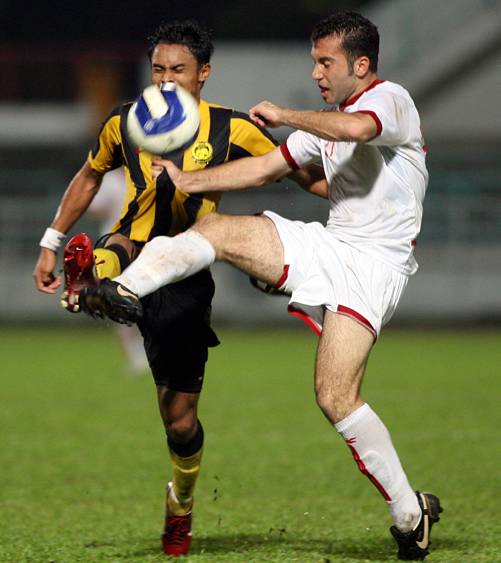
In the meantime, to make up for a dearth of Easterkind material lately, here's a bunch of links and a puzzle. What tenuous connection could there be between Godly Play and Malaysian football? Read on!
 |
| photo by Kamal Sellehuddin, of
Malaysian footballer Mohd Aidil Zafuan (on left)
|
- I've found another new(ish) blog on children's spirituality, Learning Up by Fiona. One of the posts I enjoyed most from her was a story about how a group of 8-10-year-olds gave her a completely new perspective on the story of Jesus's triumphal entry into Jerusalem. (Three cheers for Wondering!)
- David Pritchard has recently returned from Kuala Lumpur, where he presented the lesson, "Exile and Return". (photo) He reports that the Dignity for Children Foundation (an educational charity in Kuala Lumpur) has created Godly Play -style stories and materials for use with the Muslim children at their schools. (photo)
- Anyone working with children might also be interested to read Dignity's vision / mission statement, which includes graphic representations of the cycle of poverty. It's also moving to note that their work is not just (Montessori) education and teacher training, but also a football & netball tournament.
- And here is an account of a sermon David gave during that trip, on 2 Kings 5, with the theme "Small is Beautiful".
- Finally, I was pleased to see that even though I'm "taking a break from Godly Play", my blog was mentioned and linked from the Godly Play UK newsletter back in August. Thank you!
31 August 2012
learning from a child
Recently, in preparing for a young family to visit our house, I got out my own childhood doll, Lolly, only to find that her dress was so old and worn that it was coming apart. It certainly wasn't suitable for play anymore. I mentioned this to a friend, and she suggested I pick up a package of doll clothes at Ikea.
 Although they looked all right in the store, the clothes turned out to be about two sizes too big for Lolly. But with a bit of hand-stitching I took up the dress in the shoulders so that it was more or less acceptable, and put Lolly on the shelf of children's toys in our living room.
Almost as soon as our young guest found Lolly she asked me, "Don't you have any other clothes for her?" With exaggerated care, I showed her Lolly's original dress and how the fabric was disintegrating. Then I told the story of buying new clothes, finding they were too big, and hand-sewing the shoulders of the dress so that it would fit. But unlike me, this child was not daunted at all.
She took off the new striped dress, and put Lolly into the blue sweatsuit. She then carefully rolled up the sleeves and the pant-legs so that they were the right length. Then she put on the raincoat.

Again, she carefully rolled up the sleeves. This was difficult, since there was already a large bunch of fabric there (the rolled up sweatshirt sleeves), but she persevered. She even managed to get the rain-booties onto the doll, despite the fact that the doll doesn't really have feet. By fastening the booties as tight as they would go, and then holding the doll very carefully, she was able to keep them from falling right off.

I told her how glad I was that she had shown me that the too-large clothes would work for Lolly. I really meant it! I had not even considered keeping them, but already had them ear-marked for the "donate" box in our attic. What a pleasure to be shown something unexpected.
05 August 2012
distraction
This moment was part of what I've been hoping for:
This child spent the first part of our service today working with materials about the story of Jonah (a story she knows not from Godly Play but from a Bible storybook at home). However, as I snapped this photo, her attention was drawn away from her own work to the worship service taking place in the same chapel. Last week a mother said to me that she noticed her son singing along with one of the congregational responses as he sat drawing a picture.
As Carolynn wrotes,
 |
| distracted by "adult" worship |
As Carolynn wrotes,
The children playing during the worship does not mean they are not also engaging with what they are seeing and hearing.
welcoming young families
Recently, David Pritchard pointed his Facebook friends to a short article which began like this:
This week I've posted some ideas for welcoming children at church. Here's an example of another very simple and practical way to show young families that they're welcome:
Imagine a place where God's call to see children valued and cared for goes unheard. Imagine that in this place children are ignored, excluded and treated as insignificant. Now imagine that place is a church.
Viva News, 11
(The Viva News link above will take you to a pdf of the whole magazine. This article is found on pages 4-5.)
 |
| This is accessible to both men and women. |
The photos above and below were taken at a local church building, where they've provided a changing-table and even diapers / nappies. [I spotted a similar set-up at Ikea, where they had a whole range of sizes available.] The hand-lettered sign in the close-up below welcomes you to use the nappies / diapers.
 |
| (The sign welcomes you to take one. ) |
02 August 2012
children in church - advice for grown-ups
Earlier this week I wrote some advice for parents who bring their children to our Play and Pray area in church. In the weeks since we've brought children back into our regular services (rather than having them at Junior Church) I've also thought of advice I'd like to give clergy and other other grown-ups in the congregation. (Some is this is based on my own mistakes!)
 |
| photo (c) Pikku Arkki Valokuvaus, used by permission* |
Advice for clergy, worship leaders, and congregations
- Include the children in your congregation. Include the children when you make eye contact with the congregation. If you'd like the children to participate in something, such as the Peace, say so. But attract their attention before your instructions or invitation. (It's better to ask, Children, have you got your banner ready? than Could you bring the banner forward now, children, which has the attention-getter at the end of the sentence.)
- Signal that narrative Scripture texts are stories. Whether or not your church stands for the Gospel, whether or not you include a Gospel lesson - if your Bible reading is a story, try to make it sound like one. You don't have to ask the children to listen - just reading something as if it were interesting will attract attention.
- Think of ways to get children involved. Could children help collect the offering? hand out leaflets? read the lesson? serve cookies or biscuits after church? Even if the youngest you can easily include right away are in their early teens, I believe that'll help younger children look forward to the time when they too can participate.
- Remember that not all children are alike. Work not to embarrass a child. If you wouldn't call on the average adult for this, is it something you should ask a child to do? Some children love to be the center of attention (and it may then be difficult to get them to step back out of the spot-light), while others hate it. Some children love to sing and others don't. For some, the best part of church is community; for others it is the chance to be still and know God.
- Model the behavior you want children to follow. Stifle your laughter at behaviors you don't want to encourage (however hard that may be). Even glaring at a child who is "misbehaving" may be less fruitful than putting extra effort into your own concentration. If a child is going to take on a new task (such as using a tall candle-snuffer or reading into a microphone), let them watch you do it during a practice run ahead of time and then try it themselves.
* I find this photo wonderfully funny because it looks as though the boy has been invited to watch what is happening at the altar but is bored by it. However, it's important not to mistake a lack of eye contact for a lack of attention. Who's to say that he isn't listening intently? And even if he is bored, I'm so thankful that he was welcomed to the Lord's Table!
Subscribe to:
Posts (Atom)