Showing posts with label materials. Show all posts

27 September 2016

Christian Symbols (Materials)

Each day at the European Godly Play® conference we had two workshops. Knowing I'd need a break and a change of pace after plenary lectures and conversations, I made sure that one of my workshops each day was a hands-on one.

During the workshop hosted by Johanna Kaarto-Wallin, who makes the Finnish Godly Play® materials, I painted (or rather, stained) a wooden set of Christian symbols. This isn't a lesson included in the books, but is very like the Crosses lesson (vol. 4). 


Mine is a slightly different set of symbols than is sold in North America. I didn't come across the tradition of votive ships until I visited churches in the Nordic countries, so it doesn't surprise me that although not all sets include a ship there is one in Johanna's materials.

a model of a three-masted sailing ship hangs from a whitewashed arch
votive ship in Ravlunda Church
licensed photo by Yakikaki (source)
Even the North American materials site shows two slightly different sets of symbols: compare this with this. That sure gets me wondering! I wonder what symbol you would add to this set? I wonder if there's a symbol you think we could do without? 

21 February 2015

not just cute, but members of the church


Today Vandriver and I were in Denmark for a very special service- the licensing and institution of the new Anglican chaplain at St Alban's Church, Copenhagen. [This chaplaincy is part of the Church of England's Diocese in Europe.]

Within the service was a "Rededication of the Ministry of the People of God". The archdeacon (leading the service, representing the bishop) invited representative members of the congregation to come forward and, one by one, offer their new priest an object symbolizing one aspect of ministry and ask him to take that on. 

For example, the organist presented the priest with a hymnal and said, Be among us as a priest using the power of music to deepen our understanding of God's Word. And then the whole congregation affirmed, Together, by God's grace, we will worship the Lird in the beauty of Holiness. 

I was pleased to see that one symbol was to be of "ministry with young people", and that the congregation was to affirm, Together, by God's grace, we will value the vision of our young people and nurture the faith of our children. I was also pleased that the person presenting this symbol and speaking the invitation to the new priest was indeed a child. And I almost jumped with glee when I saw that the "symbol" chosen was a Godly Play object! 


[The symbolic objects: water (representing baptism), oil (for healing), a Bible, a scroll containing the text of the Porvoo Agreement (an ecumenical agreement between, amongst others, the Church of Denmark and the Church of England), a stole, the City of Bethlehem (Godly Play / children's work), a hymnal, a chalice and paten (for Holy Communion), and a booklet about this church in its local context.]

I later reflected on the fact that the child was treated no differently than the organist or any other of the congregational representatives. He was not treated as cute or amusing, not merely tolerated or indulged, but he was acknowledged as someone of equal worth and accorded the same respect and responsibility (a responsibility within his range of competence) as others. 

And you know what? He wasn't the only young person being taken seriously at that church. Not by a long shot. Because the 'server', who poured water for the priest to wash his hands with, who accepted the offerings brought to the front of the church and then presented them to the priest, who held the Gospel book as it was read from - the server was a fourteen-year-old. 

Again, though, this was not highlighted in any way. She was treated (and acted) just like servers I've known in other churches, servers aged 28 or 55 or 74. I thought of 1 Timothy 4:12- Don’t let anyone look down on you because you are young, but set an example for the believers.

I spoke with her briefly after the service (which is how I learned her age). She said she'd been doing this for some years already. It certainly had been clear during the service that she was very used to these tasks, acting with a quiet confidence, unobtrusively anticipating where she needed to be and when. She then said to me, I'm not just the server; I'm the assistant sacristan (!).


And yes, as we spoke she was gathering the chalices and ciborium and other "silverware" into a basket to carry back from the chancel to the sacristy for cleaning and putting away. I showed her this photo and asked if I could post it on the internet. Of course! she said, and explained, I do this for God. 

What a joy to see her serving in this way, with her gifts recognised and put to use, affirming her worth within the Church.

16 March 2014

Bible cards

A project I have underway is the creation of a set of cards for the books of the Bible. I am making this for one of our godsons, since he is at an age where he is very interested in collecting cards with bits of information on them - cards for the Magic game, for example (or baseball cards, to use an example I find easier to relate to!). 

I plan to use a second set as part of the materials for the Godly Play enrichment lesson about the Books of the Bible. I used the Keynote software (similar to Powerpoint) to design them, then printed and laminated them. The face of each card shows two pictures representing stories from the book (using the wonderful resource of Bible illustrations from Sweet Publishing), and the Gospels also show the symbols associated with each evangelist (with Luke's symbol repeated on the Acts card). Each card also has a quote from the book, a single phrase which sums up something distinctive or important about the contents.


Today I delivered the first batch - just six: four Gospel cards, one for the book of Acts, and one Old Testament book. All six are green, for narrative history. I tried to make the Gospel cards a different shade of green but that didn't show up as well as I'd hoped.

We looked together at the tables of contents of two complete Bibles (of very different sizes and layouts), and one which contained only the New Testament and Psalms. One Bible listed the books twice, once by the order in which they appear in the Bible and once in alphabetical order. My godson then went off by himself. He laid the cards out and organised them by their numbers (the order of the books of the Bible). Then he attempted to re-order them into alphabetical order. Later, using information on the backs of the cards, he might try ordering them by date of [estimated] composition, or the relative chronology of the events they describe (his parents will probably have to explain BC dating again!). 
What I also wanted to do, though, was to tie these cards firmly to the Bible and its contents. So I showed him that in his Jesus Storybook Bible there is a note at the beginning of each story saying which book (and chapter(s)) the story is taken from. And then, without him looking, I slid the cards into a Bible so that each card marked the place its book began. When he searched for them it reinforced the fact that the Gospels are found all together, three quarters of the way through the volume, while the Old Testament histories are much further toward the front. 

I'm providing several extra bits of information on the backs (which is why I've only finished six so far). But the description of the Godly Play cards by Jerome W. Berryman (in vol 2 of The Complete Guide to Godly Play) is that there's relatively little information on each card - just "one or two sentences about the content of each book", and a color-coding to show which genre the book belongs to. So if you set out to make your own, they needn't be as elaborate or time-consuming as mine. 

03 March 2014

lessons learned (Lent)

Yesterday it struck me that the pastor and I hadn't discussed which of us might provide a children's sermon, if needed, for our service that afternoon. Inspired by Sheila's good reports of The Mystery of Easter, I rushed a cross puzzle into production.

Before I began, I read the script (from The Complete Guide to Godly Play, Vol. 4) onto a recording which I then listened to as I worked. Once I'd finished, I listened once or twice more while I physically acted out the lesson, moving the pieces around, and finally tried it without the recording, speaking the script myself. Way back in training we tried that, having one person read the script while another moved the pieces, but I'd never tried using a recording of myself for practice before!

The materials were far from ideal. I cut a cross out of cardboard packing material from our recycling pile. Having no paint to hand, I used magazine clippings of purple on one side, and white felt on the other.


Lessons learned? I liked this method of practicing the script. But I would not use felt as a covering for this cross again. You can see the white puffing out from underneath even when the purple sides are turned up. Moreover, it prevented the pieces from slotting together as nicely as I'd have liked them to.

In the end, we had no children at church and I didn't present the lesson. But you know what? For one-time use, in a pinch, I was much happier to have far-less-than-perfect materials than not to have had any at all. I enjoyed this little project as a Sunday task, and I felt good having something to offer children if any had come along.

I've heard it said, "Perfect" is the enemy of "Done". Godly Play materials should always be made with love, as beautifully as you can. Really, they should be as good in quality as the objects you use for liturgical purposes for adults (as nice as your chalice or communion trays, as nice as the Bible on your lectern). But don't let that ideal prevent you from doing the best you can.

02 November 2013

geography

Both Godly Play and Catechesis of the Good Shepherd take geography seriously.

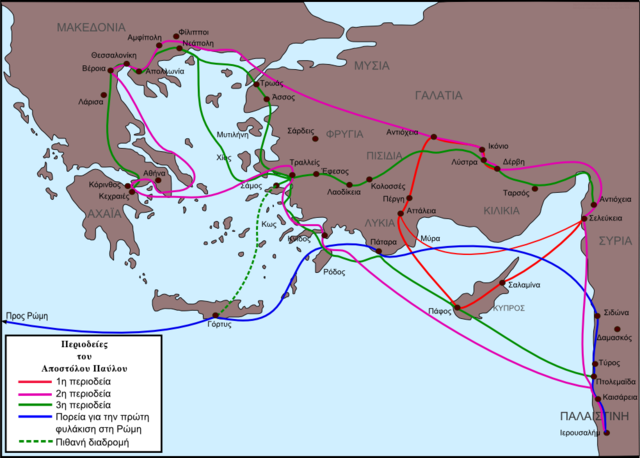
a map of the Northwest Mediterranean, showing St. Paul's missionary journeys as complicated lines, labelled in Greek
map by Geraki

I don't remember any Biblical geography in my childhood, except maps at the back of Bibles. The ones in my Bible weren't in Greek, like the one pictured above, but they might as well have been. I looked at them sometimes if I got bored during church. I guess I thought that one day I would "learn" them, whatever that might mean. Maybe really mature Christians memorize the routes of Paul's missionary journeys?

Godly Play teaches storytellers to tell the story of Abraham's journey from Ur to the oaks of Mamre with relative geographical accuracy, and the same for the story of the Babylonian captivity. It's not made into a big deal. Children aren't asked to "learn" it; they're simply shown. The storyteller lays blue ribbons onto the sand - Here is the Tigris river, here is the Euphrates. The message is, This is what I need to get ready in order to tell this story.
a small and simple map showing the Tigris and Euphrates rivers and some unlabelled national boundaries
public domain map by Kostisl
(The storyteller does this all "upside-down" so that North is at the top for children sitting opposite.) The rivers serve as points of orientation, I suppose, and when the child later sees a map like this they can think, Oh yes, I'm familiar with that place. 

In Catechesis of the Good Shepherd, the materials for 3-year-olds include a small globe. It is simple, showing only land and water. Ideally, the land is slightly textured, encouraging the child to run their fingers across it. The only marking is a small dot, showing where the land of Israel is. The catechist explains that when Jesus was born, he came to a very tiny place. That idea is left to grow in the child's mind, the beginning of a recurring theme of paradox -

Humility / Immensity (All things were made by him).

Later, perhaps some weeks or months later, the child is introduced to a topographical map of that land of Israel.

a map of Israel, showing water in blue, low-lying land in green, mountains in brown, and land in between in yellow.
licensed map image
The map is 3D. Most of the land is built up higher than the sea but the shores of the Dead Sea are below sea level. The child is encouraged to spend time feeling the mountains and valleys, the river and the sea. This is the land where Jesus was born, and where he grew up, where he died and then came to life again. Later still, the child will be shown where the cities of Bethlehem, Nazareth, and Jerusalem are. It's all a very hands-on experience, putting across the message that Jesus came into human history in a concrete place.


19 October 2013

last day, last supper

Today was the last day of our Level I, Part 1, training course in Leiden. I spent some of yesterday and this morning working with a partner on the presentation about the Last Supper.

I loved how she "offered" the wine to everyone
[Catechesis of the Good Shepherd (like its descendant, Godly Play), maintains a distinction between historical characters, represented by 3-D figures, and characters who are only elements in a story, such as the Good Samaritan (Jesus tells a story about him, but there is no assertion in the Gospels that he was a real person). Parable characters are "flat", both literally and figuratively. So Linda pointed out that although these Last Supper characters are chunky it would be even better if the corners were sanded off them so that they were rounder and more clearly distinguishable from wooden 2-D figures.]

We finished our day with a look at the Pentecost Celebration. I found it a somewhat dissatisfying mix of teaching and participation (being pressed for time, we had to do both at once). Yet even so, I was captivated enough to wonder whether and how to try to work it right into our congregation's Pentecost service next year - not just for children but for everyone!


Before leaving we presented some gifts - a book for our trainer and a bottle of wine for the local organiser. We're already talking about trying to meet in March for Part 2.

"Good Shepherd" wine, of course


22 July 2012

another baptism doll

I've written here about finding and purchasing my baptism doll, and her/his christening gown. (The doll is anatomically correct, but he/she wears bloomers so that children can decide for themselves what the doll is.) While at the same flea (super-)market last week, I bought another one for our Play and Pray area at church.

This doll came wearing a badly stained dress but since I wanted to get a christening gown, that didn't worry me at all. The doll was also wearing a pair of white and pink shorts, which will be kept for now as an undergarment. This doll is a bit different than my first one - slightly smaller, mouth pursed for a bottle, one tuft of hair on the forehead, and a little more ambiguous anatomically. I didn't take time to hunt right through the market for the "best" doll (it's an ongoing struggle for me to curb my perfectionist and "maximizer" tendencies), but chose this from among three dolls at the same stall. This one was simply the one most like the one I had already, that the children were used to.

Now that I think about it, there would be advantages to a considerably smaller doll. A smaller doll would be easier to store, and more manageable for small children to work with. Here are two (poor-quality) snapshots of children working with my original doll. They cannot lay the doll in the crook of their arm as I do when I demonstrate what it would be like to baptize a baby.

girl holds doll under left arm, grasping water jug with right handGirl struggles to keep hold of doll while opening oil jar.


On the other hand, it would have been harder to get a christening gown for a smaller doll. I was pleased to see that the doll clothes stall where I'd found the gowns the last time was still in business. There was a smaller selection this time, with only two gowns for sale, both with pink ribbons. So before I take this to church I'd like to replace the ribbon with one in a more neutral color - maybe green? 

baby doll, wearing long white gown with long pink ribbon decoration

Even on this doll (only slightly smaller than my other one) the gown is a little too big. [They're marketed as fitting a "Baby Born" doll.] The sleeves have to be pushed back up over the fingers to the wrists, and the neckline is large. But if I get a rush of energy and determination I could unpick the back placket and re-sew it (by hand - I don't have a machine) to give a better fit. Or I might just leave it - it's not impossible as it is. I gave the doll a wash before clothing it in this new dress and the tuft of hair went all funny... but I managed to curl it around a beeswax taper (!) which held it until it had dried into a cute curl.

Close-up of baby doll, with curl on its forehead. Its sleeves come down to its knuckles.


15 June 2012

more on Play and Pray

As promised, somewhat belatedly, here's more on the launch of our Play and Pray area. This post will tell you what the set-up was like, including some initial reflections on what worked and what didn't.

We chose our space to gave a good vantage point for any child who wanted to see what was going on. The space felt enormous as we were moving twelve chairs to make room for it, but didn't feel so large once three children were inside it. As soon as one lay stomach-down to do some drawing I began to be thankful that more children hadn't come!

The floor was lined with a thin comforter / padded blanket. Each corner was covered with a mat (and sometimes a strategically-positioned chair leg) to help keep it in place. Spare mats were available by the "entrance", but they weren't really made use of this week.

I realized that my idea of putting all the materials around the edges was perhaps ill-conceived when I watched the smallest child labor to get past the other two to reach the colored pencils. (I praised him for carefully avoiding stepping on any artwork in doing so.) I then moved the pencils, explaining in hushed tones that it would be better to put them where everybody could reach them.

materials
  • For an embarrassingly long time, I've had the materials for the Godly Play Jonah story on loan from a neighboring parish (fortunately, they had two sets). But I never put it into our classroom because I have trouble with that story. (Why? That's for another post!) But I brought it out for the Play and Pray area, along with an odd assortment of tiny stuffed animals in a basket - I couldn't find an ark at the flea market!


  • Our book basket included a storybook about Jonah and the Whale in English and a book in Finnish with a huge fold-out poster of  (a cartoon painting of) Noah's ark. When a child first bored of drawing, I silently drew his attention to the correspondences between the illustrations and our 3D materials.
  • Two very different sheep, both  found at the flea market for super-cheap (the cheap sheep?), stood alongside the book basket.


  • The pastor was very leery of bringing clay / plasticine / play-dough to the service, feeling that then children would need to wash their hands before coming to the altar and that would just be impracticable. Similarly, I wasn't convinced we'd be able to clean glitter glue off the blanket we were using. But we did have paper and card in various sizes, colored pencils, two kinds of crayons, and some stickers left over from Easter egg decorating.


  • On the chair closest to the altar I laid a green cloth (flea market place-mat), the Christ candle, and a basket of half-assembled cardboard Nativity pieces. As it turned out, nobody took any notice of this activity this week.


  • Also available but not used were the flip-book guides to the liturgy (I might place at least one of these into the book basket next time).
  • Because we were having baptisms that first week (a whole family was baptized), I had also brought along my own Godly Play baptism materials. But at the start of the service they were accidentally covered up. Just as the youngest's patience and attention was wearing thin and I was getting ready to bring them out... I recognized the strains of Jesus, Lamb of God and announced that it was time for communion. So we did fine without them.


When the time came for the baptisms themselves, I stood up and walked right up to the front of our space, encouraging the children to do the same. It was rather a long process, as each adult knelt to be baptized and was then robed in an alb by their godparent before the next baptism. As you can see, by the time the family father was being robed, only one child was really still interested. But when the baby was finally baptized and began to cry that got everyone's attention again.


thoughts for the future: One member of the church has already told me she owns a Noah's ark puzzle that she'd like to donate to us. Hooray!

It feels paradoxical to think that two or three children at a table will take less space than the same children coloring on the floor, but if we can figure out how to store them I'd like to consider getting a child-sized table and chairs. (Last year we tried having the children kneel in front of the pew-chairs and use them as desks, but this was disastrous because these wooden seats make extremely loud percussion instruments. A mere dab of a glue stick  reverberates around the chapel like a gun-shot.)

26 April 2012

Eastertide guest post: 'Jesus the King' materials

The Eastertide guest post festival continues. This week I've written the guest post, for Sheila's Explore and Express blog, although I "cheated" a little in that I didn't write about an Eastertide subject, but Jesus' pre-crucifixion Triumphal Entry. It fits into what I think of as my "making do" series, about materials.

I've met many people who think that Godly Play is all about expensive wooden figures. It's not true. Godly Play is about treating children with dignity and creating holy space. I own a few Godly Play materials that were made by official sourcers, but others that were cobbled together from flea market finds. Some I do plan to replace eventually with something more beautiful. But some of my quirky materials I would never want to replace! My Jesus the King materials illustrate this well, I think. ...Read the rest by clicking here.

17 March 2012

wondering with materials

It's an exciting feature of the Faces of Easter lessons that instead of opening up a time of verbal wondering or discussion at the close of each story, the storyteller says, I wonder what there is in this room that can help us tell more of the story. Look around and see if you can bring something to show more about this part of the story.

That's all. There are no more rules than that.

Some in the circle may be thrown by this and have no idea how to respond. As Berryman says, that is okay. Many children learn by watching as well as by doing.  Since most of us will present portions of this lesson at least twice during Lent, participants will have another chance on another occasion... and after all, this is an opportunity but it is never a requirement. If you don't feel like getting something, that's okay. Just enjoy what we make together.[All the Berryman quotes in this post are from The Complete Guide to Godly Play, volume 4.]

The first person I ever called upon took the instructions very literally, and brought our Bible to the circle. Which was an excellent response. Berryman had predicted what my next child did: Sometimes children get up, wander for a moment and bring something at random, without knowing why. That's okay. [Notice how often he says, that's okay. That's one of the things I love about Godly Play!] Be amazed and wonder why with them, together coming up with something relevant. Everything in the room is connected in some way.

Last year, though, I chose not to wonder explicitly about connections. I just accepted anything that was brought to the circle with silent wonder and appreciation. And perhaps a nod or a smile. My children were young, and not always very articulate. And ever since my training I've liked this special kind of Wondering for its freedom from words and freedom from over-thinking things.

And this is why I love writing this blog and reading your comments, and reading the posts that others write, especially those submitted to our Lenten link-up. It's so helpful to hear about how others put this into practice, what they like best, what they think is most important, and what they think can be left out.

photo from the So Many Joys blog
Amanda wrote a post at So Many Joys pointing out that sometimes we may need to set limits about how much it is practical to bring to the circle. Berryman suggests that a child might bring the desert box, but many desert boxes are so heavy and unwieldy that this may be too disruptive. Amanda writes about a bit of chaos that grew from large item connections to the first Face of Easter -- the entire Books of the Bible lesson, the desert, the World Communion lesson -- all big and very interesting stories to explore all out at once when we were still in our circle. I actually think that is when my headache started. Perhaps next week, I'll just have them bring one small item from the story rather than an entire story. 

Berryman proposes some Wondering Questions for use when these stories are told outside the Godly Play classroom. But it may also be entirely appropriate to ask people to think creatively and look around whatever room you find yourselves in for objects which would help to tell the story, or even to share aloud what object they would bring if it were available.

photo from Featherglen, cropped by me
When Featherglen did this, family members brought various objects, some overtly religious and others not. She writes, My beloved rummaged for a while in his overstuffed desk and brought out a beautiful big dried bean. He is gardener and this was one that came from last summer's crop. He placed it by the picture with baby Jesus. We all wondered a while about the significance of the bean, its colour (you can't see so well but it is actually a rich purple colour), baby shape and, of course all the elements of growth. 
photo from Explore and Express, cropped by me

As Sheila's experience shows, you may get unusual connections and contributions even within a Godly Play setting. Can you see what has been placed next to the plaque depicting Jesus resisting temptation?

She writes, One child laid a package of cookies and a stop sign made of sticks beside the picture of Jesus in the wilderness.  He then explained that this represented Jesus’ long fast and how hungry he must have been.  

I hope this post encourages you to try this kind of wondering if you have not done it before! Feel free to set boundaries that work for you - whether or not to ask for explanations about the objects brought, whether to limit the size of object brought, whether to restrict the objects to Godly Play materials, whether all objects should relate to one plaque or to any of those laid down...

The rewards, for you and all the circle, can be rich. As Amanda's So Many Joys post continued, I still loved seeing their connections to the Mother Mary and the Father Joseph and the Word born flesh as a wordless child. They are profound, the kids! 

28 February 2012

making do - desert sand

Seethroughfaith asked yesterday about the photo I'd used in a recent post:

learning Sacred Stories (Godly Play training)
This was a photo I took during my Godly Play training course. I wanted a photo of the desert bag, which for my purposes was a lot more manageable than a desert box:

exploring materials during the training course

That reminded me that I've wanted to start a series of posts here about Making Do. There's a certain tension in Godly Play between the ideal of a room full of beautiful materials dedicated for children's spiritual use and the practical realities of limited budgets, limited space, and limited time. Sometimes we have to make do.

When it came time for me to get and fill a desert bag, it was winter - not the right season for collecting sand at the seaside. (Besides which, it's best to have very dry sand for your classroom.) The smallest quantity we could get at the local hardware store was FAR too much. (Also I have since learned that there can be health concerns about children playing with industrial-grade sand.) But I found a solution:

my desert bag
I bought several kilos of cream of wheat! Cream of wheat is farina, or ground wheat, which can be cooked into a breakfast porridge. It's lovely - light-colored, and a beautiful texture to work with. And best of all, do you know what the Finnish for "cream of wheat" is?


Manna. 


The Gathering of the Manna (15th c. image source)

01 January 2012

materials - familiar and unfamiliar

Today three sets of story materials got used during Response Time - that's a record for us! Some children who had never worked with the church clock before wanted to have a look. But my explanations were too long-winded and they quickly lost interest!

photo by seethroughfaith (cropped by me)

One of the children chose to work with the Advent and Christmas materials instead. The other set off to draw. Meanwhile another child noticed seethroughfaith getting out the desert bag, and asked if she could look on and/or work together with her on the Great Family story. [This is the rule with story materials - you must always ask permission because the person might want to work alone.] They realized they couldn't remember certain details anymore, and turned to the Jesus Storybook Bible to remind themselves a bit.


I believe that in most GP classrooms, the expectation is that if you haven't worked with materials before, you should sit and listen to the lesson as presented by the storyteller (who will be happy to present it to you during the Response Time). I have not been as explicit or strict as that, but have always said that you should ask me or any of the children who already know the story to tell you about it or help you with it. The problem is that children don't feel that they know most stories well enough yet to present them to a peer.  Even "stf" felt more comfortable looking up some of the Abraham and Sarah story when working with another person. But on the other hand, children weren't ready to sit and listen to another whole lesson (about the Church Clock) right after having listened to today's Christmas lesson. 

I'd be interested to know what others of you do about children who show interest in unfamiliar materials. 

18 November 2011

looking ahead to Advent

The first time I tried leading a complete Godly Play session was for an "away-day" for adults in our church. We used the Godly Play room and materials at a church in one of the suburbs.

But the first time I led a full Godly Play session for children, using my own materials, was the second Sunday of Advent. It was held in my living room, with art materials set out on chairs next to my dining table for the Response Time. I did the same for the third, and then the fourth Sundays of Advent, increasing the circle from two to three children, and it culminated in an all-age celebration of the first Sunday after Christmas... again in my living room, during a snowstorm on Boxing Day.

photo by seethroughfaith
Although I love our current Junior Church setting for its spaciousness and its convenience for parents, I have fond memories of those sessions in my living room. Last spring one child asked, When are we going back to your house? Liturgically, I like the fact that we started Godly Play in Advent, the first season of the Church year. It is my hope that this year again we will have some new children joining us, coming to Junior Church for the first time... in Advent.

Many people come to this blog looking for information on Godly Play materials, and the Advent materials may look daunting to those who do not have access to wood-working tools. They can be bought from Godly Play retailers in the USA, Finland, the UK, and Germany. I bought my wooden pieces ready-cut but unfinished from Johanna Kaarto-Wallin, and stained and painted them in a workshop at the Godly Play European Conference in Finland. However, if you prefer to make your own, an easy and beautiful alternative to wooden cards is to make them from felt (as shown on the Watkins Every Flavor Beans blog).

the display racks are lovely, but a basket is just fine
A quick Google image search will show you the range of variation possible when you make your materials. Some are blue, some blue-ish purple, some pink-ish purple. Some plaques are large and square, some smaller and rectangular. Some have very stylized wreathes, some look more real. But in almost all cases the first plaque has one candle on the wreath, and a pointing hand representing the prophets. The second has two candles, and shows the road to Bethlehem. The third has three candles (sometimes the third candle is pink), and a lamb. The fourth has four candles, and three crowns. The fifth has a white background, and may show a star. These plaques are laid out on a cloth underlay, something pleasant to the touch. It has four squares of purple and one of white, onto which the plaques are placed. The easiest way to do this is to use a long stretch of purple, divide it with strips of gold cord or ribbon, and glue or sew a white square onto the end.

photo by seethroughfaith
only the Storyteller is allowed
to take things from this basket
You will also need candles, ideally in the colors used by your church (the most common alternatives are four red, or three purple and one pink), and you will probably want unobtrusive candle holders for them (I have since purchased a flea-market set of glass saucers for mine). In addition to matches, you will also need a candle-snuffer. The fifth, white, candle will be the Christ candle from your focal shelf.

ready to give a hug
You probably already have a Holy Family for your focal shelf, but if not you will want one for this lesson. You don't need it for week one, though, so there is time to hunt around. Ideally, the figures will include a baby Jesus who can be taken out of his manger and has his arms spread open, Mary, Joseph, a donkey, a cow or ox, three wise men, a shepherd, and two sheep. (And the focal shelf should also hold a picture or figure of the Risen Christ.) However, you can make do with what you have. My terra cotta Christ child has his arms open for a hug but does not come out of his manger, and this has never been a problem at all.

Several times I used a nativity set belonging to my godson, in which the baby was wrapped tightly in swaddling clothes. He was also smiling. In general, we don't like to use figures with smiles, preferring to let children imagine their expressions themselves. However, I felt that for pastoral reasons it was appropriate to use my godson's set, and I just changed the words of the script on those occasions from see how he's holding out his arms to give you a hug to see how he's smiling at you.

the Holy Family, smiling
More important than sticking precisely to the words of the script is to say the words by heart. It is considered good Godly Play practice to keep to the script as well as you can, and Jerome has written some beautiful lines. But don't rely on note cards! Just gaze at your materials and tell the story from your heart. This is your story. This is our story. This is the story of our faith.

At the same time, don't fret if things don't turn out perfectly. This story officially includes no Wondering, just "enjoying the light". However, last year one young child was far more excited about changing the light than quietly enjoying the light. As soon as the candles were lit, it was Snuff them out! Snuff them out! And the children may well want to wonder or talk about the story. Great! Similarly, don't interrupt a child's intent work to make "corrections". Just enjoy the light of Christ.

"wrong" layout

For more about Advent Godly Play, try these links at Living Montessori Now or see what else I've written.

November 2012 update: This post has been included in the Explore and Express "Getting Ready for Advent" link party.

01 November 2011

my world communion materials


It was months ago that I promised Sheila from Explore and Express that I'd write about how I made my World Communion materials. Since then she's gone ahead and made her own materials in her own way, which I'm glad about for her sake. But I'm perfectly happy to describe my own - a fair amount of the "traffic" that comes to me through search engines is people looking for information about materials - it was just that I hadn't actually finished mine until this week. These were made with much love and little expense. There was no woodworking involved!

The fence enclosing the sheep fold is of plastic (by Schleich), which disappointed me at first, but it is working well for us. It's easy to disassemble and store, which I have to do every week. We use only four pieces, two of which are designed not to fasten, so it's easy to open and close the pen. My green circle bases are simply cardboard painted green. I was a bit embarrassed about doing that, but this beautiful post at What Can We Leave Out reminds me that the beauty and value of these objects is as much in how you treat them as what they're made of. Here's another photograph of a World Communion base made out of cardboard (from Godly Play in Australia), with clothes-pin people. I would encourage you not to apologize for your materials as long as you have created them with love and care.

My figures are also made of cardboard, but a very stiff and solid board. It doesn't have the holes that you can see within the base (EDIT: corrugated, that's the word. It's not corrugated) - it's just a solid stiff cardboard. I no longer remember where it came from - it was just in our recycling box on the day that I went hunting for what to use for this. I used the patterns found in the Young Children and Worship book, but my figures are like typical Godly Play figures in that they are clothed and colored rather than just being wooden silhouettes. I bought a super-basic range of the three primary colors at the craft store: blue, yellow, red, and white paint (and bitterly regretted not having bought any black, but I used a Sharpie pen for hair and definition), and did my non-artistic best to mix them into a range of plausible skin tones and hair colors. I deliberately left one man bald and gave one woman white hair, and tried to give the priest a gender-neutral hairstyle.

side view, lamb's "wool"
upholstery swatches
I had stumbled across a couple books of upholstery swatches in the flea market. What a great find! (I also used them for my "Jesus the King" Palm Sunday materials.) With them I was able to create clothing (and sheepskin) which was soft to the touch. For the lamb on the Jesus's shoulders I actually used a thicker fleece material, for a contrast with his garment. (The priest's stole is a bit of ribbon.)

The whole process of course took much longer than I had anticipated. I clothed them front and back, just using scissors and glue. A couple of hours before church I realized I wouldn't have time to finish, and decided to prioritize the children over the adults. So we had the Good Shepherd, five sheep, one priest, and five children for our first session. It was only the Shepherd, two sheep and the priest who could even stand up that day! (This was done simply by using little cardboard bases like paper dolls often have, set at right angles to the figures' flat bodies.)

(back view)
And for the next several months, that was the range of figures that we had. I did nothing else apart from provide the rest of the bases so that each figure could stand up. The unclothed adults were stashed away in a craft box at my house. We did have a communion table or altar, which was simply a simple, unvarnished dolls' house table which I bought on sale. It's not quite to scale, but seems to work fine. The "chalice" and paten were another flea market find. They were the creamer and one saucer from a little tea set. Again it's not ideal - there's a chip missing - but they do for now. In fact, if you remember, stf couldn't find them one week and substituted cardboard ones in their place (which are now lovingly stored together with these ones in their basket).


Last Sunday I presented these materials again. The story of that presentation will have to wait for another post. But it was the motivation I needed to finally finish clothing my figures. I had already tried to dress one of the girls in a shalwar kameez for some cultural diversity, although at least one person has told me it just looks like she's wearing a coat and scarf. But I gave the adults a real variety of clothing. One woman is in a cheongsam and one is in a gákti. One man is in a suit and tie and the other is in sweats (a jogging suit). One thing I don't have, though, is a diversity of mobility (at one parish in Lohja, Finland, they include a man with a cane).


It was actually a friend who was looking to do some "community service" who clothed the man in sweats - thank you!


You might also like to read the post about the first time I presented this lesson
and a short post (with a photo) about how limited my materials were then

26 July 2011

the materials aren't the key

We know that not every parish can allocate generous funds for Christian education. We believe Godly Play is worth beginning with the simplest of resources. Without any materials at all, two teachers can make a Godly Play space that greets the children, shares a feast and blesses them goodbye each week. When Jerome Berryman began his teaching, he used shelving made from boards and cinder blocks, and only one presentation material: figures for the parable of the Good Shepherd, cut from construction paper and placed in a shoe box he had spray-painted gold.


The Complete Guide to Godly Play by Jerome W. Berryman

(you might also like to read this post)

08 June 2011

Circle of the Holy Eucharist - part two

This post follows on from yesterday's.

My desire was to create cards which would serve the dual purpose of presenting the Circle of the Holy Eucharist lesson in our classroom and be available for use by our children during adult services when necessary. I loved the idea of featuring photos of our priests and congregation (as done by Christ the King: see yesterday's post). So for over a month now, Vandriver has been snapping photos during our services for me.


Of course, when it came time to make the cards, I discovered that Vandriver had taken many beautiful shots of communion, but only two photos of the congregation singing a hymn, neither of which was ideal. What I needed, though, was only one card for communion, and four or five for hymns! But with some judicious cropping, sorting through photos taken at previous events, even hunting through the Chaplaincy's photographs on Facebook, plus a few "cheats" (such as using the face of someone reading a lesson to illustrate singing instead), I was able to come up with a complete "deck" of cards.

photo by seethroughfaith
At the time I made the cards, I had a vague recollection that Berryman's cards had been orange (all I can think is that that was the color of card that he happened to have on hand that day, and now it has become normative), but it was only upon re-reading the lesson on Monday that I understood that it was to help distinguish the two parts of the service - cards for events during the Liturgy of the Word are orange, cards for the Liturgy of the Sacrament are golden. So I have since gone back and added an orange or yellow stripe to each card. (Although Vandriver points out that these two colors are close enough that some color-blind folk may find them hard to distinguish. It might have been better had Berryman chosen two colors more distinct from each other.)


I used Powerpoint for the cards. For Sunday I just printed Powerpoint "handouts" on good-quality paper. I was in such a rush that they weren't even trimmed symmetrically. Today I'm going to drop off the revised file at the church printing office, and I hope they'll make us nice large (A5?) prints to be laminated for use in church, and slightly smaller ones for use in the classroom. Apart from the size, the cards will be identical.

All cards feature photographs of members of our congregation and/or the priests who serve us. Almost all were taken in the chapel where our adult services are held. A few have smaller photographs of Godly Play materials to emphasize connections - above you see the material for the Trinity on the Creed card, and stones in the desert (a prayer technique we have used) on the Prayers card. The New Testament card shows the German Godly Play picture of Paul writing an epistle (although my children have not had that lesson yet).

Some cards include some of the words that the congregation speaks together: Thanks be to God or Hear our prayer. Some include a question that parents might ask their children, such as What does the priest do while we sing? on the Offertory Hymn card. A very few cards include more text, such as the words we use to close the intercessions on the Prayers card. And a very few include a suggestion, such as You might like to make the sign of the cross, or hold out your hands to "receive" the blessing on the Blessing and Dismissal card.

Within the deck there is at least one photograph of vestments in each liturgical color, which is one of the things we looked at once I had finished presenting. This fit in perfectly for us with the reminder that this week is the last in Eastertide and that we would have a new color next week. I'll tell you a little more about our lesson in my next post.