22 November 2012

experience it for yourself

Here's an invitation I came across recently:

This week we will be experiencing something called Godly Play. I can't really explain it to you, other than it involves a parable. The only way you'll know what I mean is if you come and experience it for yourself.  
[source]

Some friends and I offered a Godly Play session as evening worship during our summer school last August. I was amazed at how many students came up to us afterwards saying things like,
I liked it so much more than I thought I would.
or I hadn't expected it to be like that.
or Now I understand! 

So many people "know" that they don't like trendy worship and so "know" that they won't like Godly Play.* Or they "know" that it's only for children,* and only for Episcopalians.* Maybe they "know" that Godly Play is about making children sit down and shut up.* Or that discipline is "outsourced" to the door person.* Or that Godly Play storytellers don't make eye contact with children: Preposterous!*

Whatever your preconceptions about Godly Play, may I invite you to seek out a taster course and experience it for yourself? If you've had one bad experience with Godly Play, might I beg you to give it a second chance? It's not the only curriculum out there and it's not the only approach that works. But there's a quiet beauty in the way it allows you to "play" in the presence of (and even with) God. I'd love for you to experience that.

One man from summer school said, If you'd told me I would happily sit during worship and play with modelling wax... I'd have said you were mad. 


*endnotes:
  • Most adults experience Godly Play as gently thought-provoking. Nobody is ever asked to do anything they don't want to do, not even answer questions.
  • Godly Play has been used with people of many ages. The invitation quoted above was for teenagers.
  • Godly Play is used within many Christian denominations and by people outside traditional denominations as well. It is Biblical and liturgical. Storytellers are encouraged to adapt the liturgical lessons to fit the practices of their own churches (for example, when and how people are baptised).
  • In Godly Play, children are given a lot of freedom of choice... within clear constraints and boundaries. GP follows some of the educational principles of Maria Montessori, as well as Sofia Cavalletti's use of these principles in the spiritual education of children. 
  • There is a division of labour in Godly Play, but it's about achieving the smoothest possible supervision of the classroom. The storyteller and door person work together as a team.
  • Here's a post I wrote about eye contact

16 November 2012

visualizing the Circle of the Church Year

For a while I was changing the image at the bottom of my blog screen according to the liturgical seasons, inspired by Emily at Watkins Every Flavor Beans. This year I found it easier just to stick with one image of a circular calendar by My Faith My Life. So I appreciate that Browniesmoke (at What Can We Leave Out) has linked to the new coming year's calendar, now available at My Faith My Life. (Lo hay también en español.)

© 2012 Jenifer Gamber.
Permisson granted to
reproduce for church use.
I echo Browniesmoke's advice that even if some in your family (such as children doing Godly Play or Catechesis of the Good Shepherd) already understand liturgical colors, this calendar can help others (such as grown-ups) grasp it. It's also interesting for older children in that it is more detailed than some GP classroom presentations will be, since it has a square for every day, not just for every week.

Bear in mind if you're outside the United States that it's been created for the Episcopal Church so may not entirely match your own church's practices.

Thanks, Jenifer, for sharing this resource!

14 November 2012

an overdue hello

Our little congregation in Finland isn't doing Godly Play this year, because I'm too busy with my theological studies and even more because I'm not even there right now. My husband and I are spending a year in England. Although I told myself this might mean I could write up a bunch of half-baked ideas which had never matured into proper posts, so far I haven't posted anything on this blog since summer school! Not having the input and prompting of weekly (or near weekly) sessions has meant it was easy to ignore the blog.

But Sheila's recent post on her children's first visit to a Godly Play classroom provoked me to dust off my Blogger password and add an appreciative comment. And so I thought I ought to post here as well and explain why posts here have dried up. As I have said, I do hope to carry on... but it's unlikely to be at all frequent for a while yet.

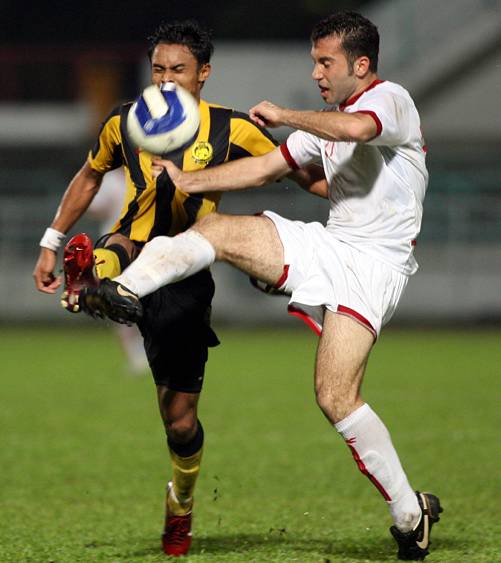
In the meantime, to make up for a dearth of Easterkind material lately, here's a bunch of links and a puzzle. What tenuous connection could there be between Godly Play and Malaysian football? Read on!

photo by Kamal Sellehuddin, of 
Malaysian footballer Mohd Aidil Zafuan (on left)
  • I've found another new(ish) blog on children's spirituality, Learning Up by Fiona. One of the posts I enjoyed most from her was a story about how a group of 8-10-year-olds gave her a completely new perspective on the story of Jesus's triumphal entry into Jerusalem. (Three cheers for Wondering!)
  • David Pritchard has recently returned from Kuala Lumpur, where he presented the lesson, "Exile and Return". (photo) He reports that the Dignity for Children Foundation (an educational charity in Kuala Lumpur) has created Godly Play -style stories and materials for use with the Muslim children at their schools. (photo)
  • Anyone working with children might also be interested to read Dignity's vision / mission statement, which includes graphic representations of the cycle of poverty. It's also moving to note that their work is not just (Montessori) education and teacher training, but also a football & netball tournament
  • And here is an account of a sermon David gave during that trip, on 2 Kings 5, with the theme "Small is Beautiful".
  • Finally, I was pleased to see that even though I'm "taking a break from Godly Play", my blog was mentioned and linked from the Godly Play UK newsletter back in August. Thank you!


10 September 2012

story images

As part of my theological training with the Church of England I was fortunate to be able to visit the Norwich Synagogue (the visit was part of our module on "World Faiths"). As beautiful and interesting as their worship space was, what really caught my eye were some pillows on benches in the lobby. The pillow covers illustrated stories from the Hebrew Scriptures (or, as we sometimes call them, the Old Testament). I had not brought a good-quality camera along, but these were so striking and beautiful that I asked a fellow student to photograph them for me so that I could share them with you.

pillow illustrating the story of Moses in the Bulrushes
photographed at the Norwich Synagogue

pillow cover: a whale with a huge, gaping mouth showing Jonah inside
photographed at the Norwich Synagogue

Visually, I judged these images as simultaneously simple enough to catch the eye and complex enough to hold a person's interest (you can just see a tiny little fish in the corner of the Jonah pillow, for example). Being myself a person who enjoys "white privilege", I was briefly startled but also very pleased to see that the figures in these images were clearly non-white. And as a Junior Church leader, I immediately rejoiced that the pillows would provide an easy point of contact and recognition for children. Young children entering the synagogue would be drawn to these beautiful yet non-breakable objects which were placed so as to be accessible to them. And yet they were not something which adults might dismiss or de-value as being "merely" for children. Wonderful.

31 August 2012

learning from a child

Recently, in preparing for a young family to visit our house, I got out my own childhood doll, Lolly, only to find that her dress was so old and worn that it was coming apart. It certainly wasn't suitable for play anymore. I mentioned this to a friend, and she suggested I pick up a package of doll clothes at Ikea.
Although they looked all right in the store, the clothes turned out to be about two sizes too big for Lolly. But with a bit of hand-stitching I took up the dress in the shoulders so that it was more or less acceptable, and put Lolly on the shelf of children's toys in our living room.

Almost as soon as our young guest found Lolly she asked me, "Don't you have any other clothes for her?" With exaggerated care, I showed her Lolly's original dress and how the fabric was disintegrating. Then I told the story of buying new clothes, finding they were too big, and hand-sewing the shoulders of the dress so that it would fit. But unlike me, this child was not daunted at all.

She took off the new striped dress, and put Lolly into the blue sweatsuit. She then carefully rolled up the sleeves and the pant-legs so that they were the right length. Then she put on the raincoat. 


Again, she carefully rolled up the sleeves. This was difficult, since there was already a large bunch of fabric there (the rolled up sweatshirt sleeves), but she persevered. She even managed to get the rain-booties onto the doll, despite the fact that the doll doesn't really have feet. By fastening the booties as tight as they would go, and then holding the doll very carefully, she was able to keep them from falling right off.


I told her how glad I was that she had shown me that the too-large clothes would work for Lolly. I really meant it! I had not even considered keeping them, but already had them ear-marked for the "donate" box in our attic. What a pleasure to be shown something unexpected.

09 August 2012

5 things to remember about Wondering

This is something I wrote as part of the Explore and Express series of Godly Play 101 posts:

Godly Play storytellers signal the end of the lesson and the opening of a time of reflection by pausing for a moment and then raising their eyes to make contact with their listeners. They say, slowly, thoughtfully, I wonder...

Each genre of Godly Play story has a slightly different set or style of Wondering Questions. I call these questions, but they aren’t phrased as questions, and that’s deliberate. Everyone is encouraged to wonder, everyone is free to share their responses, but nobody is ever pressured to answer.


Please click through to Five Things to Remember about Wondering on Sheila's blog to read the rest of my post.