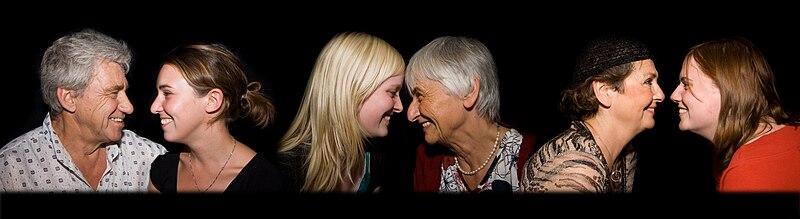
I am back home after spending a week at ministry training summer school. It was a wonderful and exhausting week. And my overwhelming sense at the end of it is that I was not only welcomed into that community, but have already come to
belong to it. That, in turn, left me with a feeling of belonging to the Anglican Church more widely, and to the Body of Christ more widely still.
What a pleasure, then, to stop on our journey home for communion at a little Anglican
church where a diverse group of people were welcomed.
 |
| St. Martin's Church, West Drayton |
There were several white-haired ladies already present when we arrived. Gradually elderly men arrived as well. Then two young women with bold platinum highlights in their hair, and a young man with tattoos on his neck and arms - a large rose spreading from his left shoulder up to his left ear, and a row of what looked to be Hebrew letters across the back of his neck. I was so struck by his tattoos that it took a while for me to notice that he was holding an infant in his arms. When I asked, at the peace, he replied that the tattoo said
father. All these people were white, but the congregation also included a middle-aged man who looked Chinese, and a young black man.
Like we have at our church, they had a re-usable leaflet containing the order of service. But unlike ours, theirs was season-specific. And, as Vandriver spotted even before I did, the cover was in the color of the season. Inside the front cover was a description of the season. I won't repeat it all, but here is a little of what it said:
We need to remember that Ordinary Time does not need to be "ordinary, or plain or dull" and it is not meant to mean that somehow we get a break from the Liturgical Year. The opposite is true: Ordinary Time celebrates the mystery of Christ in all its aspects. Many important liturgical celebrations fall during Ordinary Time, including Trinity, All Saints and Christ the King. ... As we journey through Ordinary Time may there be nothing 'ordinary' about our encounter with our Lord and Saviour.
What
I noticed was this information:
There is an area in the south side (near the font) that has been set aside for carers and toddlers to use during our services. There are book and quiet toys to keep children occupied. And so there was!
It included crayons and Bible storybooks, as well as other activities, and was within view of the altar and even the organist (depending a little on where you sat). A Sunday School for the over-3s ran from the start of the service, with children re-joining the adult congregation for the entire Liturgy of the Sacrament.
But it wasn't just the provisions for children and the presence of a visibly diverse congregation that showed off the welcoming nature of this church -
we were made welcome. We were greeted as we entered the church (by the same woman that I later saw helping an elderly man find his place in a large-print service booklet), and because we had apologized that we might have to leave early because we had a plane to catch, we were amongst the first to be ushered forward for communion!
So it was just a natural extension of the feelings that the week of summer school had left me with - a real sense of belonging to a community within a wider body. For so much of my life, I have interpreted the question
How was church? to mean firstly, "How was the sermon?" and then, "What hymns did you sing?" and "Who spoke to you?" Well, yesterday we sang several familiar, beloved hymns
and were given a competent, evangelical sermon, but what I took away with me was several images (the children's area; the hanging aumbry with a funny dove above it which looked like an angel from where I was sitting; the secluded, walled churchyard; the tattooed father holding his baby; the stained glass depiction of the crucifixion and ascension which I turned to gaze upon during the Eucharistic Prayer) and above all the sense of
belonging.