23 March 2014

storybook Sunday

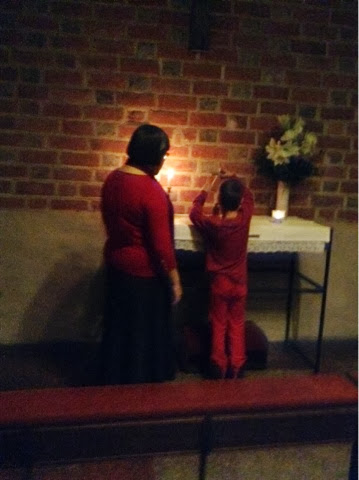
In the sermon slot today, I read a story to the congregation. Do any of you recognize the book? Or can you guess what I might have been reading today?


Tuesday will be the 25th, nine months before Christmas, which makes it Annunciation Day. The Finnish Lutherans celebrate it on the nearest Sunday. It's a six-candle day! I read the story of the Annunciation (and Mary's Visitation to Elizabeth) as told by Madeleine L'Engle in The Glorious Impossible, with illustrations by Giotto. Any fully-equipped Godly Play classroom will have at least some of the illustrations from this book among the materials for The Mystery of Christmas, and some also have a copy of the full book as well.


It was a little clumsier than I expected to try to hold the book so people could see it and read at the same time... especially to swivel back and forth so everyone had the opportunity to see! But it was fun to glance up at the congregation from time to time (something I do not do as a Godly Play storyteller) and see how people were responding. One woman leant over and rested her head on her husband's shoulder as she listened.

*     *     *     *     *

Also today, I was given another storybook by a member of our congregation who is getting ready to move house and having a clear-out. It is called The Splendour Book of Bible Stories reinterpreted by Shirley Goulden. It is interestingly similar to L'Engle's book in being an illustrated retelling of Biblical narrative. In this case, the illustrations are contemporary with the retelling (1970), and not all in the same style, being by four different artists: Nicole Claveloux, Charles-Louis LaSalle, Loup, and Jean-Claude Perrouin. Here is a part of the illustration for the Tower of Babel


What fun! Thank you! 

16 March 2014

Bible cards

A project I have underway is the creation of a set of cards for the books of the Bible. I am making this for one of our godsons, since he is at an age where he is very interested in collecting cards with bits of information on them - cards for the Magic game, for example (or baseball cards, to use an example I find easier to relate to!). 

I plan to use a second set as part of the materials for the Godly Play enrichment lesson about the Books of the Bible. I used the Keynote software (similar to Powerpoint) to design them, then printed and laminated them. The face of each card shows two pictures representing stories from the book (using the wonderful resource of Bible illustrations from Sweet Publishing), and the Gospels also show the symbols associated with each evangelist (with Luke's symbol repeated on the Acts card). Each card also has a quote from the book, a single phrase which sums up something distinctive or important about the contents.


Today I delivered the first batch - just six: four Gospel cards, one for the book of Acts, and one Old Testament book. All six are green, for narrative history. I tried to make the Gospel cards a different shade of green but that didn't show up as well as I'd hoped.

We looked together at the tables of contents of two complete Bibles (of very different sizes and layouts), and one which contained only the New Testament and Psalms. One Bible listed the books twice, once by the order in which they appear in the Bible and once in alphabetical order. My godson then went off by himself. He laid the cards out and organised them by their numbers (the order of the books of the Bible). Then he attempted to re-order them into alphabetical order. Later, using information on the backs of the cards, he might try ordering them by date of [estimated] composition, or the relative chronology of the events they describe (his parents will probably have to explain BC dating again!). 
What I also wanted to do, though, was to tie these cards firmly to the Bible and its contents. So I showed him that in his Jesus Storybook Bible there is a note at the beginning of each story saying which book (and chapter(s)) the story is taken from. And then, without him looking, I slid the cards into a Bible so that each card marked the place its book began. When he searched for them it reinforced the fact that the Gospels are found all together, three quarters of the way through the volume, while the Old Testament histories are much further toward the front. 

I'm providing several extra bits of information on the backs (which is why I've only finished six so far). But the description of the Godly Play cards by Jerome W. Berryman (in vol 2 of The Complete Guide to Godly Play) is that there's relatively little information on each card - just "one or two sentences about the content of each book", and a color-coding to show which genre the book belongs to. So if you set out to make your own, they needn't be as elaborate or time-consuming as mine. 

03 March 2014

lessons learned (Lent)

Yesterday it struck me that the pastor and I hadn't discussed which of us might provide a children's sermon, if needed, for our service that afternoon. Inspired by Sheila's good reports of The Mystery of Easter, I rushed a cross puzzle into production.

Before I began, I read the script (from The Complete Guide to Godly Play, Vol. 4) onto a recording which I then listened to as I worked. Once I'd finished, I listened once or twice more while I physically acted out the lesson, moving the pieces around, and finally tried it without the recording, speaking the script myself. Way back in training we tried that, having one person read the script while another moved the pieces, but I'd never tried using a recording of myself for practice before!

The materials were far from ideal. I cut a cross out of cardboard packing material from our recycling pile. Having no paint to hand, I used magazine clippings of purple on one side, and white felt on the other.


Lessons learned? I liked this method of practicing the script. But I would not use felt as a covering for this cross again. You can see the white puffing out from underneath even when the purple sides are turned up. Moreover, it prevented the pieces from slotting together as nicely as I'd have liked them to.

In the end, we had no children at church and I didn't present the lesson. But you know what? For one-time use, in a pinch, I was much happier to have far-less-than-perfect materials than not to have had any at all. I enjoyed this little project as a Sunday task, and I felt good having something to offer children if any had come along.

I've heard it said, "Perfect" is the enemy of "Done". Godly Play materials should always be made with love, as beautifully as you can. Really, they should be as good in quality as the objects you use for liturgical purposes for adults (as nice as your chalice or communion trays, as nice as the Bible on your lectern). But don't let that ideal prevent you from doing the best you can.

09 February 2014

an update, at long last

Thank you, Nicky, for your kind comment asking after me. I'm sorry to have neglected the blog. It's not for lack of photos!

The boy who used to attend our sessions sometimes as a sort of gentle giant (a good-natured 13-year-old among 4-year-olds because our congregation had nothing to offer teens) is now a young man of 16, and agreed to photograph my lesson about the Magi (complete with burning frankincense and myrrh). He took about 100 photos, or more! So I was a bit overwhelmed with trying to choose a mere three or so to put on the blog.

And when I forgot my i-pad at Candlemas, a mother snapped some photos with her camera phone and sent them to me afterwards:


Meanwhile, I have accepted a post as curate (assistant minister, on-the-job training) for next year. It will mean moving to England, which Vandriver and I are very excited about but also a bit overwhelmed by how much there is to do between now and then. 

But today I am about to drive to Helsinki, because tomorrow and Tuesday there is a Godly Play symposium in Finland in the town of Järvenpää, with special guest Carolyn Pritchard. Sounds like I could well be inspired to write another couple of blog posts this week already, eh?

29 December 2013

A crib service

[please bear with me as I come to grips with a new photo editor!] 


Today our congregation held a Christmas carol service. It was broadly inspired by the traditional Anglican service of lessons and carols, but having had an Advent lessons and carols service already earlier in December, Vandriver designed this one around the Christmas story itself. And I, thinking of Berryman's "Children's Liturgy for Christmas Eve" (and of English "crib" services), asked for a table at the back of the chapel to be set up with a purple underlay on it.


Earlier in the week, and again before the service, I explained to children my plan to carry Holy Family figures from "the Advent table" to the altar during our congregational carols. I said they'd be welcome to help me if they wanted.

At first nobody wanted to help. This was something entirely new to them, so I was prepared for the possibility that they might find the idea overwhelming. During our opening hymn I myself brought a sheep and the cow / ox to the altar. 


But during the second carol, after the reading of the Annunciation to Joseph, I was joined, not for the procession down the aisle but at the altar, by the oldest child present (aged 7). Together we placed Mary and Joseph on the altar.


After the reading of Mary's visit to Elizabeth I carried the donkey to the altar, and after the reading of the birth of Jesus, the same child and I brought forward the manger and infant Christ. Next I brought the second sheep and the shepherd. After the reading about the presentation of Jesus in the temple, "seethroughfaith" and I carried the Baptismal dove (in this case representing one of two doves presented as a sacrifice) and a candle (a light to lighten the Gentiles) up to the altar. 

Then it was time for the Christmas Gospel - John 1:1-14. Following this, the child was ready to carry up the figure of the Risen Christ, unbound by time or space. 


We did not have a reading about the magi, since they will arrive "late" (as Berryman has it), which is to say next week. But still, during the closing music, the child and I fetched the magi figures, the last standing on the Advent table. As we walked forward I offered one to another child, who had up until now gently declined any offers to participate. 


This time, it was accepted. 


On the other hand, the child below (aged only 4) continued to decline to join in. Which was also fine! We happened to leave church together so I was able to give this child a little hug and say, I don't really mind whether you carry things up to the front with us or not. The important thing to me is that you were here! 


After all, as I said to the child's mother as we walked along, we don't force all adult congregants to read Scripture or lead intercessions. Why should children be required to take public roles in the service? 

And as we approached the crosswalk, that child (the 4-year-old) took my hand.


25 December 2013

Christmas greetings, wherever and however you are

In my last post I left out one Wondering question. Yes, I did ask all four. And the third was the only one that got answered. (Often it can be the other way around!) 

I wonder which part of the Advent lesson we could leave out, and still have all the story we need?

One of the adults suggested we could leave out the journey to Bethlehem. I nodded and asked whether Mary and Joseph had really had to go to Bethlehem. This gave one child the opportunity to raise their hand very high, volunteering an answer, which was, Yes because they had to write their names in the book. Ok, there was a census. But mightn't it have been even better if there hadn't been any census?

pointing (like the prophet's hand) to the space for "the journey to Bethlehem"
One the adults now pointed out that although Mary might not have been very happy about travelling so close to her due date, perhaps Joseph did want to go. A fair point, I suggested. It was his ancestral homeland. There are people in this congregation who would like to be celebrating Christmas in their ancestral homelands. 

Given that one of the families present had just cancelled a trip "home" due to illness, this was pretty close to the bone. One child (from a different family) matter-of-factly explained that their non-Finnish parent had a trip planned, although it was still some months away. 

It felt good to me to get some of that acknowledged. 

So some of us are travelling and wish we weren't, while others are not travelling and wish we were. Some are glad to be at home and some are glad to be far away. Some are lonely, some are seeking a moment's peace. Some are at work, some are at war. 

Our faith is that Jesus is with us in all our circumstances: Emmanuel. 

May you be aware of his presence this Christmas.