22 December 2013

Fourth Advent

After three weeks of Advent observed in three different countries, today I was back in Finland. As I did on Second Advent, I presented the Godly Play lesson to the whole congregation. I encouraged adults to move further forward for this, and on the floor in front of me I had a familiar group of four children. 

It's a long post today. It's a long lesson! Berryman says, "Do not minimize or rush the story," but realistically speaking it is often going to be the case that one has to shorten it a little, especially the parts you've told before. This can be done, however, without rushing and without trivializing them. 

So I reviewed the season of Advent, with its purple color (seen on our altar / focal shelf but not on our pulpit fall, which is always black), and the need to get ready to enter or come close to a Mystery. I reviewed the prophets, who we remember on First Advent, and the Holy Family on the Road to Bethlehem from Second Advent. Then I told the story of the shepherds watching over their flocks by night, who were blinded by a dazzling light. 

This is a modern-day photograph of a medieval chapel. A woman is seated on cross-legged on the floor, in front of the altar rail, facing away from the altar (towards the camera). She is wearing a white shirt, a purple skirt, and grey tights. She is white and has brown hair. There is a long narrow purple cloth on the floor in front of her, Among the objects laid on this cloth are some wooden figures from a Nativity Set (others are on a tray to her left). The woman has covered her eyes with her arms, as if to shield them from a bright light. Also in the photo are: a boy on the floor facing the Storyteller. He is wearing a Christmassy red stocking cap. We can just see the back of the head of a girl wearing a ribbon in her hair (facing the Storyteller) and the very edge of the face of a boy on the right also facing the Storyteller. In the left of the picture we also see, on the floor, a roll of paper towels, several baskets, and at least one piece of paper and some crayons.


Once again, I am grateful to a mother who took an amazing number of photos with my ipad during the telling. And now, I notice how much detritus there is about us in the photo. The children were "playing and praying" both before and after this lesson. In fact, some found it very difficult to tear themselves away from what they were working on when I asked them to come listen. 

The Storyteller is holding up a plaque with her arms outstretched. From the angle we are looking the plaque blocks our view of her face. The plaque has a purple background, and shows an Advent wreath on the left and three gold crowns on the right. If you were to look closely you might see that all four colored candles of the Advent wreath have little flames above them, because this is the plaque for Fourth Advent.


Looking through the pictures, though, it was striking how much of the time all of the children were really intent upon the story. One child lay down, but was watching and listening.

At the top of the picture we see the Storyteller, seated cross-legged on the floor with the Godly Play "Advent lesson" spread out before her. In the foreground we see two children, from the back, facing her. They too are seated on the floor, on mats, watching her. Just visible on the left is the head of a child who is lying curled up on a mat, but with his face toward the Storyteller.


Did you notice in the first photos that the candles were already lit? That was one of the first things that happened in the service today. Not only that, but the candles were introduced according to the readings in the Revised Common Lectionary, which is a very different system from the one that Godly Play follows. The Godly Play ordering was used in American Protestant liturgical churches for decades, long before they adopted the RCL. (The RCL's system surely has long roots elsewhere.)

I was not too bothered either by the fact that the candles were introduced with different symbolism or that they were already lit. I just mentioned once or twice, without making a very big deal about it, that there are different systems in use. And after telling the stories and placing the figures onto my underlay, I lifted down the candles one by one, and placed them by the figures. 

We see a small portion of a medieval chapel still in modern use. We see part of the altar, laid with a purple cloth, two candles and a Godly Play Risen Christ figure. In front of the altar rail is a woman holding a short pink pillar candle, which is lit. To her left and behind her is a tiny table covered in a white linen and lace tablecloth, on which one lit purple pillar candle remains.


Today I used the Sacred Story questions for Wondering. I wonder which part of the Advent story you like best. You can say out loud if you want, but you don't have to. Nobody has to answer. Nobody did answer. 

I wonder what part of the Advent story you think is the most important. Thoughtful looks, but no words. 

In the foreground, large, we see the back of a girl's head. She is looking toward the front of a chapel, in which a Storyteller is kneeling in front of the altar rail, facing the congregation. Before her are spread the Godly Play Advent materials - a long strip of purple cloth, with four plaques on it (exactly matching the purple of the cloth), various figures from a wooden nativity set, and four lit candles behind it. Also visible are a wooden cross on the wall, most of the altar (with two candles on the end of it that we can see), a small table to the Storyteller's left, covered in a lace and linen cloth, and beside that, on the floor, a poinsettia plant.


I wonder where you are in the Advent story. Or where you are in terms of getting ready for the Mystery of Christmas. Are you ready for Christmas? Maybe you feel like the wise men - like you'll probably be late! Maybe you feel like you're shivering in the cold night air, trying to stay awake to keep the sheep safe... or maybe you can hear the song of the angels. 

I'm afraid I got rather long-winded. A budding preacher, that's what I am! 

Sometimes there are women who feel a lot like Mary during Advent, because they too are expecting a baby! You might feel like the prophets, that you know what is important but you fear that people aren't listening, and that it's going to take years and years and years before what's supposed to happen does happen. I wonder where you are on the road to Bethlehem.

This photo has been cropped, so it is short and long, showing just the Godly Play Advent materials - - a long strip of purple cloth, with four plaques on it (exactly matching the purple of the cloth), various figures from a wooden nativity set, and four lit candles behind it.


And then once again I asked the children to snuff out the candles change the light. I liked doing it this way, although it occurs to me that it might be a bad precedent to do it this way too often. I might not be able to go back to doing it myself. [I also realized, and said, that the service leader would probably want to re-light them for the rest of the service, once we'd gone back to "playing and praying".]

This is a rather jumbled picture - there are several baskets visible on the left, as well as a spray bottle of cleaner and a crumpled paper towel, and some papers and crayons. The focus of the picture, however, is of the Storyteller in the back right of the photo, kneeling, and holding the edges of a candle holder, and a young girl in the center of the photo who is down on one knee and leaning forward to snuff out the candle with a small snuffer.


And then I began to put things away. Even without taking the Holy Family back up to the altar (in case a child wanted to work with it), there was a lot to put away. It took time. 

But look. Although one child has (understandably) turned away, at least two children watched intently right through to the very end. 

This picture is similar to many we have already seen - the chapel with the Storyteller kneeling in front of the altar rail, facing the congregation (but looking down). To her left is a tray with wooden figures on it. With her right hand she is placing a rolled-up purple cloth into a square basket. All that remains in front of her are four candles, three purple and one pink. In the foreground we glimpse three children. On the right is a boy looking straight at the Storyteller. In the middle is a girl, also looking at the Storyteller (all we can see is the back of her head and a bow in her hair). To the left we can just glimpse the right side of a child who is crouching and facing something out of our view.


15 December 2013

Third Advent

(I'm posting this from Stockholm Arlanda airport, and having a little trouble with editing. One photo is missing and the font keeps changing. I probably won't manage to fix those things before Tuesday!)

Today I was in Madrid, on my way back from a conference in Andalucia to Finland. Vandriver found me a hotel right around the corner from St George's Anglican Church. Although I had not found time to let anyone know I'd be coming, I recognized a fellow ordinand and he asked on my behalf if I could sit in and observe the Godly Play circle. While he was off asking, I watched a liitle boy supervise the priest's preparations for the service.


The GP team graciously allowed me to join them, even though it was an awkward Sunday. Understandably but disappointingly, their usual Godly Play room had been taken over with preparations for the Christmas Bazaar. Fortunately, they have a second, much smaller room, which they tend to use for older children. It contains a second Holy Family, and materials for enrichment lessons. So we crowded into there. We were at least 15, three adults and a dozen children. [Godly Play strongly advise against having more than two adults in the room, so I tried to minimize the adult-ness of my presence by sitting on the floor (even though I was offered a low chair), and keeping quiet.]

Their Storyteller presented the Holy Family, and then the children worked on a couple of crafts. It was simply too difficult to manage a feast, but they closed by singing and signing "Go now in peace".


Imagine a photo of a crowded room here.
(I admit I did stand up for that second picture, but by then everyone was absorbed in their work.)

There were some potentially frustrating moments. (We all have those!) The story got interrupted several times, and it was hard to maintain an atmosphere of listening with wonder. When Storyteller invited all the children to help put the figures back where they belonged, even though she did this in an orderly fashion, working around the circle, one by one, these figures got knocked over when three boys at once tried to help put Mary away. 


There were also some sweet moments. When the Storyteller introduced Mary, the mother, one child clapped quietly. 

There's a line in the script about many nativity sets being too fragile for children to be allowed to play with, but reassuring children that this one is for their use. The Storyteller said that line towards the end of her telling, shortly before the Wondering. Almost right away, a child asked to hold the Risen Christ figure. 


Thank you very much, St George's!


09 December 2013

Second Advent


We had a Service of the Word yesterday (no Holy Communion), and the whole congregation got a "sermon" suitable for children. I laid the altar to look similar to a focal shelf. (The underlay is in fact a chalice veil!)


And I told the first two sections of the Godly Play Advent lesson. I encouraged everyone to move closer to the front for this, and almost everyone did. Only one adult chose to sit on the floor, though. 


All our (Finnish Lutheran) lectionary readings had themes of Waiting &/or Getting Ready, so we wanted this lesson to lead into a meditative time of singing the Taizé chant, "Wait for the Lord". For that reason, I swapped the order of the script a little, talking about the need to get ready for the Mystery of Christmas after I had presented the two plaques. 


It took three tries to "change the light" of the second candle. This child found it hard to WAIT long enough for the flame to die beneath the snuffer. 

(Many thanks to his mother, for taking most of these photographs!)

I've added some old Christmas cards to the art supplies we have on hand. (Several of them were donated to our cause by congregants last winter!) 


01 December 2013

Happy New [liturgical] Year!


We visited my parents' church today. They had purple and pink Advent candles in the Sunday School / Fellowship group session, and red ones in the worship service. The "baby boomers" in the Sunday School group debated whether to light the candles in a circular pattern (which is what I had assumed was the only way), or in the shape of a cross. As you can see (because the pink candle will be third), the cross pattern was the one chosen.


As a Finnish resident, I was pleased that we happened to sing a Hosanna song. The song, "Hoosianna", is mandatory and loved for First Advent all across Finland. 

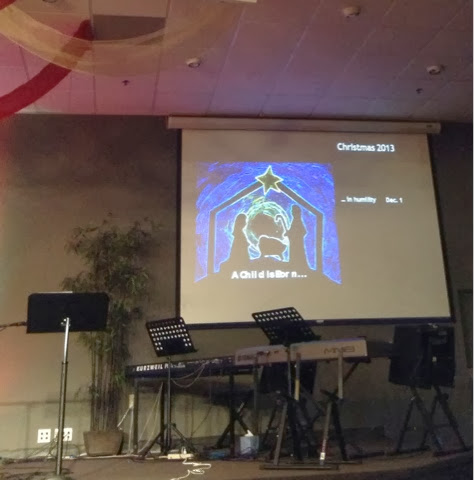
One of our PowerPoint slides reminded me of one of Sheila's art projects


and we even had a geography lesson!


17 November 2013

Another geography picture (CGS)

One of my new friends from the Catechesis training course wrote to say, "You haven't blogged much recently." No, it's been a busy and chaotic couple of months, and I can't say I see much calm on the horizon either. But as a super-brief follow-up to my last post on geography, here's something that was hanging on the wall in the Leiden atrium.

I think it's meant mostly to reinforce, silently, the geography lessons. It could also be a way for children to check their work as they learn the locations of Nazareth (indicated by symbols of the Holy Spirit, the flame and dove), Jerusalem (cross), and Bethlehem (star).

A simple A4-sized map of Israel, laminated, and tacked to the wall with a drawing pin. It shows four regions, labeled in Dutch, each of which has been colored a different color with crayon (Galilea, Samaria, Judea, Perea). Three cities are shown, each with a small dot and a single letter (N, J, S) and then a symbol glued onto the map near each (a dove on a glittering flame-shape, a silver cross, and a red star).

02 November 2013

geography

Both Godly Play and Catechesis of the Good Shepherd take geography seriously.

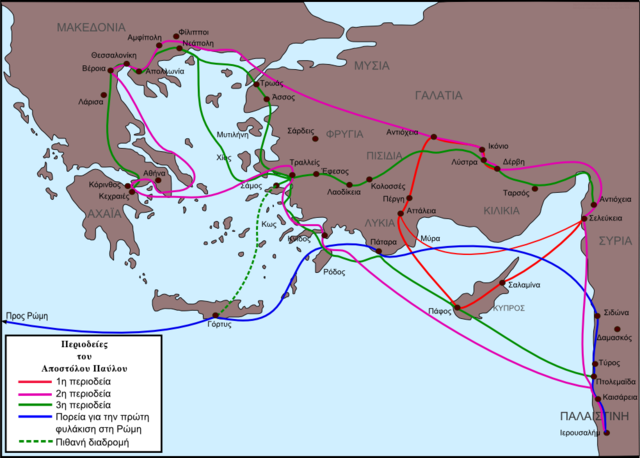
a map of the Northwest Mediterranean, showing St. Paul's missionary journeys as complicated lines, labelled in Greek
map by Geraki

I don't remember any Biblical geography in my childhood, except maps at the back of Bibles. The ones in my Bible weren't in Greek, like the one pictured above, but they might as well have been. I looked at them sometimes if I got bored during church. I guess I thought that one day I would "learn" them, whatever that might mean. Maybe really mature Christians memorize the routes of Paul's missionary journeys?

Godly Play teaches storytellers to tell the story of Abraham's journey from Ur to the oaks of Mamre with relative geographical accuracy, and the same for the story of the Babylonian captivity. It's not made into a big deal. Children aren't asked to "learn" it; they're simply shown. The storyteller lays blue ribbons onto the sand - Here is the Tigris river, here is the Euphrates. The message is, This is what I need to get ready in order to tell this story.
a small and simple map showing the Tigris and Euphrates rivers and some unlabelled national boundaries
public domain map by Kostisl
(The storyteller does this all "upside-down" so that North is at the top for children sitting opposite.) The rivers serve as points of orientation, I suppose, and when the child later sees a map like this they can think, Oh yes, I'm familiar with that place. 

In Catechesis of the Good Shepherd, the materials for 3-year-olds include a small globe. It is simple, showing only land and water. Ideally, the land is slightly textured, encouraging the child to run their fingers across it. The only marking is a small dot, showing where the land of Israel is. The catechist explains that when Jesus was born, he came to a very tiny place. That idea is left to grow in the child's mind, the beginning of a recurring theme of paradox -

Humility / Immensity (All things were made by him).

Later, perhaps some weeks or months later, the child is introduced to a topographical map of that land of Israel.

a map of Israel, showing water in blue, low-lying land in green, mountains in brown, and land in between in yellow.
licensed map image
The map is 3D. Most of the land is built up higher than the sea but the shores of the Dead Sea are below sea level. The child is encouraged to spend time feeling the mountains and valleys, the river and the sea. This is the land where Jesus was born, and where he grew up, where he died and then came to life again. Later still, the child will be shown where the cities of Bethlehem, Nazareth, and Jerusalem are. It's all a very hands-on experience, putting across the message that Jesus came into human history in a concrete place.