 |
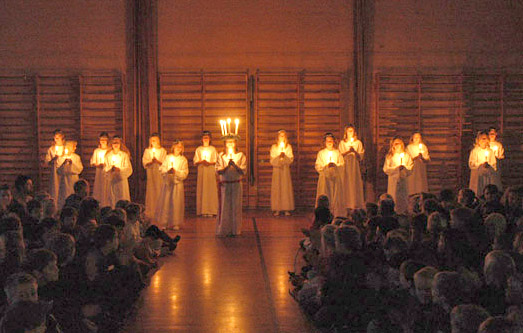
| public domain photo by Niels Henningsen (Helsingør, 2001) |
13 December 2012
Lucia greetings
Wishing my Nordic friends well on St Lucia Day!

02 December 2012
gifts for godchildren
I'm so pleased with some gifts that I delivered last weekend that I'm very tempted to write a self-congratulatory post. I'm going to try to turn it into an informative post for others, though. My apologies if I fail and just sound prideful.
We have two godsons. One is a young adult; the other is six years old. We're far away from them this year, but were visiting last weekend, and so I wanted to give them gifts - partly just to show our love but partly to foster their spiritual growth. So I went shopping for Advent gifts.
We have two godsons. One is a young adult; the other is six years old. We're far away from them this year, but were visiting last weekend, and so I wanted to give them gifts - partly just to show our love but partly to foster their spiritual growth. So I went shopping for Advent gifts.

For our young adult godson, we bought a collection of Advent reflections, one for each day of the season (plus Christmas Day and Boxing Day): Inside the Christmas Story, by Bash & Bash. It's written by a priest who once served the parish of a relative of ours, with his wife, which gave it a little extra personal connection.
Sheila, at Explore and Express, has written a post about children's spiritual styles, and I agree that it's important not to assume that the same things will touch the same children. It's almost trite, isn't it, to comment on how different siblings can be. Our young godson and his younger sister are a case in point. He is deliberate, even cautious. He likes to know things, and to get things right. His sister is impulsive; she has no patience for long explanations. She's very extroverted - friendly and open.
For our six-year-old godson, I bought the Advent magnets shown above. The big magnets on the top half of the sheet separate out into six - the wreath and candles, plus five separate flame magnets. Each "flame" can be placed over a candle on each Sunday of Advent (and Christmas Day). Below this are five "cards", with a suggested short Bible reading and prayer to go with the lighting of each candle. Besides encouraging his word-based expression of faith it also helps him practice his new reading skills, with the themes for each candle written in such large letters.
We don't usually buy presents for this boy's little sister, but in the shop I spotted a holding cross (similar to the one pictured here) which was especially proportioned for a young child's hand. Do you remember the Lego stick that we pretended was a prayer cross? That was made by this little girl! So I thought of her as soon as I saw this cross, and really wanted to get it for her. Her first words upon opening it were, I remember we used to have a cross like this in Junior Church.
I knew you would remember! I replied, and that's why I wanted to get this for you. Her second comment had to do with how small it was. I explained that it was designed for a child's hand but she corrected me: This was designed for a BABY's hand! Still, she was pleased with it. Being an extrovert, she thanked me for it (or told me how much she liked it) about four different times. Finally she said, When we have Junior Church again, I'm going to bring this, and we can pass it around the circle at prayer time.
I'm not sure our godson explicitly thanked us for his gift, except when prompted by his mother. But he immediately opened up the package and found a place to display the magnets, and later carefully asked me to help him read all the different themes. I took the opportunity for a quick chat with him about the fact that these themes don't match up exactly with the Godly Play themes for the Sundays, and encouraged him to ponder ways in which they do match up and ways in which they don't. We both laughed at the suggestion that Mary and Joseph's entry into Bethlehem might have been peaceful - probably not! Towards the end of our visit he caught my eye and slyly demonstrated how a flame would look atop a candle. As soon as we'd both seen it he snatched it away again, as if to stress how well he understood that it was not yet time to light that candle! So even though he didn't gush over the present the way his sister did, I know he appreciated it and will use it in his observance of Advent.
 |
| image source |
For our six-year-old godson, I bought the Advent magnets shown above. The big magnets on the top half of the sheet separate out into six - the wreath and candles, plus five separate flame magnets. Each "flame" can be placed over a candle on each Sunday of Advent (and Christmas Day). Below this are five "cards", with a suggested short Bible reading and prayer to go with the lighting of each candle. Besides encouraging his word-based expression of faith it also helps him practice his new reading skills, with the themes for each candle written in such large letters.
 |
| image source |
I knew you would remember! I replied, and that's why I wanted to get this for you. Her second comment had to do with how small it was. I explained that it was designed for a child's hand but she corrected me: This was designed for a BABY's hand! Still, she was pleased with it. Being an extrovert, she thanked me for it (or told me how much she liked it) about four different times. Finally she said, When we have Junior Church again, I'm going to bring this, and we can pass it around the circle at prayer time.
I'm not sure our godson explicitly thanked us for his gift, except when prompted by his mother. But he immediately opened up the package and found a place to display the magnets, and later carefully asked me to help him read all the different themes. I took the opportunity for a quick chat with him about the fact that these themes don't match up exactly with the Godly Play themes for the Sundays, and encouraged him to ponder ways in which they do match up and ways in which they don't. We both laughed at the suggestion that Mary and Joseph's entry into Bethlehem might have been peaceful - probably not! Towards the end of our visit he caught my eye and slyly demonstrated how a flame would look atop a candle. As soon as we'd both seen it he snatched it away again, as if to stress how well he understood that it was not yet time to light that candle! So even though he didn't gush over the present the way his sister did, I know he appreciated it and will use it in his observance of Advent.
What about your own observances of Advent? What are you doing? And if you have children, what are you doing with them? I love the Busted Halo's suggestion that our preparations for Advent can be like preparing for a special guest. It's not that everything has to be perfect or that we need to pretend to be somebody we're not. If you're an extrovert - go ahead and gush! If you're a word-based spiritual type, do a special Bible study for the season. It's not too late to start.
22 November 2012
experience it for yourself
Here's an invitation I came across recently:
 Whatever your preconceptions about Godly Play, may I invite you to seek out a taster course and experience it for yourself? If you've had one bad experience with Godly Play, might I beg you to give it a second chance? It's not the only curriculum out there and it's not the only approach that works. But there's a quiet beauty in the way it allows you to "play" in the presence of (and even with) God. I'd love for you to experience that.
This week we will be experiencing something called Godly Play. I can't really explain it to you, other than it involves a parable. The only way you'll know what I mean is if you come and experience it for yourself.
[source]
Some friends and I offered a Godly Play session as evening worship during our summer school last August. I was amazed at how many students came up to us afterwards saying things like,
I liked it so much more than I thought I would.
or I hadn't expected it to be like that.
or Now I understand!
I liked it so much more than I thought I would.
or I hadn't expected it to be like that.
or Now I understand!
So many people "know" that they don't like trendy worship and so "know" that they won't like Godly Play.* Or they "know" that it's only for children,* and only for Episcopalians.* Maybe they "know" that Godly Play is about making children sit down and shut up.* Or that discipline is "outsourced" to the door person.* Or that Godly Play storytellers don't make eye contact with children: Preposterous!*
 Whatever your preconceptions about Godly Play, may I invite you to seek out a taster course and experience it for yourself? If you've had one bad experience with Godly Play, might I beg you to give it a second chance? It's not the only curriculum out there and it's not the only approach that works. But there's a quiet beauty in the way it allows you to "play" in the presence of (and even with) God. I'd love for you to experience that.
One man from summer school said, If you'd told me I would happily sit during worship and play with modelling wax... I'd have said you were mad.
*endnotes:
- Most adults experience Godly Play as gently thought-provoking. Nobody is ever asked to do anything they don't want to do, not even answer questions.
- Godly Play has been used with people of many ages. The invitation quoted above was for teenagers.
- Godly Play is used within many Christian denominations and by people outside traditional denominations as well. It is Biblical and liturgical. Storytellers are encouraged to adapt the liturgical lessons to fit the practices of their own churches (for example, when and how people are baptised).
- In Godly Play, children are given a lot of freedom of choice... within clear constraints and boundaries. GP follows some of the educational principles of Maria Montessori, as well as Sofia Cavalletti's use of these principles in the spiritual education of children.
- There is a division of labour in Godly Play, but it's about achieving the smoothest possible supervision of the classroom. The storyteller and door person work together as a team.
- Here's a post I wrote about eye contact.
16 November 2012
visualizing the Circle of the Church Year
For a while I was changing the image at the bottom of my blog screen according to the liturgical seasons, inspired by Emily at Watkins Every Flavor Beans. This year I found it easier just to stick with one image of a circular calendar by My Faith My Life. So I appreciate that Browniesmoke (at What Can We Leave Out) has linked to the new coming year's calendar, now available at My Faith My Life. (Lo hay también en español.)
I echo Browniesmoke's advice that even if some in your family (such as children doing Godly Play or Catechesis of the Good Shepherd) already understand liturgical colors, this calendar can help others (such as grown-ups) grasp it. It's also interesting for older children in that it is more detailed than some GP classroom presentations will be, since it has a square for every day, not just for every week.
Bear in mind if you're outside the United States that it's been created for the Episcopal Church so may not entirely match your own church's practices.
Thanks, Jenifer, for sharing this resource!
 |
| © 2012 Jenifer Gamber. Permisson granted to reproduce for church use. |
Bear in mind if you're outside the United States that it's been created for the Episcopal Church so may not entirely match your own church's practices.
Thanks, Jenifer, for sharing this resource!
14 November 2012
an overdue hello
Our little congregation in Finland isn't doing Godly Play this year, because I'm too busy with my theological studies and even more because I'm not even there right now. My husband and I are spending a year in England. Although I told myself this might mean I could write up a bunch of half-baked ideas which had never matured into proper posts, so far I haven't posted anything on this blog since summer school! Not having the input and prompting of weekly (or near weekly) sessions has meant it was easy to ignore the blog.
But Sheila's recent post on her children's first visit to a Godly Play classroom provoked me to dust off my Blogger password and add an appreciative comment. And so I thought I ought to post here as well and explain why posts here have dried up. As I have said, I do hope to carry on... but it's unlikely to be at all frequent for a while yet.
In the meantime, to make up for a dearth of Easterkind material lately, here's a bunch of links and a puzzle. What tenuous connection could there be between Godly Play and Malaysian football? Read on!
But Sheila's recent post on her children's first visit to a Godly Play classroom provoked me to dust off my Blogger password and add an appreciative comment. And so I thought I ought to post here as well and explain why posts here have dried up. As I have said, I do hope to carry on... but it's unlikely to be at all frequent for a while yet.
In the meantime, to make up for a dearth of Easterkind material lately, here's a bunch of links and a puzzle. What tenuous connection could there be between Godly Play and Malaysian football? Read on!
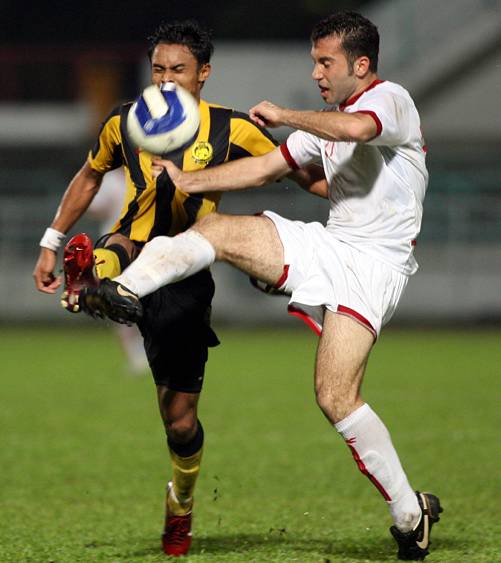 |
| photo by Kamal Sellehuddin, of
Malaysian footballer Mohd Aidil Zafuan (on left)
|
- I've found another new(ish) blog on children's spirituality, Learning Up by Fiona. One of the posts I enjoyed most from her was a story about how a group of 8-10-year-olds gave her a completely new perspective on the story of Jesus's triumphal entry into Jerusalem. (Three cheers for Wondering!)
- David Pritchard has recently returned from Kuala Lumpur, where he presented the lesson, "Exile and Return". (photo) He reports that the Dignity for Children Foundation (an educational charity in Kuala Lumpur) has created Godly Play -style stories and materials for use with the Muslim children at their schools. (photo)
- Anyone working with children might also be interested to read Dignity's vision / mission statement, which includes graphic representations of the cycle of poverty. It's also moving to note that their work is not just (Montessori) education and teacher training, but also a football & netball tournament.
- And here is an account of a sermon David gave during that trip, on 2 Kings 5, with the theme "Small is Beautiful".
- Finally, I was pleased to see that even though I'm "taking a break from Godly Play", my blog was mentioned and linked from the Godly Play UK newsletter back in August. Thank you!
10 September 2012
story images
As part of my theological training with the Church of England I was fortunate to be able to visit the Norwich Synagogue (the visit was part of our module on "World Faiths"). As beautiful and interesting as their worship space was, what really caught my eye were some pillows on benches in the lobby. The pillow covers illustrated stories from the Hebrew Scriptures (or, as we sometimes call them, the Old Testament). I had not brought a good-quality camera along, but these were so striking and beautiful that I asked a fellow student to photograph them for me so that I could share them with you.
Visually, I judged these images as simultaneously simple enough to catch the eye and complex enough to hold a person's interest (you can just see a tiny little fish in the corner of the Jonah pillow, for example). Being myself a person who enjoys "white privilege", I was briefly startled but also very pleased to see that the figures in these images were clearly non-white. And as a Junior Church leader, I immediately rejoiced that the pillows would provide an easy point of contact and recognition for children. Young children entering the synagogue would be drawn to these beautiful yet non-breakable objects which were placed so as to be accessible to them. And yet they were not something which adults might dismiss or de-value as being "merely" for children. Wonderful.
 |
| photographed at the Norwich Synagogue |
 |
| photographed at the Norwich Synagogue |
Visually, I judged these images as simultaneously simple enough to catch the eye and complex enough to hold a person's interest (you can just see a tiny little fish in the corner of the Jonah pillow, for example). Being myself a person who enjoys "white privilege", I was briefly startled but also very pleased to see that the figures in these images were clearly non-white. And as a Junior Church leader, I immediately rejoiced that the pillows would provide an easy point of contact and recognition for children. Young children entering the synagogue would be drawn to these beautiful yet non-breakable objects which were placed so as to be accessible to them. And yet they were not something which adults might dismiss or de-value as being "merely" for children. Wonderful.
Subscribe to:
Posts (Atom)