11 September 2011

off-topic: 9/11

US Navy photo (public domain)
Today our grown-up congregation is observing "Awareness Sunday", a joint initiative of many churches in the English-speaking countries, to remember the victims of violence, the conflicts that underlie it, and to pray for peace and reconciliation.

And so today I'd like to recommend Gordon MacDonald's "Reflections from Ground Zero", a 5-day diary written while he was working as a chaplain at Ground Zero, a week after the terror attacks (September 18-22, 2001). I first read them as forwarded e-mails soon after they were written. They are thoughtful musings on the work of a chaplain, the task of ministering in crisis situations. (If you're not up for reading the whole thing - it's pretty long! - you can find an abridged version here.)
However, I was distressed to see that even the "complete" version has been edited. The following paragraphs have been left out entirely (compare what you find at the bottom of this page to the "Day One" version linked above):
The Salvation Army is the only group that introduces you as a couple. It's never "we're glad to have Gordon MacDonald with us this morning...and Gordon is pastor...., etc." They always say, "We're glad to have Gordon and Gail MacDonald with us; they are pastors of..." The Army, from the very beginning, has respected the notion of women in ministry and leadership and the genius of couples working together as teams on a partnership basis.
So, literally within minutes, I decided that this was not a moment for me to preach but that Gail should join me in dialoguing the thoughts on Elijah's wilderness experience that I'd prepared. I whispered to her that I would "preach" the sermon to her and she should respond with ideas, insights and questions of her own. The result was a presentation that was twice what I could have done alone. She was just terrific. And to think that this was a woman who, twenty-five years ago, would have been terrified of getting up to do a spontaneous talk.
We started by reminding people of the familiar instruction given by flight attendants:"If you have a child with you, put your airbag on first and then do what has to be done to the child." That seemed a useful way to remind these dear folks of the importance of tending after the soul and the body as they help others.
It's particularly distressing to me as a woman training for ministry to find that these words about women in ministry and leadership had been omitted. I haven't yet re-read through the whole journal, so I don't know what else is missing, but I remember how impressed I was, upon my first reading in 2001, by the candor of MacDonald's musings on the strengths and weaknesses of different church traditions - comparing, for example, his own ministry with that of a Roman Catholic nearby. As well, of course, as his observations about the Salvation Army, who were his hosts and indeed his passport into this zone.

Let me close not with distress over omissions, but on the powerful and practical witness of the Salvation Army, with the words of another preacher who visited Ground Zero with them, Philip Yancey:
The Salvation Army has learned to meet needs at the most basic human level. They’ll certainly talk with you and pray with you if you want, and the Salvationists in the shiny red “Chaplain” jackets were in high demand. Mainly, though, they were there to wash out eyes stinging from smoke, and provide Blistex for parched lips, and foot inserts for boots walking across hot metal. They operated hydration stations, and snack canteens. They offered a place to rest, and freshly cooked chicken courtesy of Tyson’s. The day I arrived, they distributed 1500 phone cards for the workers to use in calling home. Every day they served 7500 meals. They offered an oasis of compassion in a wilderness of rubble.

(kind permission for use of this photo granted by the photographer, urban)

02 September 2011

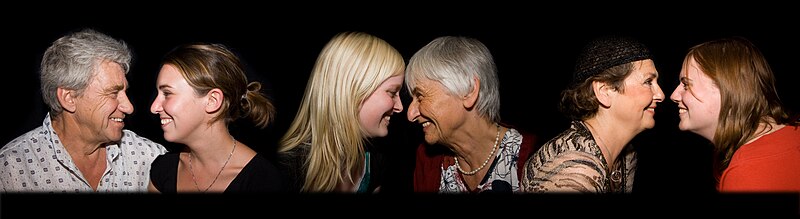
eye contact

photo by Heptagon, used by permission

Something that really sets Godly Play apart from other kinds of storytelling is the lack of eye contact between the teller and listeners. It seems to be one of the most disturbing features of Godly Play. It's certainly one that I have often heard people complain about. And I too find it frustrating sometimes not to be able to "see" how children are reacting to the story. But if I've understood right - that's precisely the point: It's not about where the storyteller's focus isn't, but about where it is.

The storyteller is completely engrossed in the story. And this deep involvement draws the listeners' attention to the same place. There's a lovely photograph of Jerome Berryman telling a parable story to a child. It's copyrighted and so I won't include it here, but please follow this link to the picture.

I don't think anyone could look at that photograph and say, "How weird that Jerome isn't looking at the boy!" It's clear that Jerome and the boy are looking together at a shared story. It looks perfectly natural and right.

If you have time you might click through the complete sequence of five photographs of that telling (at the National Godly Play Conference in Australia, July, 2011). There is one photo illustrating the eye contact that does occur before the parable begins, Even if you don't know what a parable is, the parable is already yours.

And then, I wonder how many sheep there really are? What I love about this photo is how curious Jerome looks. He has handed over control to the boy, and has no idea what answer the boy will come up with.

The third photo we've seen already: When there are places of danger I show them how to go through.

Four: I wonder if you ever had to go through a place of danger?

And finally, a picture of real intimacy and trust. I wonder what caption you would give to this photo.

29 August 2011

"we, who are many, are one body in Christ"

I am back home after spending a week at ministry training summer school. It was a wonderful and exhausting week. And my overwhelming sense at the end of it is that I was not only welcomed into that community, but have already come to belong to it. That, in turn, left me with a feeling of belonging to the Anglican Church more widely, and to the Body of Christ more widely still.

What a pleasure, then, to stop on our journey home for communion at a little Anglican church where a diverse group of people were welcomed.

St. Martin's Church, West Drayton
There were several white-haired ladies already present when we arrived. Gradually elderly men arrived as well. Then two young women with bold platinum highlights in their hair, and a young man with tattoos on his neck and arms - a large rose spreading from his left shoulder up to his left ear, and a row of what looked to be Hebrew letters across the back of his neck. I was so struck by his tattoos that it took a while for me to notice that he was holding an infant in his arms. When I asked, at the peace, he replied that the tattoo said father. All these people were white, but the congregation also included a middle-aged man who looked Chinese, and a young black man.


Like we have at our church, they had a re-usable leaflet containing the order of service. But unlike ours, theirs was season-specific. And, as Vandriver spotted even before I did, the cover was in the color of the season. Inside the front cover was a description of the season. I won't repeat it all, but here is a little of what it said: We need to remember that Ordinary Time does not need to be "ordinary, or plain or dull" and it is not meant to mean that somehow we get a break from the Liturgical Year. The opposite is true: Ordinary Time celebrates the mystery of Christ in all its aspects. Many important liturgical celebrations fall during Ordinary Time, including Trinity, All Saints and Christ the King. ... As we journey through Ordinary Time may there be nothing 'ordinary' about our encounter with our Lord and Saviour. 

What I noticed was this information: There is an area in the south side (near the font) that has been set aside for carers and toddlers to use during our services. There are book and quiet toys to keep children occupied. And so there was!


It included crayons and Bible storybooks, as well as other activities, and was within view of the altar and even the organist (depending a little on where you sat). A Sunday School for the over-3s ran from the start of the service, with children re-joining the adult congregation for the entire Liturgy of the Sacrament.


But it wasn't just the provisions for children and the presence of a visibly diverse congregation that showed off the welcoming nature of this church - we were made welcome. We were greeted as we entered the church (by the same woman that I later saw helping an elderly man find his place in a large-print service booklet), and because we had apologized that we might have to leave early because we had a plane to catch, we were amongst the first to be ushered forward for communion!

So it was just a natural extension of the feelings that the week of summer school had left me with - a real sense of belonging to a community within a wider body. For so much of my life, I have interpreted the question How was church? to mean firstly, "How was the sermon?" and then, "What hymns did you sing?" and "Who spoke to you?" Well, yesterday we sang several familiar, beloved hymns and were given a competent, evangelical sermon, but what I took away with me was several images (the children's area; the hanging aumbry with a funny dove above it which looked like an angel from where I was sitting; the secluded, walled churchyard; the tattooed father holding his baby; the stained glass depiction of the crucifixion and ascension which I turned to gaze upon during the Eucharistic Prayer) and above all the sense of belonging.

25 August 2011

meeting the Good Shepherd face to face

Like many bloggers before me, I feel that through blogging I am making new friends, even though I have yet to meet these new friends in RL - real life. One is Leslie, who blogs at Thoughts from the Sheepfold. I keep meaning to add her blog into my list on the right, once I decide how to classify it, since hers is not a blog about Godly Play but Catechesis of the Good Shepherd.

CGS is the big sister, or maybe even the mother, of Godly Play. Both programs follow certain Montessori educational principles, both use the notion of sacred space and value silence, and, in the words of the Rev. Joyce Scherer-Hoock, "Both methods strive to provide Christian formation rather than education". Moreover, both place great emphasis on Christ's identification of himself as the Good Shepherd.

Today I read on Leslie's blog that the co-founder of CGS, Sofia Cavalletti, died on Tuesday at the age of 94.
the Magnificat transcribed by Sofia (via cgsusa)
Leslie writes, She was a woman of great strength and intellect, who loved God deeply and cared passionately about the spiritual lives of children. 

I join many others in rejoicing at our confidence that Sofia has gone to meet the Good Shepherd face to face and to live in his celestial pasture.

(Leslie's post: With Thanksgiving for Sofia: I just received the announcement below from The National Association of the Catechesis of the Good Shepherd ...)

20 August 2011

Being Present with the Invisible

Auguste Deter (first documented case of Alzheimer's Disease).
I'm off to start my ministry training with an orientation and summer school, and so for the second time in a week am linking to others rather than writing up a whole post about our own work. The first link is to a short blog post about Godly Play ministry to Alzheimer's patients. The second is a considerably longer article about the same work.

Ministry to those with Alzheimer’s Disease: My mother has Alzheimer’s. We recently moved her to a nursing home where she could receive the 24-hour-a-day care she needed in order to be safe. So I was particularly interested in a workshop led by The Rev. Lois Howard, Deacon at a recent Christian Education Day in Lexington, Kentucky. Lois has a ministry of presence and relationship with folks who have dementia. And she brings Godly Play to them.

Being Present with the Invisible: Ministry to Alzheimer's Folks Using the Godly Play Model: by Dn. Lois Howard, The Church of the Resurrection, Jessamine County, KY. (You might need to scroll to page 10.)

(If you're brand new to my blog, you might also be interested in this post about an elderly man from two weeks ago.)

16 August 2011

welcoming a new children's ministry blog

I ran across a new blog last week: "Motley Play." (Isn't that a great title?)

 German Federal Archive
The author, Cathy, says she wants her blog to be "a place to discuss the pedagogical, wrestle with the theological and decide to act on the illogical".  And she's certainly jumped in with both feet, with a post entitled, I wonder ... Is Godly Play Ethical?  She sets up a dichotomy: those adults who feel that "raising up children in the way they should go" requires a fairly heavy hand vs. those who are genuinely inspired by the Montessori principles behind Godly Play (and Catechesis of the Good Shepherd), feeling able to trust to that the Holy Spirit will move in the classroom and touch all the children where they need to be met.

Although I felt that she was preaching to the converted in my case, it was a good reminder to me that I need constantly to be letting go in the classroom. I sometimes get disappointed that the children so often choose art materials over the story materials, for example. I mustn't let myself start over-selling the story materials, or trying to coax out the sort of responses that I want or expect. Let it go. Trust.

Welcome, Cathy. I hope you get the kind of dialogue you're seeking!