13 June 2011

Pentecost in Helsinki

IMG_8238 copyIMG_8192 copyIMG_8204 copyIMG_8205 copyIMG_8209 copyIMG_8214 copy
IMG_8218 copyIMG_8223 copyIMG_8229 copyIMG_8247 copyIMG_8253 copyIMG_8255
IMG_8258 copyIMG_8261 copyIMG_8263 copyIMG_8266 copyIMG_8267 copyIMG_8275 copy
IMG_8280 copyIMG_8284 copy

Pentecost, a set by Pikku Arkki on Flickr.

Here's a beautiful and fun set of pictures from the Anglican Chaplaincy's child-friendly Pentecost Eucharist yesterday. These were taken by the talented and super-friendly Sarah.

(This is not "our" service, although we are affiliated with these folk. We had Junior Church yesterday, while Vandriver preached at big church.)

12 June 2011

clothed in humility?

Happy Pentecost! 


Giotto di Bondone (1266-1337)


Today, I've dressed for my Junior Church children, wearing an outfit I would never consider wearing to grown-up church. One of our main-stay topics of small talk in Junior Church is what people are wearing. I see you have your rainbow skirt on today! --*I*ve got stripey socks on! --Oh, look. Three people have white on today. --These are my *church* shoes. We've had something of a heat-wave this week, so I'm wearing a red sleeveless top, and a black skort. I'm expecting the skort to be a great topic of conversation with the children, even if I feel it would be too short for big church. (I won't be at big church at all, since the children are dropped off with us before big church begins, and they meet their parents afterwards at coffee.) To be honest, I fear that it's a pretty unflattering outfit, but I think the children will be glad that I'm wearing red for Pentecost, and get a kick out of it.

1 Peter 5:5b

08 June 2011

Circle of the Holy Eucharist - part three

As I've said already, I presented this lesson on the fly. The downside to this was leaving out some of Berryman's poetry, which I hope to include next time: [Holy Communion] helps us go where words and thinking alone cannot take us. ... This is a time to lift up our hearts, to give thanks and praise. What is beginning to happen is a great mystery. We remember the Last Supper of Jesus and the Twelve and then gradually we are there and it is here. ... Jesus is with us in the bread and wine and we are all together, all over the world, and with all who have lived and died in this huge family of families called the Church.

But the upside was that it was a very personal lesson, about our congregation.


At the end, I wondered which part was their favorite. The child who answered first was not the one who usually answers first. And she pointed to one of the photographs of her mother. 

I still have to work on letting their answers stand for themselves, and not suggesting interpretations, or rephrasing things for them, but I was glad to add or reply this time that one of the nice things about going to adult church would be worshiping together with their families. 

I didn't ask any other wondering questions. As I've said elsewhere, we did look briefly at the liturgical colors in the photos, but really, the children's attention had been exhausted. They were somewhat silly in the response time, and I think it was partly the need to relax after such a long and focussed lesson. It's probably a very good thing that our 3-year-old was absent that day! 


It's a long lesson, and there are no figures to move around, no sand to smooth out (I didn't even have the recommended green underlay). I really pushed my children to the limits of their attention span. But just as they'd begin to flag, there'd be another photograph featuring one of their parents or something else that would catch their attention again (or I'd sing another one of the responses, for example). Almost as soon as I'd finished, one child had a question. I don't think that's happened before in our classroom.

Before collecting the material, I had held up the table, the wine and the bread from the World Communion lesson to introduce the topic. And then, although I left out a lot of Berryman's phrasings, I did keep his idea of setting the scene with two episodes (much abridged) from the life of Christ - the beginning and end of his ministry: his reading Isaiah's prophecy in the synagogue of his hometown and his Last Supper with his friends. The first illustrates the first half of our service, the Liturgy of the Word, and the second illustrates the Liturgy of the Sacrament. On those cards, I used illustrations I had found on-line. This is what one artist thinks that might have looked like. Our children had not heard the first story before, but had heard the second, and I think enjoyed that feeling of "Oh, yes. I remember this!".

All throughout this lesson I felt that we saw connections and moved back and forth between the unfamiliar and the familiar. The Old Testament reading might be one of our Sacred Stories, like the story of the Ark and the Great Flood, or it might be the words of a prophet. Our choir usually sings the Psalm - look who's singing here in this picture. --It's Pappa! 

These were children aged four and five, who don't read yet, and they followed this Enrichment Lesson all the way through. They took it in, asked intelligent questions at the end, and seemed to enjoy it. I was so proud of them, and pleased for our congregation as a whole.

Circle of the Holy Eucharist - part two

This post follows on from yesterday's.

My desire was to create cards which would serve the dual purpose of presenting the Circle of the Holy Eucharist lesson in our classroom and be available for use by our children during adult services when necessary. I loved the idea of featuring photos of our priests and congregation (as done by Christ the King: see yesterday's post). So for over a month now, Vandriver has been snapping photos during our services for me.


Of course, when it came time to make the cards, I discovered that Vandriver had taken many beautiful shots of communion, but only two photos of the congregation singing a hymn, neither of which was ideal. What I needed, though, was only one card for communion, and four or five for hymns! But with some judicious cropping, sorting through photos taken at previous events, even hunting through the Chaplaincy's photographs on Facebook, plus a few "cheats" (such as using the face of someone reading a lesson to illustrate singing instead), I was able to come up with a complete "deck" of cards.

photo by seethroughfaith
At the time I made the cards, I had a vague recollection that Berryman's cards had been orange (all I can think is that that was the color of card that he happened to have on hand that day, and now it has become normative), but it was only upon re-reading the lesson on Monday that I understood that it was to help distinguish the two parts of the service - cards for events during the Liturgy of the Word are orange, cards for the Liturgy of the Sacrament are golden. So I have since gone back and added an orange or yellow stripe to each card. (Although Vandriver points out that these two colors are close enough that some color-blind folk may find them hard to distinguish. It might have been better had Berryman chosen two colors more distinct from each other.)


I used Powerpoint for the cards. For Sunday I just printed Powerpoint "handouts" on good-quality paper. I was in such a rush that they weren't even trimmed symmetrically. Today I'm going to drop off the revised file at the church printing office, and I hope they'll make us nice large (A5?) prints to be laminated for use in church, and slightly smaller ones for use in the classroom. Apart from the size, the cards will be identical.

All cards feature photographs of members of our congregation and/or the priests who serve us. Almost all were taken in the chapel where our adult services are held. A few have smaller photographs of Godly Play materials to emphasize connections - above you see the material for the Trinity on the Creed card, and stones in the desert (a prayer technique we have used) on the Prayers card. The New Testament card shows the German Godly Play picture of Paul writing an epistle (although my children have not had that lesson yet).

Some cards include some of the words that the congregation speaks together: Thanks be to God or Hear our prayer. Some include a question that parents might ask their children, such as What does the priest do while we sing? on the Offertory Hymn card. A very few cards include more text, such as the words we use to close the intercessions on the Prayers card. And a very few include a suggestion, such as You might like to make the sign of the cross, or hold out your hands to "receive" the blessing on the Blessing and Dismissal card.

Within the deck there is at least one photograph of vestments in each liturgical color, which is one of the things we looked at once I had finished presenting. This fit in perfectly for us with the reminder that this week is the last in Eastertide and that we would have a new color next week. I'll tell you a little more about our lesson in my next post.

07 June 2011

Circle of the Holy Eucharist - part one

Next Sunday (Pentecost) will be my last Junior Church session until the autumn. It was looking like we wouldn't have any Junior Church at all across the summer (although now Finnglish Mum is trying to organize something), and I was a little worried about our young children moving suddenly from a situation in which they have their own church for an hour and a half each Sunday... to being in grown-up church for the whole time. So I wanted to present them with the Enrichment Lesson called The Circle of the Holy Eucharist.

I've never seen anyone else's cards for this lesson, apart from having once come across a webpage for Christ the King Lutheran Church in Houston, Texas, who have cards "based on the Godly Play lesson ... for young children to follow the sequence of liturgical actions," which I thought was a lovely idea!

(source - scroll down to find this)
Of course, it took me FAR longer than I had anticipated to create the materials for the lesson. (In fact I've continued to work on them since Sunday and they now look rather different than they did then.) I was right down to the wire having even that earlier version of them ready for Sunday, so I had no time to review Berryman's script for the lesson, let alone rehearse. 

But in some ways, that worked well. I presented the lesson much as I imagine Jerome Berryman did when he first created the lesson. I just gently talked through how our services go. I pointed out the things that occurred to me as I went along - such as that Father R usually uses a red Gospel book, but that all Gospels are also found in every Bible, and Lay Reader G reads out of a regular Bible. I sang a few of the key pieces of service music (or at least the opening phrases), to the tunes that we use in our church: Lord have mercy, Christ have mercy, Lord have mercy; Alleluia, Alleluia, Alleluia (before the Gospel reading); Holy, Holy, Holy Lord God of power and might; Jesus Lamb of God, have mercy on us. It was gentle and personal, and still now I have a great feeling about it. 

In the next post I want to tell you more about my materials, but for now I'll point you to a photo by seethroughfaith. [I've also written a third post, with more about how the young children coped with the lesson.]

06 June 2011

Core vs Enrichment - which are the foundational lessons?


I don't yet own Volumes 6 or 7 of the Godly Play scripts, containing Enrichment Lessons "for older children". (Most of Volume 8 hasn't even been published yet.) The materials for these enrichment lessons should sit underneath the Core Lessons in the classroom, and should be presented once children have really absorbed the Core Lessons. Since my circle is mostly children aged five and under, and since I'd never been introduced to the Enrichment Lessons by a GP trainer, I started off with the assumption that I would just ignore those for now.

But as Watkins and I discussed in the comments to her post about the Godly Play story of Joseph, an exclusive focus on the Core Lessons in Godly Play means accepting Berryman's determination of which are the foundational stories. If we're under the authority of a Sunday School committee or superintendent, it might be important to accept that determination, but for those who are using Godly Play in the home as Watkins is, or solely responsible for the Sunday School curriculum as I currently am, we carry a responsibility to decide for ourselves what stories our own children need to hear, and when.

Some of you probably feel like jumping in here to remind me that Berryman has been doing this for almost forty years. He has studied pedagogy and theology, and tested his ideas on generations of children. He's a priest, he has a doctorate, and he studied with Sofia Cavalletti. So I would agree that an important part of our decision-making process is to draw upon his knowledge and insights. But we also "follow the child". And we tell the stories of our faith and our own congregations from our own hearts. 

Most stories of individuals are Enrichment Lessons rather than Core Lessons: Abraham, Moses, Ruth, Daniel, Jonah (yes - it's in Volume 2 but it's an enrichment lesson), and also the saints, from St. Patrick to Mother Teresa. The idea is that the curriculum is a spiral. Berryman sometimes calls the enrichment lessons "Extension Lessons" (Teaching Godly Play page 126). The stories of individuals follow on from and extend the Core Presentations. The Enrichment Lessons are therefore fitted into the larger context of "The Story of the People of God". The stories in Volume 7 show how the Holy Spirit continues to inspire and lead us as the People of God, the Communion of Saints, post-Pentecost.


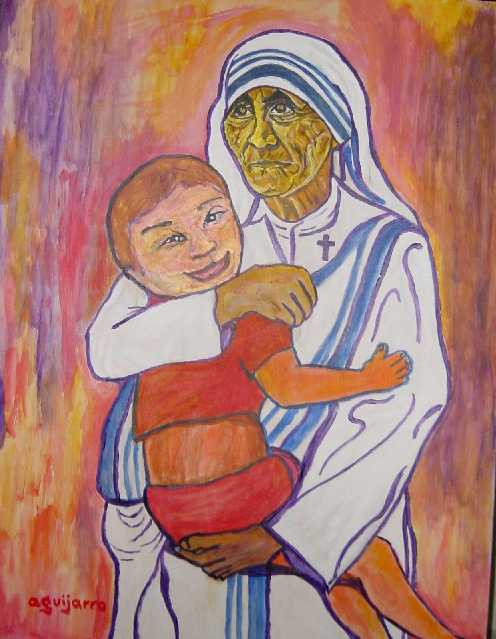
"Teresa of Calcutta carrying Pepo, a friendly child with Down's Syndrome" by Aguijarro  (by permission)

But Berryman also emphasizes that Godly Play is not a complete children's program (this is repeated in the introduction to every volume of The Complete Guide to Godly Play). Ideally children are also participating in Vacation Bible School, listening to children's sermons at church, reading Children's Bibles at home, and talking to their parents and godparents. So of course stories of individuals in the Bible will have come up in those contexts.

Moreover, Berryman emphasizes how important it is to adapt [at least some of] his materials to our own circumstances. Here's a quote from the lesson on Holy Baptism: Adapt the materials according to the usage of your church. For example, if your church uses a shell for baptism, you can place one on the tray with the other materials. If your tradition baptizes by total immersion, you will need to work out a way to show that, perhaps by using a larger bowl or basin...

And that makes me think that for some of us it is surely appropriate to follow our own intuitions and present the Enrichment Lessons when we feel it is right for our children. But the lessons in Volume 6 haven't been written for young children. As Watkins wrote, they don't interact with the materials playfully. Then again, as I've mentioned already, not all the Enrichment Lessons are in Volumes 6-7. Did you know that even "The Holy Family" is labelled as an Enrichment Lesson? (I confess that I'm not sure why, unless it's because it's often presented not as the main lesson of the day, but as part of the getting ready when we enter a new liturgical season.)

As you might have guessed - I presented an Enrichment Lesson in our classroom yesterday. In my next post I plan to tell you which one that was, and how it went.