27 August 2019

'wonder' quote from Chesterton

I recently came across a lovely quote, attributed to G.K. Chesterton, saying that we are perishing for lack of wonder. My first thought was that it would be a good quote to share with Godly Players, and my second was that you can't always be sure that these quotes, or their attributions, are accurate. So I did a bit of snuffling around online. Several people quote it, including in published books, but I couldn't find that quote in a work by Chesterton himself... at first. But now I've got it. The wondering is slightly different but the sentiment is the same, and I'm happy to share it in Chesterton's own, actual words:
The world will never starve for want of wonders; but only for want of wonder. 
G.K. Chesterton, Tremendous Trifles

01 May 2019

I wonder where you are...

At the end of a sacred story, we may invite those in the circle to locate themselves in the story: I wonder where you are in this story.

Today, (the festival of Philip and James, Apostles) I took a midweek Communion service for a small congregation of retired people. In the sermon slot I showed them a red stole, painted by Yvonne Bell, depicting a worshipping communion of saints.

Without any experience of the Godly Play wondering questions, one woman, after the service was over, gently took hold of the stole and said, "I have to find myself in this stole."

an elderly woman's hand holds the end of a red stole, painted with yellow and orange human figures of different shapes and sizes, with a white dove hovering above them
"Where am I in this stole?"

26 November 2016

Wondering about Advent

Tomorrow is Advent Sunday! I commissioned this stole from Paula-Marie at Bespoke Stoles. Isn't it lovely?


This year I have the opportunity to tell Godly Play® reflective stories at a small after-school club we are trialling for primary school children. 

We don't meet every week, so I started already last week telling the first two parts of the Advent lesson. And then I tried asking some Wondering questions, although they are not usually part of this lesson. I structured them around the Sacred Story questions, asking:

I wonder what part of getting ready for Christmas you like best?
I wonder what part of getting ready for Christmas you think is most important?
I wonder if there's any part of getting ready for Christmas that we could leave out, and still be ready?

What I hadn't expected is that the children would hear the second and third questions as ones that had "right" answers. Upon reflection, I should have anticipated this. I was there as a priest, wearing my clerical collar. They don't know me well, and are unfamiliar with Godly Play. 

So which parts of getting ready for Christmas did they tell me were most important? Praying, and going to church. Maybe those were their true thoughts, but I suspect they said this trying to please me. Nonetheless, I stuck to my training and mused on each answer as a genuine contribution, repeating it, or giving a nod and a Hmm. 

Even then, I didn't spot that my third question would suggest to them that I believed we should sacrifice the "secular" elements of Christmas in favour of more "important" ones. So I went ahead and asked, I wonder if there's any part of getting ready for Christmas that we could leave out, and still be ready? A child who'd earlier said the best part was presents now said we could leave them out. I was so genuinely shocked that I blurted out, But that's the part you like best! So another child came to our rescue and suggested that if we did leave out the presents, that would be like leaving out the Wise Men. What a brilliant answer - attempting to bridge the apparent divide between churchy priest and present-loving child. 

I need to think hard about how I will help them to wonder next time.

27 September 2016

Christian Symbols (Materials)

Each day at the European Godly Play® conference we had two workshops. Knowing I'd need a break and a change of pace after plenary lectures and conversations, I made sure that one of my workshops each day was a hands-on one.

During the workshop hosted by Johanna Kaarto-Wallin, who makes the Finnish Godly Play® materials, I painted (or rather, stained) a wooden set of Christian symbols. This isn't a lesson included in the books, but is very like the Crosses lesson (vol. 4). 


Mine is a slightly different set of symbols than is sold in North America. I didn't come across the tradition of votive ships until I visited churches in the Nordic countries, so it doesn't surprise me that although not all sets include a ship there is one in Johanna's materials.

a model of a three-masted sailing ship hangs from a whitewashed arch
votive ship in Ravlunda Church
licensed photo by Yakikaki (source)
Even the North American materials site shows two slightly different sets of symbols: compare this with this. That sure gets me wondering! I wonder what symbol you would add to this set? I wonder if there's a symbol you think we could do without? 

19 September 2016

European Godly Play conference - last day - stories

We've begun and ended each day of the conference with stories. This morning I had planned to listen to Mary Cooper tell The Ark and the Tent. I was really looking forward to it... But I lingered too long over breakfast (and/or, lingered too long in getting out of bed so had less time at breakfast), and by the time I got to her room there was no room left. At least six of us were turned away.

So, I joined another circle and listened to Rosemary Lavelle tell The Great Family. We commented during the Wondering on how smoothly she managed the 'sleight of hand' involved in 'burying' the bodies of those who die (first Sarah and later Abraham). And some people shared ways in which they had found those deaths to be an important, beautiful, helpful part of the story. 

The story is about death and also about birth. So it was truly lovely to have in our midst a baby, who occasionally gurgled and cooed. His mother said afterwards she had worried he might disturb, but for me, it added to the story, and when we were asked about our favorite part, I said mine was having a baby present and audible for this tale.


Afterwards, we listened to a plenary lecture by one of our organisers, Rune Øystese. He found himself in that difficult position of having less time than he'd planned for, but he squeezed a lot of worthwhile information into that time, talking about stories - stories in education, Bible stories, myths or grand narratives, and the ways these overlap. 

An idea posed early on in the talk was this: When we use a story to illustrate a point we may close the story. That is to say, we may allow it only one meaning or moral, sapping its energy. 

It has certainly been my experience at this conference that it has been eye-opening (as it so often has been in the past as well) to hear and see the many different ways people respond to one and the same story. A myriad of different parts they liked best, the breadth of thoughts sparked by a parable, and yet the way this discussion of varied viewpoints can bring us together as a community sharing a common story.

18 September 2016

Conference Day 4 - Deep Talk

I've been hearing about it for years, but today I finally got a handle on what Deep Talk is. I knew it was something that Tuula Valkonen had developed based on Godly Play, and that she took it to corporations and businesses, but how- what- What?!? I didn't really understand.

Today I went to her conference workshop and experienced it for myself.

There is a cloth on the flloor covered in sand. Little wooden figures representing people have been placed in the sand, and a hand is reaching out to place yet another.

Jerome W. Berryman calls it "an adaptation of Godly Play ... to help work communities develop in creative ways". It's been adopted by the University of Sheffield chaplaincy as "a chance to explore with others by joining a wondering reflection, conversation and discussion... allow[ing] for quick, honest and deep reflection".
A piece of fabric covered with sand is on the flloor. Someone is holding their hands over the sand, close but not touching it. In one hand is a crystal or prism.It had elements in common with a team-building day my university department once participated in. And it had elements of Godly Play, of course.

Based on today's taster, I would say that it's primarily a way to facilitate group communication and encourage good group dynamics. It's designed to appeal to secular organisations, while retaining a subtle Christian element - not imposed but available to those who wish to take it up. If used in a church setting that could obviously be enhanced. In secular use Deep Talk might be a bridging activity, creating links between church and community, making the church feel more accessible and welcoming to those outside it, and showing that we can offer "practical" help beyond our own walls.

I bought Tuula's book today, and look forward to learning more.

17 September 2016

Conference Day 3 - Reminded of Playfulness

This morning started out with a Godly Play story. We had a choice of seven circles to join, each telling a Parable, but in six different languages. I went to hear the Parable of the Great Pearl told in Spanish.

I know that our storytelling can (and indeed should) be rather playful, but that does not always come naturally to me. It is certainly helpful to see how others do it. I remember in training watching Rebecca Nye as she put materials away, playfully flicking a rolled-up underlay back and forth a bit, unrolling and re-rolling it a bit. It was playful but also emphasised that we should roll those underlays back up as we put them away.

This morning, I watched David Pritchard playfully act out how heavy the merchant's bags of money were, and mop his own brow as he "struggled" to carry all the possessions across to pay for the pearl. 

picture of parable materials spread on the floor: a large white circle, brown outlines representing buildings, some containing single pearls and one filled with many possessions. Also on the white circle is the flat figure of the merchant, with a single pearl placed on his hand.

During our Response Time, therefore, I felt encouraged to be a little playful with the figures on the focal shelf, and brought the shepherd and sheep from the Holy Family across to interact with the Good Shepherd and his sheep:

Flat wooden figures mounted on bases to stand upright: A male figure carrying a lamb on his shoulders, and five sheep enclosed by a wooden toy fence. Also within the fence is a wooden sheep from a nativity set, and next to the "Good Shepherd" is the shepherd from a nativity set.

15 September 2016

ready for the 5th European Godly Play Conference

I am so pleased to be at the European Godly Play Conference! The conference proper doesn't start until tomorrow, but today we began an academic programme with a plenary lecture on ethical questions concerning research with children, a paper on the methodology of academic research, and another on primary school teachers' and students' responses to Godly Play®. After a very interesting poster session (10 five-minute presentations plus time to speak with those presenters in small groups or even one-on-one), it was time for a story:

A figure kneels, arms outstretched. The image is cropped so you cannot see the person's face, but they have just laid a linen cloth on the floor in front of them. A partially-open box sits beside the person.


This photo captures my sense of the beginning of this conference. There is a lot still in the box, and the underlay is like a 'blank slate'. We shall see how things develop from here! 

26 May 2016

Getting the terminology right

Sheila, over at Explore and Express has published a post today about a new term to replace "Door Person" when talking about Godly Play in German. She explains,
When a door is understood as a symbol of opening up new possibilities, it's a great name. However, the literal translation in German, Tür-Person, has very different connotations. People think of a bouncer or a guard - someone who keeps people out.
When I was new to Godly Play I used to forget and call the Door Person a "doorkeeper", a word I fear can have some of those connotations of "someone who keeps people out". But then again, some of us might think of the Psalmist saying,
I would rather be a doorkeeper in the house of my God than dwell in the tents of the wicked.
A wheelchair ramp leads to the open doors of a stone church.
licensed photo by "Emw"
open doors at St Anne's, Lowell, Massachusetts

I wonder what you think about the title, "Door Person".

13 May 2016

Prayers at Pentecost

This week leading up to Pentecost has been a week of prayer in the Church of England. Activities have ranged from novenas to 24-7 prayer rooms, from Lectio Divina to neighbourhood prayer walks. To involve my church, I scheduled a prayer activity for each weekday this week. Three of these were services at the church. But I also offered to do "themed devotions" for our two children's ministries this week.

These are not children accustomed to Godly Play; most of them are not even accustomed to attending church. Our ministry includes opening prayers and some teaching about the Christian faith, but most of the time is spent on games and other activities.

I chose to use part of the Pentecost Celebration from Catechesis of the Good Shepherd. This is something I learned about back in October 2013, and already then I was excited and intrigued about using it with others. The goal was to invite each child to a prayerful moment, one which could be understood as a prayer for renewal by the Holy Spirit (which is one of the themes of our week of prayer).

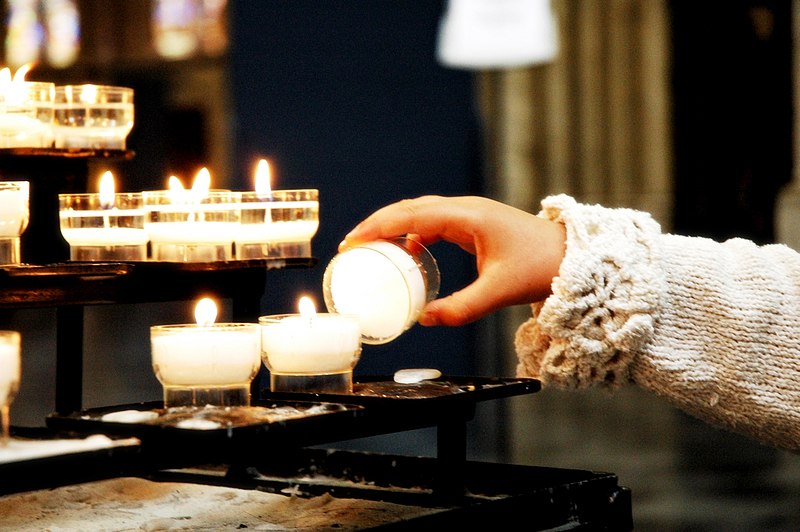
I began by super-briefly reminding children of the Christian concept of the Trinity, and reading Isaiah 11:2. I then listed the seven gifts of the Holy Spirit, showing cards I had prepared. These included illustrations to help non-readers. I lit seven candles placed by the cards. I started playing a cd of Taizé chants (starting with one on the theme of the Holy Spirit), and invited each person to come forward, one at a time, and light a candle of their own from the candle of one of the gifts. This would be their prayer for more of that gift.


It wasn't entirely smooth and ideal. The boys poked each other and stage-whispered, "Fire-POWER!" One teenage girl announced that she didn't know how to pick because they were all about God and she was an atheist. The "taper" dribbled far more wax than I had predicted, and some of the tea lights were surprisingly hard to light. 


But, each person present did come forward and light a candle. While the group atmosphere was not consistently reverent, almost everyone was serious about their own turn at lighting a candle. Most of them took time to select which gift they would choose. Although I had included illustrations so that non-readers might choose meaningfully from amongst the cards, I was also aware of the advice from Catechesis training that for some children the solemn lighting of a candle would be meaningful enough without fretting over the extent to which they had understood the choice to be made. 

After doing it with the first group, I realised that it was best to have the table positioned so that those lighting candles were facing away from the rest of the children. Something that did work well was having them blow out the taper once they'd lit their own candle, and then hand the taper to someone else who would then come forward for their turn.


Once all the children had lit candles, I asked them to invite the staff to do so as well. And it was clearly a moving and meaningful activity for them, too. 

18 August 2015

on worship and play

High up on the list of things that hinder worship is the idea that there's some particular way to be good at it, that one can be more or less effective... 

(licensed photo)

Worship is simply the Christian word for the joy of existence.

(Giles Fraser, on "Thought for the Day")

31 July 2015

Wonder of the week


One gift that Godly Play gives to adults can be to reconnect them with a sense of wonder. What gives you a sense of wonder? From time to time I am freshly awed by the way bodies can heal themselves.

I had a blood test a week or so ago, and have a colorful bruise as a result. Then I walked too close past a neighbor's shrub and got two parallel scratches across my lower arm. But they are fading, and the lower one would already be very difficult to see without the first one. Soon there will be no trace of either scratch, nor of the bruise.

Sometimes I imagine what it would be like if we were like dolls or other objects that chip and get stained and cracked. Of course, I know that some things don't heal to the point that they are like new again, and we carry scars. But the fact that we heal at all is a source of wonder to me.

22 May 2015

excitement about things to come

Vandriver and I moved house this week. This is our sixth move in three years and not one we were expecting. So, although we are very happy to be here, the move has been both physically and emotionally grueling.

But here is one of the reasons I am happy to be here: we looked at the layout of our new house and the ways we used our most recent house, and decided that here we'd use one of the upstairs bedrooms as our sitting room, and the ground floor "living room" as a theological library and Godly Play room!

I am so excited by this prospect! So much so that it's the room I most want to unpack and set up. Here's where I'm up to so far. (Nothing is yet organised; I'm still just getting things out of boxes and onto shelves.)


10 April 2015

today

I am feeling a little sorry for myself today. Lovely pictures of this weekend's Godly Play® UK annual conference keep appearing in my Facebook feed, and I am not there. I would so much have loved to put myself forward as a potential Godly Play Advocate (for which they were doing training today)!

But for various reasons, all related to being a curate (a trainee minister), I was unable to attend.

However, I did have a nice Godly Play® encounter today and I am trying to tell myself I should focus on that (rather than dwelling on feeling sorry for myself missing the conference and Advocate training).

Today, for the first time, I made a "baptism visit". That is to say, I met with a young family who will have their 8-month-old baptised in our church. They have an older child, a girl who is in "Reception" (similar to American Kindergarden), who has already been baptised. However, as is the case with many families seeking baptism in the Church of England, they do not regularly attend our church. I decided that what I would do at this meeting was to present the Godly Play baptism lesson.

I explained to the mother (the father was at work) that this was aimed at the older daughter, but that it was also for her (the mother) and that at the end of it I would ask her about whether there was a particular hymn she'd like at the baptism. And we sat down on the living room floor.

I didn't feel there was really time to settle down, but trusted that the lesson itself would gradually settle us. It did, although it took a while. The mother interrupted near the beginning to ask, "Is this how the baptism itself is going to be?" and I explained that no, this was just to lay the groundwork for them. With the baby crawling about, I didn't leave all the symbols on all the circles, but put them down one at a time, and then once I'd used each one I removed it to the coffee table.

it never looked like this today

But by the time I got the doll out, we were still and focussed. Mum had corralled the baby into her lap when I lit the Christ candle, and the older sister had settled into the mode of watching a presentation or hearing a story.

I asked what we should name the baby and looked at them, and the girl suggested, "Rosie". She looked ever so pleased when I said (straight from the script), "Rosie. That's a good name." And I showed how I would baptise the baby, and lit tea lights for each of us, and then we changed the light and spent a long time watching the smoke (the invisible light of Christ!) rising into the air.

What have I taken away from this? And what have they? In addition to the little lesson or reminder about our Trinitarian God, I believe I gave the sister a framework from which to follow the baby's baptism service, and I think the gentle demonstration prepared both Mum and sister to expect something reverent. And it's made me realise how much I want to try to carve out the time at the font (the baptism and then an anointing with oil) as a reverent time within any baptism service. I don't feel that's something I've done as well (or as consciously) as I'd like at baptisms I've done previously.

04 April 2015

Wondering about the Way of the Cross

Yesterday evening I attended a Way of the Cross service. We were invited to gaze upon modern paintings of the traditional stations of the cross, while two ministers read descriptions of the paintings, verses from Scripture, meditations, and short prayers (from A Journey to the Cross by Maureen Pamphilon).

paintings by the Benedictine Sisters of Turvey Abbey

It was nicely done, and I found it a helpful Good Friday devotion. But I did find myself wishing that we might be asked, I wonder which painting you liked best? and What do you need to do now as your response to this? That just shows how steeped in Godly Play®  I am!

21 March 2015

paying attention

David Pritchard shared a quote on Facebook last month, illustrating an important difference between "conventional" education and Montessori education.

Conventional education: the child pays attention to the teacher.
Montessori education: the teacher pays attention to the child.
via the Maria Montessori Facebook page


Berlin-Dahlem, Montessori-Kinderheim, Deutsches Bundesarchiv (source)

14 March 2015

holding space

Today, two very different Facebook friends have linked to a beautiful blog post by Heather Plett, about how to "hold space" for people. Although the original post is about palliative care and the care of families in that situation, Heather goes on to say that it's a task for all of us (see the quote below).

Heather Plett: What it means to “hold space” for people, plus eight tips on how to do it wellTo truly support people ... [we] have to be prepared to step to the side so that they can make their own choices, offer them unconditional love and support, give gentle guidance when it’s needed, and make them feel safe even when they make mistakes. ... It is something that ALL of us can do for each other – for our partners, children, friends, neighbours, and even strangers who strike up conversations as we’re riding the bus to work. 

(licensed photo by Auztrel, used with permission)
It's a beautiful and challenging post. I'd encourage you to read it all, not least because this is what Godly Play doorkeepers and storytellers do for the members of the circle.

24 February 2015

recreating ("playing") church at home

I'm grateful to Carolyn Pritchard for sharing this video on Facebook, and wanted to share it with my blog readers, too. It has already been blogged about at Pastoral Meanderings, who calls it a testament to what children see, hear, and learn, and Ex occidente ad orientem, who gives "Kudos" to their mother who probably took them to the vigils and the Divine Liturgy. 

The video shows two Orthodox Christian children repeating what they have seen at church: crossing themselves, anointing each other, carrying a Gospel book, swinging a thurible (incense), chanting Alleluia, and kissing the hands of the priest. Their mother, while filming, sings.


21 February 2015

not just cute, but members of the church


Today Vandriver and I were in Denmark for a very special service- the licensing and institution of the new Anglican chaplain at St Alban's Church, Copenhagen. [This chaplaincy is part of the Church of England's Diocese in Europe.]

Within the service was a "Rededication of the Ministry of the People of God". The archdeacon (leading the service, representing the bishop) invited representative members of the congregation to come forward and, one by one, offer their new priest an object symbolizing one aspect of ministry and ask him to take that on. 

For example, the organist presented the priest with a hymnal and said, Be among us as a priest using the power of music to deepen our understanding of God's Word. And then the whole congregation affirmed, Together, by God's grace, we will worship the Lird in the beauty of Holiness. 

I was pleased to see that one symbol was to be of "ministry with young people", and that the congregation was to affirm, Together, by God's grace, we will value the vision of our young people and nurture the faith of our children. I was also pleased that the person presenting this symbol and speaking the invitation to the new priest was indeed a child. And I almost jumped with glee when I saw that the "symbol" chosen was a Godly Play object! 


[The symbolic objects: water (representing baptism), oil (for healing), a Bible, a scroll containing the text of the Porvoo Agreement (an ecumenical agreement between, amongst others, the Church of Denmark and the Church of England), a stole, the City of Bethlehem (Godly Play / children's work), a hymnal, a chalice and paten (for Holy Communion), and a booklet about this church in its local context.]

I later reflected on the fact that the child was treated no differently than the organist or any other of the congregational representatives. He was not treated as cute or amusing, not merely tolerated or indulged, but he was acknowledged as someone of equal worth and accorded the same respect and responsibility (a responsibility within his range of competence) as others. 

And you know what? He wasn't the only young person being taken seriously at that church. Not by a long shot. Because the 'server', who poured water for the priest to wash his hands with, who accepted the offerings brought to the front of the church and then presented them to the priest, who held the Gospel book as it was read from - the server was a fourteen-year-old. 

Again, though, this was not highlighted in any way. She was treated (and acted) just like servers I've known in other churches, servers aged 28 or 55 or 74. I thought of 1 Timothy 4:12- Don’t let anyone look down on you because you are young, but set an example for the believers.

I spoke with her briefly after the service (which is how I learned her age). She said she'd been doing this for some years already. It certainly had been clear during the service that she was very used to these tasks, acting with a quiet confidence, unobtrusively anticipating where she needed to be and when. She then said to me, I'm not just the server; I'm the assistant sacristan (!).


And yes, as we spoke she was gathering the chalices and ciborium and other "silverware" into a basket to carry back from the chancel to the sacristy for cleaning and putting away. I showed her this photo and asked if I could post it on the internet. Of course! she said, and explained, I do this for God

What a joy to see her serving in this way, with her gifts recognised and put to use, affirming her worth within the Church.